I would go so far as to say that our survey yesterday was joyful. Signs of spring abounded: snowdrops, daffodils, crocuses and birdlife (although not so much birdlife as one would wish). Best of all was to feel the sun on our skins after so long in grey, dreary wetness. Surpisingly the ground was mostly nowhere near as muddy as I had expected after all the rain we have experienced since Christmas. After last year’s dry summer the ground had been able to absorb vast quantities of water. We also saw Muntjac and Roe Deer and heard Long-tailed Tits.
On top of all this what we found and recorded in terms of badger setts was truly heartening. Firstly though I noticed this remarkably circular hole which was mostly likely made by a foraging squirrel (we also saw two dead squirrels, killed by traps).

We began with the odd sett entrance here and there (outliers) but were puzzled as to the location of the main sett, which had to be somewhere as evidenced by latrines, hairs on barbed wire and and badger runs. Then we came across a sett consisting of perhaps ten holes but that did not seem big enough for the extensive number of latrines we had come across not far from it. That turned out to be an annex. Suddenly there it was, the huge main sett consisting of no fewer that 68 holes, some 35 of them clearly active. In total we counted 97 holes during the course of the day. We noticed that at least three had unusually steep downward drops.


This deer print is almost certainly from a Muntjac.

The group has been going for long enough for us to be reasonably certain that not only was this the biggest sett any of us had ever seen but that it is probably the largest in Berkshire.
The arched entrance below was wonderfully smooth and symmetrical.

There is little if any direct correlation between numbers of holes and numbers of badgers but this surely suggests a good number and probably considerable longevity – some setts have existed for hundreds of years.
This was a huge improvement on those surveys where we are looking at land about to suffer a housing development – the landscape yesterday was beautiful. We then walked along roads back to where we had started, seeing a truly shocking amount of litter thrown out of cars in the hedgerows and ditches. We do pick up litter when we see it but this would have needed a lorry for all the plastic bottles and drinks cans. What a sorry display of laziness and lack of consideration for others and for wildlife.
One member of the group and I had visited another sett a few years go only to see that within days the entire area had been cleared of trees and bulldozed flat. We decided to go and take another look which, franky, I thought would be a waste of time. Surely no sett could withstand that level of devastation – we did manage to get the police to attend but they were unable to act since we could not prove that it had been active within the last 24 hours, which is of course a ridiculous criterion, albeit a convenient one for developers. In fact this site had been cleared for the planting of saplings, which seemed especially pointless. Why destroy the original trees? And yet, and yet, the sett somehow survived and is still active. Nature can be incredibly resilient.


It was very uplifting.
We wondered what was going on with this Beech tree.


Most likely rot holes or canker, the bulbous woody growths being the tree’s attempts to heal the wounds. The tiny holes may be caused by Common Furniture Beetles, exploiting the wood when it was soft to lay eggs. The larvae then dug their was out leaving these exit holes. Beeches have relatively thin bark and are particularly susceptible to injury – these may simply have been the result of branches falling off.
These small fungi are probably Hairy Curtain Crust.

This fallen oak was covered with King Alfred’s Cakes.


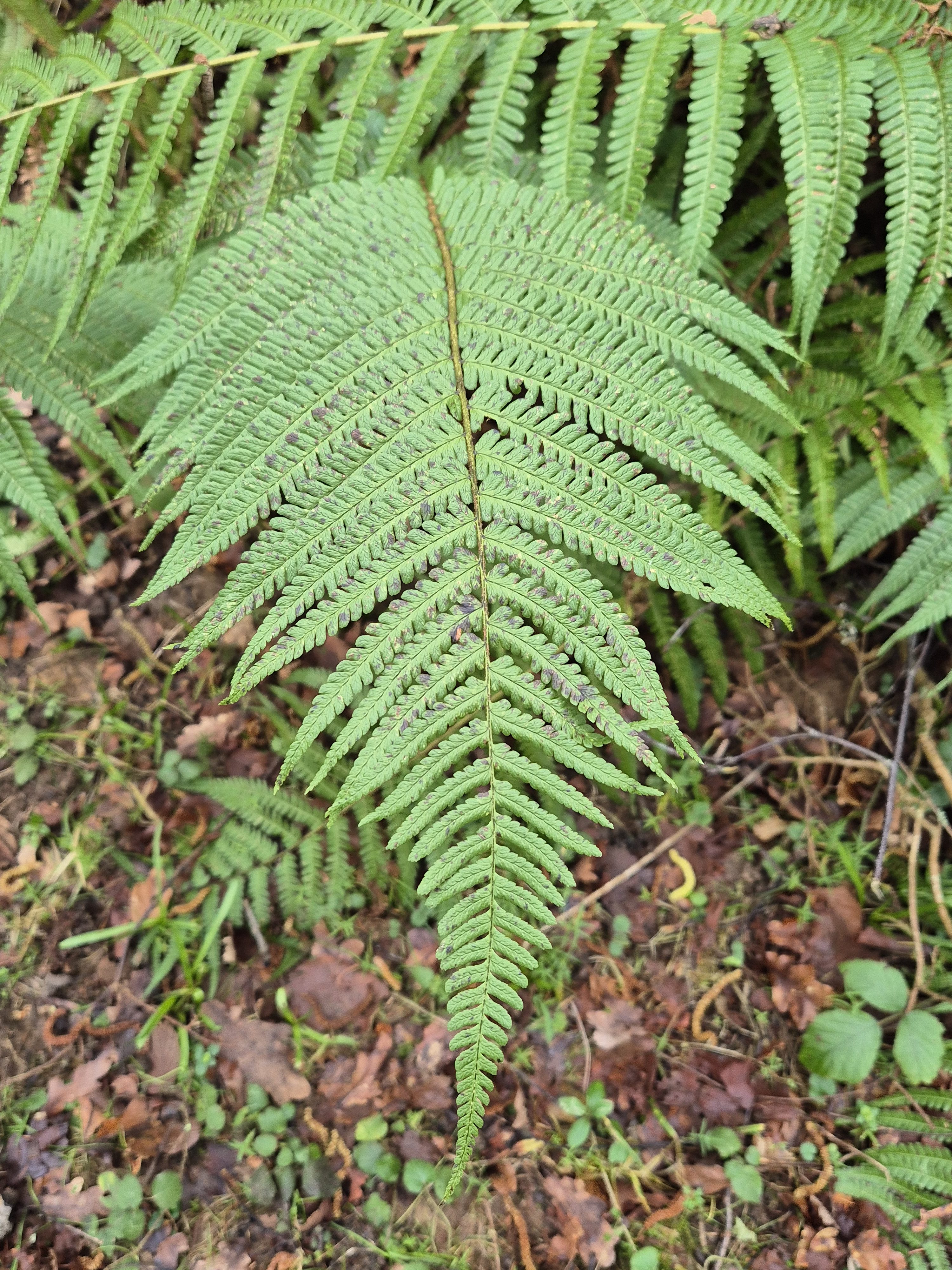
These ferns were beautiful, they made my heart sing.


Although immediately identified by one of our number this was new to me and the strangest sight of the day – White Mass Slime Mould, a.k.a. Dog Vomit or Scrambled Egg slime mould. Not snow melt as our phone software suggested, nor Hair Ice Fungus, it was much too warm for that. Slime Moulds are weird. They have single and multi-cellular phases through aggregation and are more closely related to amoebae than fungi. They move across the leaf litter and are most often seen like this on a warm day after rain. They eat bacteria and are harmless.

Also brought out by the warmth was this pretty ladybird.

He or she is a Harlequin Ladybird, classified as invasive, which outcompetes and even eats the larvae of other ladybirds.
This restorative was much needed having read the day before about the culling of wolves in France on farmland near big cities. 200 of them. At least France has some wolves. It was dispiriting to learn when I got home of the decision to increase deer culling by farmers:
Farmers in England to gain stronger deer control powers – Farmers Weekly
Deer shooting to be facilitated in England to protect woodlands | Conservation | The Guardian
As I have said countless times, the problem is the absence of apex predators. I am not sure farmers are the best people to entrust with the killing. But we must protect our great wildlife friendly farming and timber industries at all costs. I don’t mean that of course.
I wrote about the sad felling of the Enfield Oak in March last year. Gallimaufry: Badgers, birds and birdsong, royal hands, Coyotes, an Oak Tree, a Colossal Squid, a Slow Worm & aliens – Animal Wild
It has now been confirmed that the 450-500 year-old tree was still alive when it was chopped down by Toby Carvery. Indeed it is still alive, showing green shoots and healthy buds. Mutilation by lopping and topping is now viewed as outdated. Legal proceedings against the perpetrators are ongoing.
I watched yet another two Thai elephant rescue videos, below, to restore my mental equilibrium. I am probably too old to volunteer at Lek Chailert’s rescue but I do wonder about visiting at least. I definitely have a strong desire to see elephants again. She sings to them. It had me wondering what I would do were I ever to meet her. I suspect I would fall to my knees and bow my head.
FaaMai and ThongAe rival for Mother Lek’s attention – ElephantNews
“I Got You” – heartwarming relationships at Elephant Nature Park
Leave a Reply