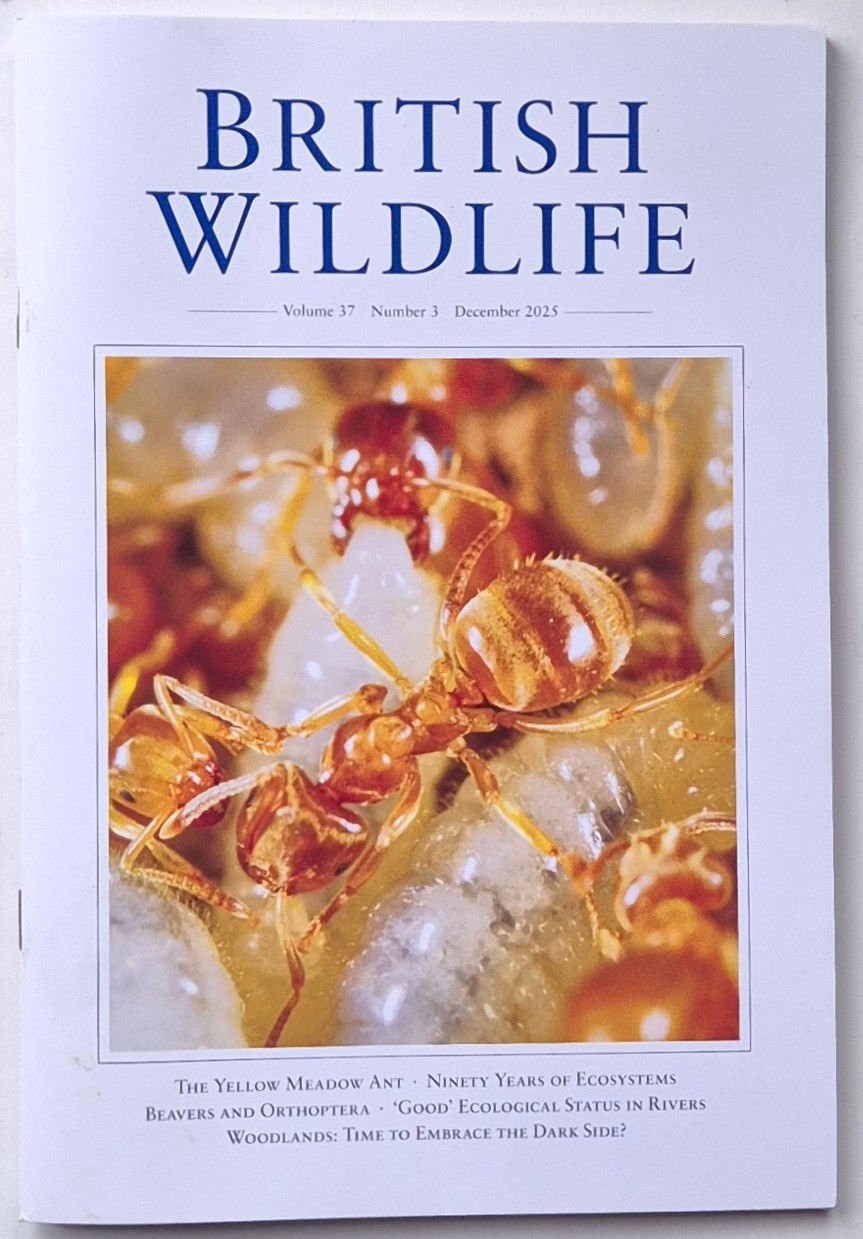
Volume 37 number 3
Tim King writes an update to a piece from almost twenty years ago about Yellow Meadow Ants, who are featured on the cover. They are fascinating biodiversity boosters. I have a quibble. Tim describes them as “ecosystem engineers”, going on to say that the term has been debased by some to include mammalian herbivores. I don’t know what he means. Given recent posts I immediately thought of elephants. Then in the very next sentence he gives an example of another mammalian, herbivore ecosystem engineer: the beaver. Perhaps a word or two are missing. Beavers feature again later in the magazine with particular reference to the benefits of their reintroductions to Orthoptera.
I almost hate to say, as almost always when it comes to wildlife, that farming practices and mowing have been and are a massive problem. Heaven forbid that we should be inconvenienced by the ants’ mounds. We won’t go round them, we have to flatten them. Apparently they might also be dangerous to horses – a tripping hazard presumably. I think horses would realise and be willing to accommodate. Now ecologists are working to reintroduce them as a valuable asset, not least for butterflies, grasshoppers and woodpeckers.
This reminds me of a friend whose house adjoins a farm. When a field was ploughed active, occupied Lapwing nests were simply destroyed in the process.
Brett Westwood is amusing about his latent twitcher within, unable to contain his excitement at seeing a White-throated Needletail, a swift, the fastest bird in level flight. The sighting is already recorded on the Wikipedia page for the bird.
In ‘Ninety years of ecosystems’ David M. Wilkinson considers the origins of the word. It was coined by botanist and key ecologist Arthur Tansley in 1935 but the concept of, for example, climate and soils interacting with life in important ways appears in the writings of Theophrastus around 2,300 years ago. We get to see Tansley’s charming bookplate, a view of the South Downs through a study window, with a microscope on the desk. There’s also a photograph of Gilbert White’s grave, the stone adorned with lichens, which can themselves be seen as small ecosystems. At the other end of the scale “the whole planet can be considered one giant ecosystem.” James Lovelock’s concept of Gaia is just that. It is interesting to wonder if the rules of evolution in the sense of survival of the fittest can be applied to ecosystems too. I don’t see why not and I don’t understand in what sense there is a conflict with Darwinian natural selection.
Amy-Jane Beer rediscovers her local nature walks, recalling her young son’s map of the area which featured landmarks bearing his own names such as ‘The Badger Track’, “now overgrown since access for people and badgers was severed by fencing, hostile signage and anti-climb paint.” Hostile signage. There’s a lot of it about. How dare they?
Roger Meade, Mike Averill and Trevor Ponman question the Environment Agency’s ranking of the Middle Severn river as being in ‘Good Ecological Status’. This seems to be far from the case. For a start, aquatic plants have all but disappeared, replaced only by green algae, with a consequent effect on aquatic invertebrates. There are various complicated methodologies for calculating the statistics, but the EA, it is suggested, would do well just to … take a look. The river’s status is clearly ‘Poor’.
Hugh Raven welcomes the Land Reform Bill making its way through Scottish Parliament. The hope is that it will achieve transparency and some democratisation when it comes to land ownership and there’s a rider obliging big landowners to say how they will contribute to achieving net-zero. Needless to say, the landowners’ lobby is none too keen.
Białowieża Forest in Poland home to the extraordinary Simona Kossak, (see If you go down to the woods today… – Animal Wild) comes up again and again in my reading. It is one of the few remnants of primary forest in Europe. It is not managed and yet supports an extremely high richness of forest species. Ellie Crane suggests we should learn from this and perhaps leave forests in the UK alone. Some especially lovely photos accompany the article.
Simon Barnes is excellent as ever on the self-serving and often ludicrous myths about animals which we choose to believe, such as that goldfish have very short memories or that lemmings commit mass suicide. He confirms that the event recorded in the Disney documentary White Wilderness was faked – the lemmings were herded off a cliff. We may think of butterflies as “feeble, fickle and foolish” but “Try explaining that to a Painted Lady, barrelling up from Africa into the Arctic Circle.”
“Birds are stupid, bats are blind, camels carry water in their humps, owls can swivel their heads through 360 degrees, dogs see in black and white, bulls are enraged by the colour red, snakes hypnotise their prey, piranhas will strip a human to the bone in seconds, magpies are the cause of songbird decline and in a city you’re never more than six feet from a rat.” All completely untrue of course (although there are a couple of those I wasn’t completely sure about), but these myths have a remarkable longevity. And they excuse us from truth.
In Conservation News we read about the COP 30 deal in which fossil fuels are not even mentioned and Keir Starmer’s refusal to sanction a UK contribution to the Tropical Forests Forever Facility which aims to protect forests such as those in the Amazon and the Congo basin.
Drax, the energy company, as I first suspected a long time ago is perhaps the ultimate greenwash. The power plant is our biggest source of carbon emissions and in spite of promises and assurances to the contrary was still sourcing wood from old growth forest in 2025, subsidised by the UK government. The rest of the news is at least as depressing. I have covered most of it elsewhere.

To finish on a positive note, the first Wild Primroses have flowered in the garden and this morning there were ten Jackdaws all at once. The Greater Spotted Woodpecker waited for a bit but then decided to come back later.
Leave a Reply