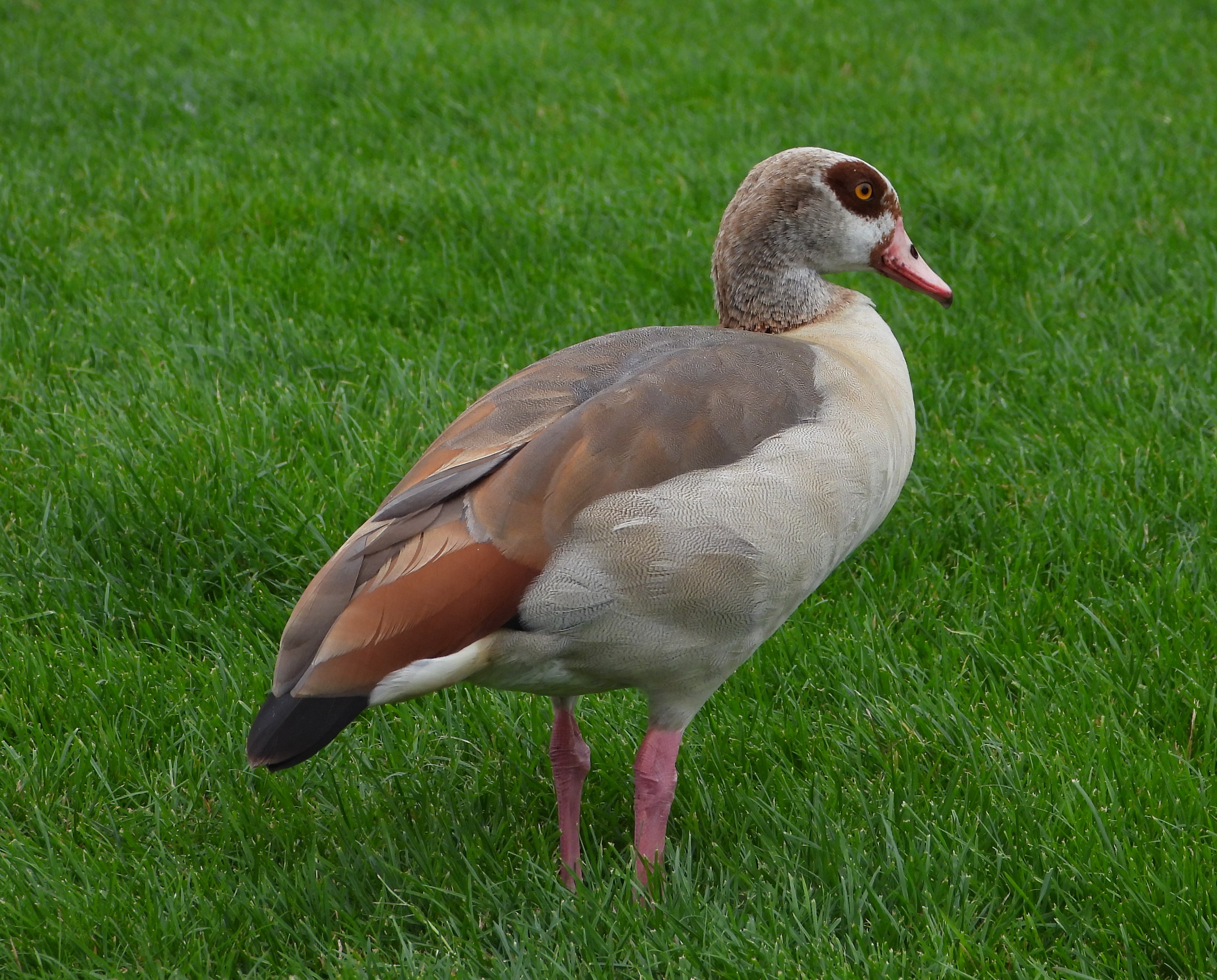
Egyptian Geese
The photo above was taken at Ranworth Broad in Norfolk in 2023, a lovely place with a floating visitor centre. They are strange looking birds and seem to be a classic example of a misnomer. I can’t remember where I saw this but they are not really geese, or as far as I have been able to establish, not “true” geese, but are related to the Shelduck family. News to me. There seems to be a good deal of uncertainty. I had only expected to find them in Collins Bird Guide in the ‘Introduced and escapes’ section, but no – confusingly they and Shelducks are listed and illustrated towards the end of the geese section, before any other (?) ducks.
To muddy the waters even further they occasionally hybridise with Canada Geese.
I suppose it isn’t too surprising – they look more like large ducks than geese, but their heavy flight is more goose-like. Wikipedia states that further investigation is needed – they are a bit of a mystery. Even the first part of their nomenclature is a little suspect since their original distribution is mostly in sub-Saharan Africa. But they do feature in ancient Egyptian art. They can be raucous and highly, aggressively territorial.
As I wrote in Animal Wild:
From Chris Packham’s programme centred around a waterhole, we saw Egyptian Geese driving every other animal away just by being noisy and annoying, even hyenas who are capable of ingesting anthrax without harm.
Otters
There are some superb photographs here: (20+) Facebook
Those of otters are remarkable. I especially like Steve Midgeley’s words beneath one of them:
“Some members of the angling fraternity really don’t like otters or my otter pictures and videos. I’m enjoying reading then deleting their inane, ill-informed and uneducated comments. What they don’t realise is the more they interact with my otter posts the better my metrics are on Facebook and the more the images will be seen.
Facebook also pay me each month and I donate anything I get to local animal and fox rescues, some of whom will aid injured otters. So thank you for joining in and for helping these rescues and for putting your comments out there so I can delete them and then block you. I’ll also continue cleaning up your mess on our rivers.
In the meantime here’s some more otter pictures for you to splutter over and for everyone else to enjoy.”
I do find that anglers are often extraordinarily selfish – and very ignorant about otters. They should celebrate their presence, not complain about them. And too many anglers do indeed leave debris behind them, often endangering and harming other wildlife which is what the strange, so-called sport does in the first place to the fish.
Keith Richards
It is hard for me to imagine anyone being more of a Keith Richards fan than I am, but somehow his cover of The Velvet Underground’s ‘I’m Waiting for the Man’, written by Lou Reed, passed me by. It was released about two and a half years ago. It’s a great song in the first place and, given his past, highly appropriate that Keith should be covering it. As you might expect there’s a real edge and menace to his guitar playing and singing. He also proves, yet again, that you don’t necessarily have to do terribly much in terms of virtuosity and guitar noodling to perform brilliantly and the rhythm section is none too shabby ether. Not all of his forays into reggae entirely succeed it has to be said, but those that do … ‘Words of Wonder’ and ‘Too Rude’ for example. His favourite reggae track of all time is Gregory Isaacs’ ‘Extra Classic’ and it’s one of mine too. His legendary riffs come, he has said, from the ether. And it’s worth mentioning that he is a very intelligent, educated and witty man. When asked if it worried him when he was taking heroin, he laughed and said, “It’s in the very nature of the drug, nothing worries you.”
In other rock’n’roll news, David Coverdale has made a short, sweetly touching video about his retirement. I love Whitesnake and have seen them live many times. I like to say everybody likes Whitesnake even if they don’t know it. Mentioning one of the big hits usually does the trick. ‘Cov’ is a great songwriter, not forgetting the vital early contribution by Bernie Marsden (his solo album Shine is wonderful).
Disturbingly Pete Townshend has announced that he is going use AI to rework and/or finish some of his unused songs. There’s a slippery slope – we have gone too far with that already. AI is great for factual research and I do use it for that but creatively never. For my writing and photography (other than of books, for work, when it is good and very quick for enhancing images and removing unwanted items) I can’t see the point of bothering at all if it’s not really coming from me.
Offensive words
A professor at Manchester University has been suspended for using a racially offensive word. That one. No question that it’s word with horrible origins and when spoken by a White person about a Black person, unforgivable. But the professor is a philologist and was at a meeting to support a colleague in hot water for using the word “bitch”. As the professor points out, it’s all about context and intent and he used the taboo word as an example to strengthen his argument. He is, his colleagues say, very far from being a racist having worked with Holocaust survivors in Israel and set up an anti-racism group in Hamburg. So, with some trepidation (I have even shied away from mentioning this section in the blog’s title), I am going to say that I think the suspension is meretricious. I absolutely despise homophobia, but surely that doesn’t mean I cannot be interested in and comment on the reclamation of the word “queer” by members of the gay community.
I am reminded of Philip Roth’s novel, The Human Stain. The central character, Coleman Silk, wonders if two of his students who have missed all their classes are real or if they might be “spooks” (i.e., of course, ghosts). Although he has never seen them this is interpreted as a racial slur since the absent two happen to be of African-American origin. Silk resigns and his life falls apart. Then we discover that Silk is himself African-American which turns everything on its head – or perhaps not.
British Wildlife Magazine October 2025
Volme 37, Number 1

Jonathan Briggs open this issue with a piece about Teasels, of which there are a number of varieties (wild and cultivated) and of which I am very fond. One species was an important crop used in the process of creating soft, fluffy wool by raising the nap. The flowers and seeds provide food for birds (especially Goldfinches) and insects all year round. They also provide homes for micro-lepidopteran larvae. Sometimes insects drown in the rainwater collected in the cupped leaves leading to suggestions that Teasels may be passively carnivorous, but this is not certain. Enigmas remain.
Brett Westwood walks along the banks of the Stour, noticing and knowing an astounding variety of insect life. Rather humbling.
An Alpine Newt features on the cover and Steven J.R. Allain tells us about this introduced species. There’s a nice mention of fictional newt enthusiast Gussie Fink-Nottle from the Wodehouse Jeeves novels (although not of Ken Livingstone, also a lover of newts). Collecting them was a popular pastime and this and other species abounded through escapes and deliberate releases. They are ecologically flexible and spreading thinly but widely across the country. From 1981, releasing them became illegal. They may compete with native newts and may spread disease, but the jury is out on their actual impact.
There’s a long piece on ice age ponds which often sustain wildlife rarely found elsewhere and Amy-Jane Beer writes about hedgerows and the pleasures of gathering wayside fruits. From Hugh D. Jones we learn abut flatworms of which there are a surprising number of species, some native, some introduced, some as yet unidentified. They are predators or scavengers with different species having different dieting specialities. “Some feed only or mainly on earthworms.”
Pádraic Fogarty compares the depleted, barren landscapes of Britain and Ireland with those of Scandinavia and elsewhere. In southern Norway, France and Spain there are expanses of natural forests, bears and wolves. Sometimes what we do and have done in this regard just seems downright weird. In this same issue we are told that twelve pesticide ingredients banned in the EU since 2020 are still in use in the UK. We always seem to be not just a step but miles behind.
There’s also a wonderfully niche piece of the kind this magazine does so well on snowline slime moulds.
It is heartening to read that Ash trees maybe developing resistance to Ash Dieback caused by a fungus more quickly than thought or hoped. Evolution moves fast sometimes, as in our garden birds developing longer beaks to better use the feeders and, I read elsewhere, urban Racoons in America beginning to show signs of “domestication syndrome” as it is thought wild dogs and cats and even mice did as they began to live more closely to us: shorter snouts, smaller heads, floppy years and white patches on fur, as noted by Charles Darwin. Observations of our urban foxes are showing the same process. Raccoons Are Showing Early Signs of Domestication | Scientific American
Leaves on the line really is a reasonable excuse for trains running late – the combination of iron rom the rails and tannin from the leaves creates a very slippery surface. There are now special trains which run spraying the tracks with water at high pressure and depositing a sticky, gritty gel to mitigate the problem. It seems Sycamore and Oak leaves cause more of an issue than those of other species.
In ‘Conservation news’ it is suggested that Emma Reynolds with her background in banking and other financial services may not be the best choice to be the new DEFRA secretary of state. Why not someone who actually knows about wildlife, and farming and forestry for that matter? In the ‘Wildlife Crime’ section, we read of prosecutions for hare coursing and badger baiting. These vile activities are very far from being buried in the past where they should be. Grey Seal pups continue to be targeted for harassment. Other victims reported here include deer, Wild Boar, Otters and of course birds of prey.
Ben McFarland says that those who bemoan rewilding of land formerly used to grow crops might ask themselves about land used for pheasant shooting, golf courses, the keeping of horses and ponies and the feeding of cats and dogs.
Leave a Reply