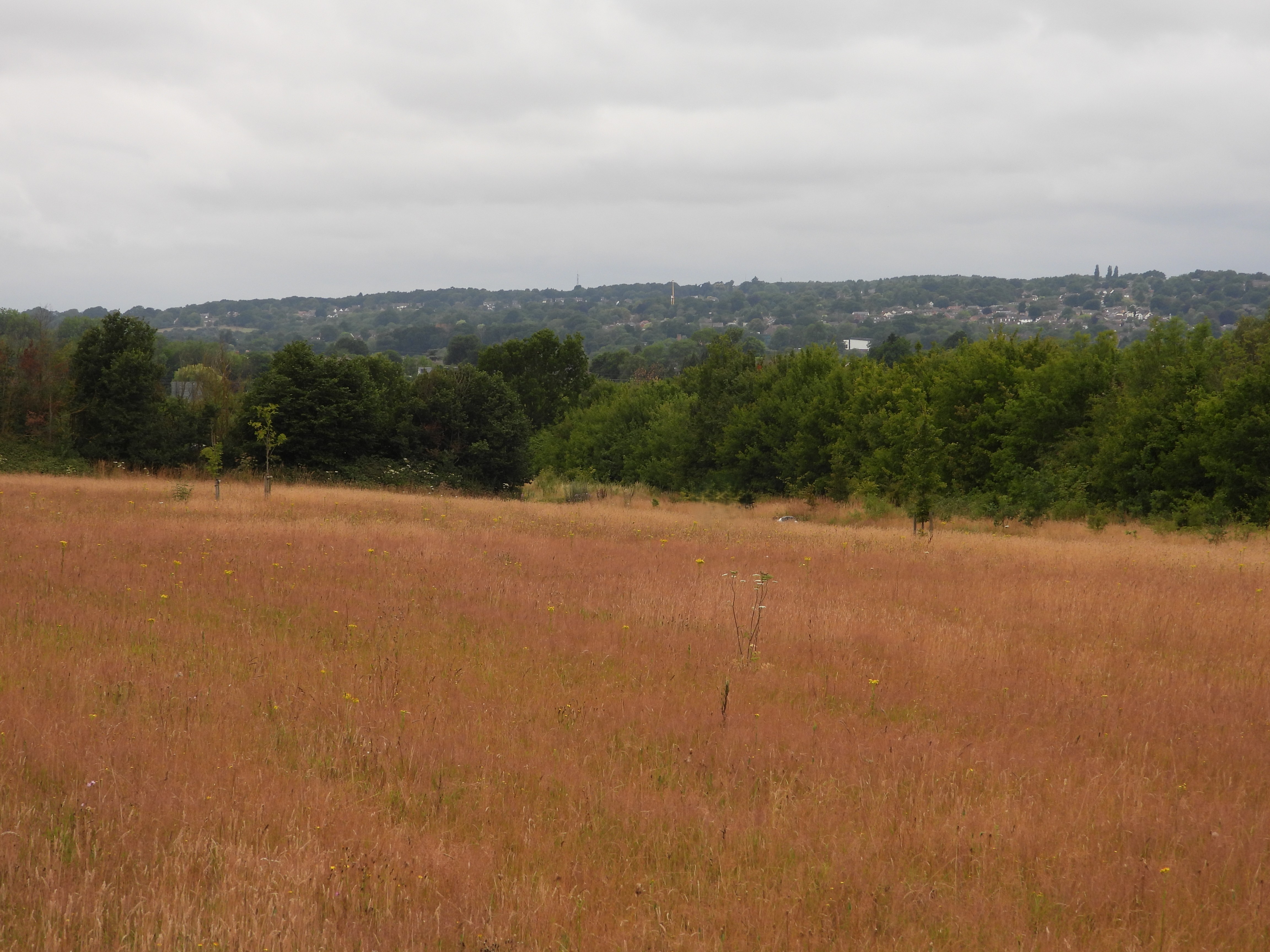

This made for a lovely morning, low-key and laid-back and all the more charming for it. The only blight was the arrival of three extremely noisy dogs who barked at everyone and everything and, incredibly, were not kept on leads in such a sensitive area – and it is still nesting season. The attitude of people with dogs never ceases to astonish and infuriate me.
Two wonderful young guides from http://www.brimstones.co.uk took a few of us on a guided walk around the chalky meadow, which lies on the northern slope of the Hog’s Back, the ridge which runs from the North Downs all the way to Dover. It is clearly well managed by the Land Trust in co-operation with the Blackwater Valley Countryside Partnership – trees are planted and wildlife boxes are in place. It is very close to a noisy, busy road, but it is hoped that planting will mitigate that to some extent.
This is the unfairly demonised Ragwort which I have written about many times.. It was one of the few wild flowers of the day which I already knew. Cinnabar caterpillars, which I happened to have seen a few days previously, were feeding on it – it is their main food source. One of the guides explained to the two delightfully enthusiastic and inquisitive young children on the walk that they wore their black and yellow striped pyjamas to let predators know they were not good to eat. The moths are bright red and black for the same reason.

A somewhat tousled looking Greenfinch called noisily from a treetop.

Lady’s Bedstraw, Galium verum, sweet-smelling, like honey, was once used to stuff mattresses, taking advantage of its ability to repel fleas.

Next the seed heads of Goat’s-beard (Tragopogon pratensis), or Meadow Salsify, also seen on a recent badger sett survey.

A Gatekeeper Butterfly, Pyronia tithonus.

I do not find them easy to distinguish from Meadows, but they are a brighter orange and I learnt that the giveaway is the presence of the two white dots on their ‘eyespots’ (ocelli). I turned to the Natural History Museum to find out about these spots. Like so much about butterflies, we are very much still learning, but the hypotheses are that they are there to deter or distract predators. Also their antennae end in a club shape.
Why do some butterflies and moths have eyespots? | Natural History Museum
I confess that I used Google’s Gemini AI to check I had remembered these identifications correctly – I have to say it did not put a foot wrong.
There was a lot of Ragwort and also a lot of Rosebay Willowherb, Chamerion angustifolium, especially it seemed around where new trees had been planted. Its commonly known as fireweed for its propensity to thrive on fire-damaged areas. It was highly prevalant on London bomb sites during the Second World War. And it’s extremely pretty.


Kidney Vetch, Anthyllis vulneraria, is another important flower for pollinators and was once thought to help with human kidney problems. The hope is that it will attract Small Blue butterflies who have a particular liking for it. Butterflies are so often so worryingly very highly specialised.

Common Bird’s-foot Trefoil, Lotus corniculatus, another key food source, was also present in abundance.

Tufted Vetch, Vicia cracca.

To finish our gentle stroll as the rain we had seen in the distance began to arrive, one of the guides told me of one her favourite examples of symbiosis. Yellow Meadow Ants ant hills are favoured by Horseshoe Vetch which in turn attracts Chalkhill Blue and Adonis Blue butterflies. The relationship between the ants and the butterflies is known as myrmecophily. The larvae are taken in by the ants, secreting for them a sweet honey-like substance and benefitting in turn from the ants’ protection until they are ready to transform.
Leave a Reply