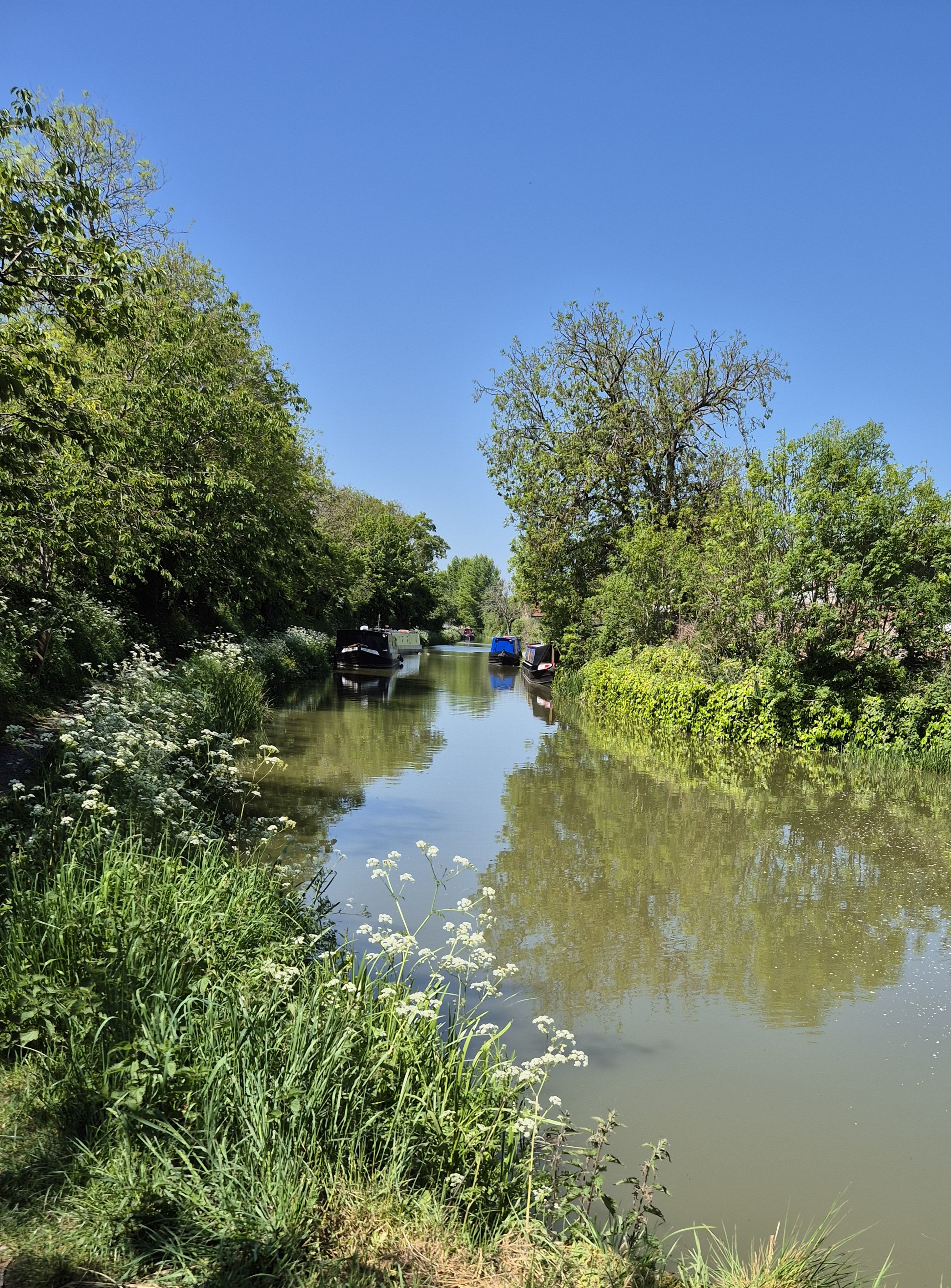
Honeystreet to Horton
This was the longest ride yet, six and a quarter miles*. Not very far but the first mile or so was pretty tough in terms of the usual hazards of the towpath. Knowing, with my new strategy for the ambition of riding the entire canal, that I would be making the return trip by road, took the pressure off. I decided to take absolutely no risks with the path this time – a dunking would be expensive, there would be a bike and a camera to replace. I’ve also decided to reduce the risk element on the road by getting a removable wing mirror.
Had this been the first leg, I would probably have waxed lyrical about this section of the canal, still part of the White Horse Trail, but it was perhaps the least picturesque so far albeit none too shabby, with fewer points of interest than most. The road return distance was less than five miles – the canal loops and turns to avoid ups and downs, and so again there are no locks on this part. The sky was a completely clear, vivid blue and I had lunch at the Bridge Inn at Horton and an ice cream and coffee at the excellent café at Honeystreet Mill. Again, I saw almost no one other than boaters of various kinds on the towpath. It is such a shame it is so under appreciated, much as I am grateful for the solitude. People I did meet though were chatty and friendly. I noticed when I first let my hair grow long that it seemed to make me seem more approachable, presumably on the grounds that I look like a harmless old hippy. I was described as such by the brother of a pair of twins at the next table in the pub garden, and as “a good advertisement for summer” by an American lady as I enjoyed my ice cream. I was rather pleased by both descriptions. I heard her saying to her friend that she wouldn’t visit the Indian shop because she already had enough “stuff”, which I thought was admirable and a lesson I could learn. To be honest, some of the items for sale did not seem of the best quality and rather overpriced.
*The OS maps app uses a lot of battery power so I didn’t have it running to record the distance this time, but was bemused to see that the timeline on Google Maps ‘knew’ that I was cycling, which is slightly unsettling, but had the distance at fifteen miles. So much for Google’s accuracy.

The two highlights were the sight of a Heron (is it the same one I keep seeing now?) flying past at my eye level along the dead centre of the canal and the dazzling flash of a pair of Goldfinches heading back to their nest.


Also several Moorhens, one with a tiny, downy chick. They are very shy and always seem to nest on the opposite side to the towpath. My approach is pretty quiet but they still quickly although loudly hide away in the reeds.
At lunch I watched Blue Tits quickly flying across the canal to find food and then return to their nest under the eaves, over and over again. How very hard avian parents work. Also Crows cawing constantly. A friend recently complained about how annoying he found the sound of Wood Pigeons. They do rather go on and I confess it used to irritate me a bit, but I now find it soothing. I think I would find the harsh, rasping Crow calls harder to take as a constant background.
The bridges were Honeystreet, Stanton, England’s, All Cannings, Woodway, Horton Townsend and Horton, plus two swing bridges. There were once three but one seems to have disappeared – an online image shows remnants only, its having fallen into ruin.


This is Woodway Bridge:

There is also Horton Chain Bridge. I was expecting something unusual but don’t know why it is called that. There is an amazing amount of information out there though, this being described on historic.england.org.uk as “Road Bridge over Kennet and Avon Canal. c.1806-7. Brick with stone copings. Bridge splayed on plan. Thirteen-inch bullnosed brick elliptical arch. Two brick string course at base of parapet and half-round flush copings ending in slight piers. Parapet slightly raised at east end. Stone capping to revetment of canal, forming towpath. Sluice slots renewed in steel.”
Over lunch it occurred to me that I could do with another out of copyright bird book from the digitised version of which to take images for this blog, Gould & Morris by no means always quite working for me. I decided upon Swaysland (Walter). Familiar Wild Birds. Four volumes. Illustrated by Archibald Thorburn et al. Cassell & Company, Limited, 1883. The bird illustrations above I had hoped to take from this, but neither Heron nor Goldfinch are included and the scan quality is quite poor, so I turned to Meyer again: Meyer (Henry Leonard). Illustrations of British Birds, c.1835-1844. It’s wonderful that digital versions of these ornithological epics are so readily available. One of the four volumes is from the Library of the University of California’s copy, three from that of the University of Toronto.

Professor Kofoid was an American zoologist and marine biologist. The Toronto copy is cluttered with library stamps and labels, recording the gift of the set by the Ontario Legislative Library. I wonder how welcome the gift was: the first volume lacks a title-page, which is supplied in crude manuscript, misspelling the name of the publisher. Other stamps state “Seen by Preservation Services”. I have seen beautiful colour plate books with library stamps on every single plate, which seems vandalistic. Librarians want to prevent theft of course but can be extremely over zealous. In the bookseller’s litany of condition, from fine, to very good (not very good) to good (bad), the lowest is “ex-library copy” which usually implies inappropriate rebinding and stamps and other markings galore, although of course some provenances greatly add to value. I am reminded of my visit to the Factory House Library in Oporto to carry out a valuation in 2010, the second the firm had been asked to provide, the first having been in 1977. I was asked also to advise on how best to arrange the library, to comment on whether the books were being well preserved, which were in need of urgent repair. I did say: “Much was made in Mr Taylor’s reports of the labels, stamps and other library marks – any of the books bearing those would have to be catalogued by a bookseller as an “ex-library copy”, but my feeling is that there is far more interest in provenance these days and were I to be the cataloguer I would, within reason, make a virtue of it, describing a book as “The Factory House copy”.” There was work to be done – cataloguing really needed to be started again from scratch, some sets of books had their volumes scattered over different shelves or even different rooms. Mr Taylor’s valuation total figure could be reached over thirty years later with fewer than a dozen books. This actually upset me: “Darwin’s On the Origin of Species is a special case. This is, I am afraid, rebinding at its worst. Issued originally in green cloth, the cheap red leather is inappropriate, the top edge should not have been stained red and the gilt decoration and lettering are amateurish and unsightly. Furthermore the book seems to be suffering – it has been jammed into a binding for which it is too large and thick and, worst of all, it has been cut down to fit. The binding should be removed and an attempt should be made to rebind sympathetically and with a view to conservation.”
I enjoyed the drive back home too. Since the release of his stellar new album, Rise, I have been listening to little but Alpha Blondy, the Ivorian reggae legend, with his band the Solar System, who just seems to keep getting better and better, but I switched to Goat’s Head Soup, perhaps the most laid-back of all the Stones albums, on which Angie first appeared. Keith Richards once said that using a girl’s name as a track title was an old trick to sell records to everyone with a girlfriend of that name. There’s also the notorious Star Star and one of Bill Nighy’s Desert Island Discs: Winter.
I am ambivalent about the next stage of my Kennet & Avon mission – it is going to get a bit urban.
Leave a Reply