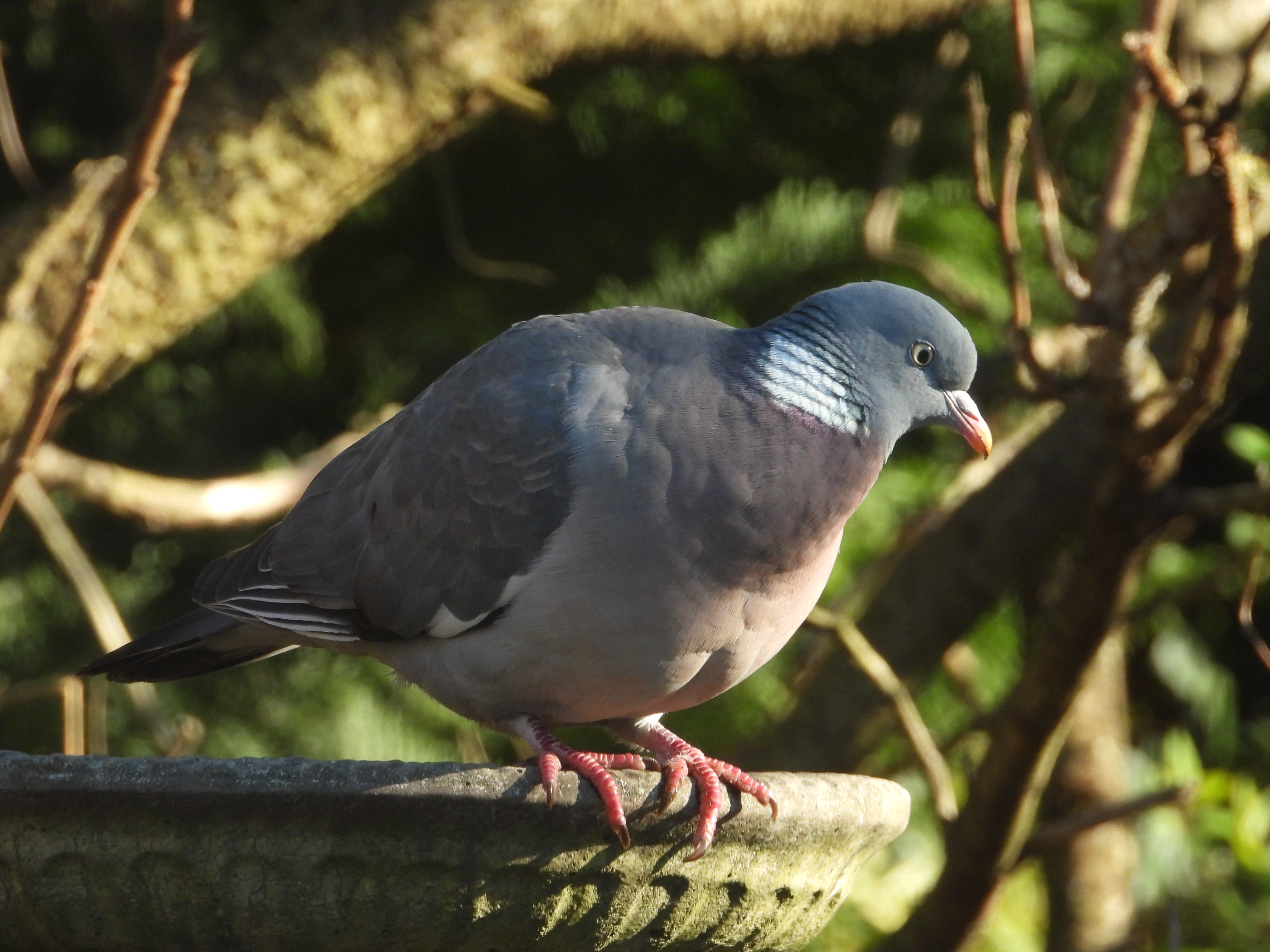
There is no particular reason for the Wood Pigeon photos, except that I was pleased with them when I took them yesterday: the light and shadow in the picture above, the blink and the textural detail.
Ambelopoulia
I wrote about the consumption of Ortolan Buntings in France here:
Spurn Migration Festival 2024 – Animal Wild
That bird is the one notoriously eaten by the French in particular, illegally. The beautiful little birds are caught during their migration south, kept alive for 21 days whilst they are fattened up to nearly triple their natural size (achieved by keeping them in darkness, which messes with their body clocks and eating patterns), then they are drowned in armagnac and eaten whole. For some reason diners cover their heads with a towel whilst doing so, perhaps to hide their shame.
Ambelopoulia is a Greek dish which achieves perhaps even higher levels of decadence: αμπελοπούλια is the Greek word for Blackcaps, boiled, grilled, pickled or fried for human consumption, but now other songbirds are included in the recipe, including Robins. The trapping methods are completely indiscriminate and the numbers of birds killed illegally in Cyprus alone is staggering. A BirdLife Cyprus report from 2014 estimated over 1.5 million songbirds annually in that country alone (at least 620,000 in 2024). The birds either are caught in fine mesh nets hung between acacia trees or by using glue made from berries or birdlime which is applied to sticks and branches. I have seen photographs of songbirds caught in the latter manner, dead and alive, and they are absolutely heartbreaking. The usual last refuge of a scoundrel, patriotism aside, is trotted out: it’s traditional. But, again as usual, money is the prime motivator and large sums are involved in this criminal enterprise. Cyprus authorities estimated 15 million euros in 2015. A network of dealers, exporters, trappers and restaurateurs are the beneficiaries. As with the Ortolan, the birds are eaten whole: it is not cost-effective to remove the entrails. Over 150 species, many of them not the targets, are killed in large numbers, some of them with vulnerable or worse conservation status. Even raptors fall victim. Enforcement is lax. As with Prohibition or the “War on Drugs”, if there is a demand for something illegal, criminal enterprises will arrange supply. The restaurateurs have a lot to answer for, but ultimately blame has to lie with the consumers. One solution was to lay waste to the acacia trees but that surely is not the root of the problem.
Mentioning that I had been delighted to see a Nuthatch in the garden again recently, I was asked if they were rare. Not particularly, I replied, except in the sense that all songbirds are.

Jeremy Clarkson
I don’t know why I am still drawn to read the deliberately misinformed and vitriolic bile spewed out by this man (I would say “oaf” but he is far from stupid), but I was interested to read about how he dealt with trespassing travellers on his land. He took a sensible, conciliatory approach (not usually his forte) and was even repaid the £50 cost of a broken padlock. He also wrote that when the hunt comes through, they have twice done at least £150 worth of damage. On one occasion he prevented them from entering. He soon received a letter stating that they were “very disappointed” and that he would find things very awkward socially if he did it again. Clarkson understandably did not take kindly to this rather sinister threat and by recounting it in print, I have to wonder if he is in some small way starting to see the light.
Steve Backshall
I have hugely enjoyed the first two episodes of his new series Expedition. He is definitely, for me, on the side of the angels in the panoply of wildlife presenters (unlike the likes of the idiotic Steve Irwin or fraudulent and destructive Bear Grylls). He and his team thread their way through remote, seemingly impossible and extremely dangerous gorges and delightfully he can hardly contain his enthusiasm for the wildlife he encounters. My only quibble is a failure to identify for the viewer the beautiful birds of which we are given a fleeting glimpse. I am a bit obsessed with bird names and learning about taxonomy but am also aware that in the broadest sense, names don’t really matter.
UPDATE. Having now watched seven of these, the last, to Greenland, had me wondering quite why he puts himself in these ludicrously high risk situations. Adventure, the thrill of the unknown I get, but at one point Steve Backshall heads off on his own and become isolated, trapped in the rapidly forming ice, putting himself and therefore his team in even greater peril. Then a Polar Bear approaches the camp. They manage to scare her away with flash bombs, rocks and a lot of shouting, but they do consider that they might have to do more with the rifle than fire warning shots. Killing her is “the last thing any of us want” he says. Hmm. Another solution if there is even the slightest risk of that being necessary is not to be there, in her territory, in the first place. Failing to name the birds has started to irritate me too – as I say in my review of Simon Barnes’ How to be a Bad Botanist, names are a portal, a way of engaging. It seems a bit lazy.
Maria Vincent Robinson
I first wrote about his fabulous photography here:
Maria Vincent Robinson, photographer extraordinaire – Animal Wild
And see here:
https://mariavincentrobinson.com/
I follow his blog and this recent image simply blew me away. I asked him if I might reproduce a few of his photographs on my blog almost a year ago and he kindly acquiesced. I hope that still applies. It is helped by the fact that egrets are my favourite birds and the colour palettes of the parts of the world where he works, but the the colour of this Eastern Cattle Egret taken in a rice field in Ubud, Bali, against the verdant background achieves photographic perfection.

Thames Water
I have written too much about them already but I did start watching a two-part documentary on the BBC last night. I lasted about twenty minutes, it was too depressing. I felt for the employees on or under the ground as they mourned the dilapidated state of sites and equipment, but not for the communications officer who seemed mostly to do a lot of shrugging, laughing nervously as she said things along the lines of “We’re bad, but not that bad”. How much worse could they be? Words fail me completely when it comes to the meaningless blandishments of the new CEO (there seems to be rapid turnover). It is revealed in the programme, as I remember that our water bill at home has increased by 38% on last year (Thames are disappointed with this restriction, they had asked to be able to add consireably more), that he received a bonus of £195,000 for just three months in his post. That’s not his salary, that’s on top of his regular remuneration. It seems the norm for such people to receive bonuses and shareholders to receive generous (to say the least) dividends without reference to actual performance, service to the public, and in this instance running up debts (not all the current incumbent’s fault of course) of £16bn, whilst applying for government approval for a presumably very expensive loan of £3bn. CEO Steve Weston’s ‘basic’ salary is £850,000 p.a. We humble consumers can only wonder what the bonus was supposed to be for. No wonder though that he is smiling all the time.
UPDATE. I went back to this and watched the rest of part one: it got worse. I had not realised that as well as abandoning maintenance there had been massive staff cuts, so that those loyal staff who used to take great pride in their work are simply no longer able to. They are firefighting all the time. Participants and onlookers at a swimming competition in the Thames at Henley noted that Thames Water’s water testing points was as far away as they possibly could be from their sewage outlets. A strange to and fro with OFWAT too: they insisted on a maximum rise in consumers’ bills of 22%, so Thames came back with 44%. OFWAT said no, 23%. Thames then asked for 52% and then 59% over five years. Against all of this, gargantuan dividends and bonuses are still being paid out. A new young site manager clearly gained the respect of his staff – he was not afraid to get his hands dirty and muck in with them. But they didn’t blame him when he had a better offer and resigned, and who could? He was constantly fighting crises. That manager also had a conscience. I don’t think the same can be said for the CEO, who has probably never got his hands dirty in his life. When asked how it was that things had got so bad, he literally said that he had “no idea” since he had only been in his position for ten months. Enough time to look into it, surely? He described all reportage as “media noise” and stated that OFWAT was “intrusive around dividends” and that they had “all the powers they need.” Clearly not. And what a giveaway. It is a case of long-term criminal plunder. For Thames Water, rain is not a blessing, it is a cause of great concern. Just as sad is the fact that workers leaving the site for lunch remove any clothing with the company’s logo on it for fear of public retaliation.
UPDATE 2. Having watched the equally painful second part, again admiring the bravery of employees, being tasked with impossible jobs without the right tools, who speak out, it was good to be introduced to Ashley Smith, an ex-policeman, founder of Windrush Against Sewage Pollution (which refers to the river Windrush not the Windrush generation of immigrants from the West Indies). He and his team collect and analyse information on water quality, noting that the Environment Agency records fewer than 3.5% of Thames Water’s illicit spills and giving details data analysis. “We want our river back” they poignantly demand.
Breaking news is that the court has not overturned the ruling that Thames can borrow another £3bn, on top of what is now already running at £19bn. All stolen from the British public.
Windrush Against Sewage Pollution | Environmental pollution campaign
Given his background it’s safe to assume he knows a bit about the law. Water companies are allowed to discharge sewage in times of exceptionally heavy rain (even then it must have been treated to certain standards) but when it’s dry, that’s when they get fined. Smith bluntly states that Thames’ business model is based on getting away with breaking the law and is a terrible betrayal of the public. To use the weather as an excuse as they do is, he says, nonsense, and the shareholders have used the company as a cash machine. The CEO is as smug and shruggy as ever. Yes, he says, he does feel responsible. I don’t believe him. He boasts to his staff that he has worked “really, really hard” to extend the “liquidity runway”, by which he means the amount of time left before the money runs out completely. I doubt that too. A few drinks or a lunch, or perhaps just a few phone calls with his fat cat mates seem more likely. Interest rates on the debt are stratospheric, peaking at 9.7%. Fines of course make the financial situation even worse – a vicious circle and a tragedy. The less attractive the company is to an investor, the more interest will be charged. Dividends between 2006 and 2017 totalled a staggering £2.7m, during which time the ‘debt pile’ tripled. Investors and shareholders were allowed to do what they did, so they did it – it was a heist, they sucked out every penny. The only real hope, the only way forward, would be to take it all back into public ownership, from which it should never have been taken in the first place.
Cheltenham
The death toll at the debauched Cheltenham horse degradation festival this year is two. There have been 76 since 2000. Greyhound racing, which evolved from hare coursing, is indubitably on its way out: this is the final year for Swindon’s Abbey Stadium, it is already illegal in the United States and will soon become so in Wales. The public is much better informed than it once was and cruelty for human entertainment is becoming increasingly unacceptable.
______________
In other news, following the superb grouse shooting flow chart produced by Wild Justice, Chris Packham has released a comedic sketch in which he interviews a caricature of a shooter, named Glenn Massacre. See here (and of course the Wild Justice and Raptor Persecution UK websites) for the chart:
I naturally subscribe to the principle of ahimsa, non-violent protest, as personified by Mahatma Gandhi, but I cannot resist suggesting that the guns are really out this year for this anachronistic, ecocidal business.

In other news from BirdGuides, a report from Slimbridge says that there has been an 86% decline in Bewick’s Swans at the wetland site over the last fifty years. This winter just past saw only 87 of the birds and no cygnets at all, thought to be largely due to short-stopping as a result of climate change. In Ireland no Bewick’s Swans were recorded whatsoever. There is no need for them to come further from Denmark, Germany and the Netherlands to the UK if the climate in those countries is milder than it used to be.
Another new report suggests that a tendency to ignore female birds, often less striking than their male counterparts, in data collation, is harming scientific understanding, conservation research and practice. I confess that I find the male birds in the garden rather easier to identify, although I am improving. From feeding fledglings at HART Wildlife Rescue (which is extremely quiet at the moment, the calm before the storm as the nestlings, fledglings, ducklings and goslings are just starting to come in), I am getting better at the juveniles too, but I am really just a beginner. I very much like the name of the originators of the report: the Galbatross Project.
Also from Birdguides: “Surrey Wildlife Trust (SWT) has teamed up with the Dogs Trust to appeal to dog owners to keep their pets on leads at the county’s many sensitive sites for ground-nesting birds.” It isn’t just the obvious risks for ground-nesting birds, there is also the potential spread of disease to wildlife and farm animals from faeces and serious long-term harm from worming and flea treatments. As one commenter says, “A massive penny needs to drop on this issue.” I totally agree with another who says that dogs should be banned from all nature reserves altogether, on lead or off. I was hugely fond of our family dog when I was a child and cared deeply for and helped look after rescue dogs where I used to volunteer, but increasingly despise those who don’t feel the need to keep them under control, even in our local pub. I also increasingly question the motivation of many who have dogs as pets. Companionship is one thing, but I believe that an awful lot of it is about domination of another species, especially amongst men.
UPDATE. A local rugby player was hospitalised for twelve days with a serious and painful leg infection after coming into contact with dog faeces during a game, our local paper reports today. It reminds me of taking my son to one away football match in Reading when he was a younger player. The other team’s dads turned up with garden spades because they knew there would be a lot of clearing up to do before the game could start. Who would let their dog foul a children’s football pitch? Do such people forget or not care about children’s (or adults’) health or the fact that not cleaning up is an offence which incurs a £100 fine?

Leave a Reply