Magpies are pretty common, I see them all the time, but I have only ever seen a Jay perhaps two or three times in my life. Their colours, both delicate and bold, are beyond words. At Hart Wildlife Rescue, in the isolation room again, I was entrusted with five hedgehogs and moving a Jay and a Magpie from their pods to clean ones immediately below. I have seen Magpies before at HART but never a Jay, let alone so close up (one tries not to stare in awe at their beauty of course), and I had certainly never handled either. I seem to have got the hang of catching hold of birds though and everything went pretty smoothly, apart from being bitten a number of times by the Jay – pecked is not really the right word. Apparently he or she used to do this with staff too, but was perhaps more aggressive since it hadn’t seen me before.
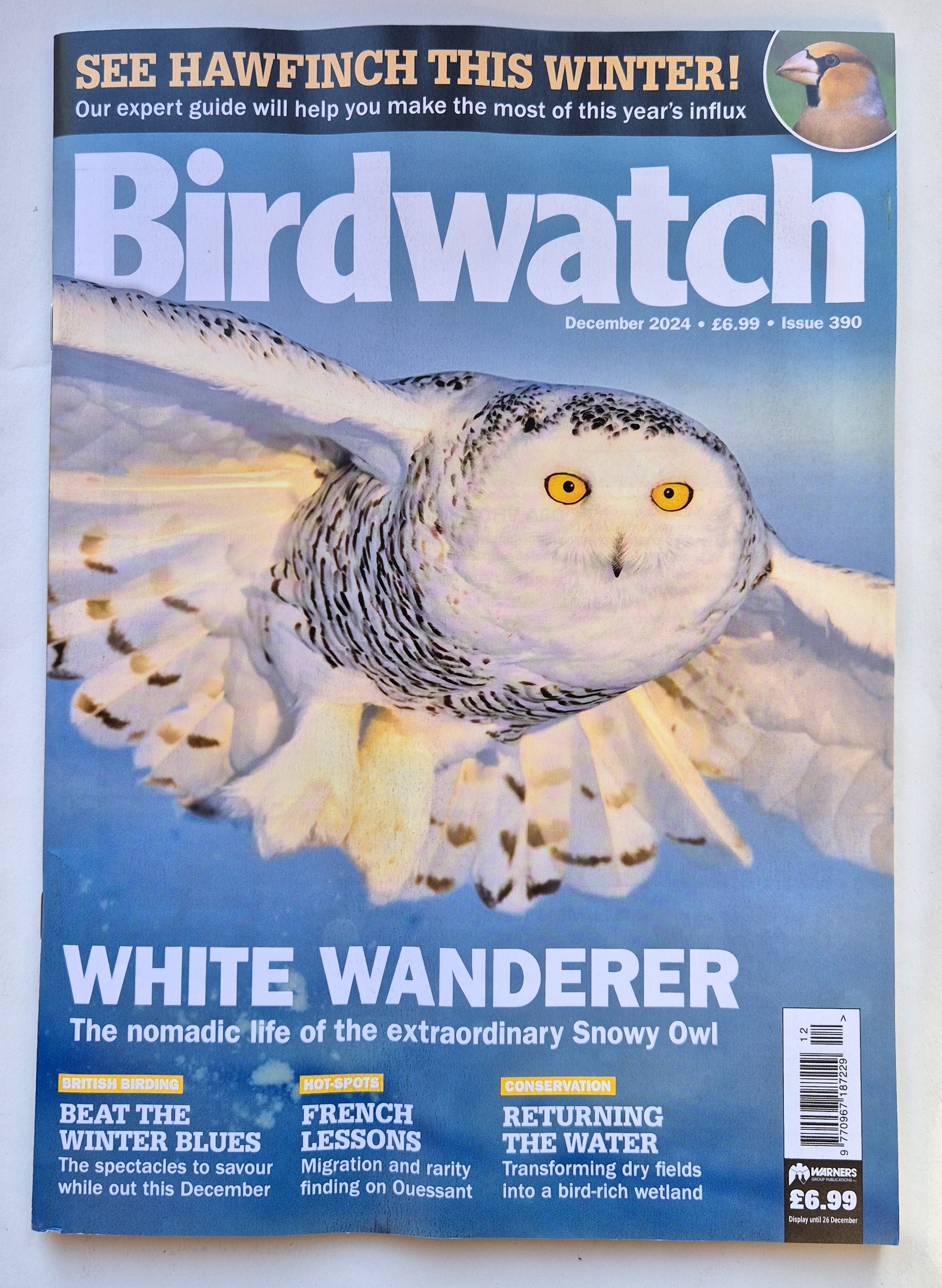
Issue 390 of Birdwatch features a Snowy Owl on the cover. Useful to know from the editor that churchyard Yews are a good place to keep an eye open for Hawfinches. I really hope I get lucky – it would be a ‘lifer’, as they say, a first for me.
As usual the magazine begins with a celebration, in this case of the resurgence of the White-tailed Eagle, known for its huge 2.4m ‘barn-door’ wingspan. They became extinct in the UK in 1918 through persecution. One has to wonder what was going through the head (and heart) of the person who shot the very last one. With releases on the Isle of Wight, not so very far from me, there’s a good chance I might get to see one.
Many rare UK sightings (including some ‘megas’) are recorded: Nearctic Thrush (mostly black with rufous underparts), Asian Desert Warbler, Eastern Crowned Warbler, a variety of other warblers and buntings, a Booted Eagle and many more.
If you follow this blog you will know of my fascination with bird names and David Campbell has written about the looming shake-up. A new, unified, global list is on its way. As he points out, relatively few birds in Britain are named after people (the cause of many of the perceived problems), but sometimes the nomenclature is just a bit on the dull side. Perhaps, he wonders, we could take the opportunity to create more celebratory names.
Mark Avery is back on the subject of grouse shooting, suggesting that it is in terminal decline. Alleluia! This season has been quiet not just because of the unpopularity of the pursuit in the public eye these days, but also disease and poor weather. As he says, we should not take anything for granted, but there would be so many benefits beyond stopping the cruelty and environmental destruction involved: “less flooding, more secure carbon storage and a much more natural wildlife community.” He adds that we don’t know about Starmer but Cameron, Johnson and Sunak were in favour of grouse shooting. Not sure what happened to serving the will of the people with those three there.
A little drama here as an interlude – wonderfully there are at least twenty small songbirds on the two feeders or the ground right now, sparrows, tits and Dunnocks, interrupted by Jackdaws and a Woodpigeon. One of them, a Great Tit, just flew into the summerhouse window with quite a thud. I checked immediately and it was sat on the ground, obviously stunned but apparently otherwise unharmed. Of course I rang Hart Wildlife Rescue for advice and put it in a special container in a dark place to recover as suggested, but it came to very quickly and sensing that he or she was ready to go, I opened the box and off he or she flew just fine, with a sore head no doubt. Our cat appeared moments later, so I am glad that I was there.
Returning to Birdwatch, Sarah Harris seems not to be a winter person any more than I am, but her writing about flocks of Pink-footed and Brent Geese in Norfolk makes me want to go back the the county to see them. There are many other water birds to be seen in large numbers – I must get out there more, stay positive in spite of the cold and rain. She also writes of the Knot spectacular at RSPB Snettisham which I was lucky enough to witness, twice, earlier in the year.
There’s plenty more on Hawfinches and Snowy Owls, with some stunning photographs, and a successful rewilding: Dickleburgh Moor, a small wetland in Norfolk, once devoid of wildlife but now restored with the help of a herd of Redpoll Cattle and visited by any number and variety of birds. The Saker Falcon and Snow Leopard’s presence and preservation in northern Pakistan are also celebrated.
Suitably for the time of year there’s a piece on mistletoe. There are some 1,300 species, some of them poisonous. They are hemiparasitic: the seeds penetrate a tree’s bark and the plant feeds on the host but also photosynthesises. In this country the berries are especially consumed by Mistle Thrush (aha!) and Blackcap, and to a lesser extent other thrushes such as Fieldfare and Redwing. There’s even a website: Mistletoe Directory UK
There are good book reviews as usual but they are mostly pretty specialised for me and I really need to catch up on books I already own. I can’t wait to read more of Amy-Jane Beer’s The Flow, for example, but just haven’t been able to find the time.
I didn’t know that many birds have special areas near the tips of their bills which are rich in nerve endings and detect movement in mud or water, either through pressure or velocity changes.
Lucy McRobert, another writer whose columns I always enjoy reading, tackles the funding crisis at the RSPB. She makes a good point about the right to roam, of which I am hugely in favour: some areas have to be off limits to protect wildlife, particularly at certain times of year. She concludes by expressing the hope that money saved by the proposed cuts at centres and to public engagement will at least “be generously poured into saving and restoring bigger and better wild places above all else.”
Meanwhile, Berkshire, Buckinghamshire & Oxfordshire Wildlife Trust’s quarterly is here. I have issues with the organisation, such as their allowing the killing of Grey Squirrels and the use of glyphosates on their land, but remain a supporter on the basis that they do a lot more good than harm. And it’s a broad church. There’s a Curlew on the cover, but mammals and reptiles feature strongly too and I think their efforts to engage people with nature seem to work very well.
It is the time of year when I and so many others will be inundated with pleas for donations, which will often be matched or even trebled from elsewhere. I wish I could do more, but these are straitened times all round. I hope that the many charities will not suffer too much from the despondency and shortage of funds which our governments have bequeathed us.
Leave a Reply