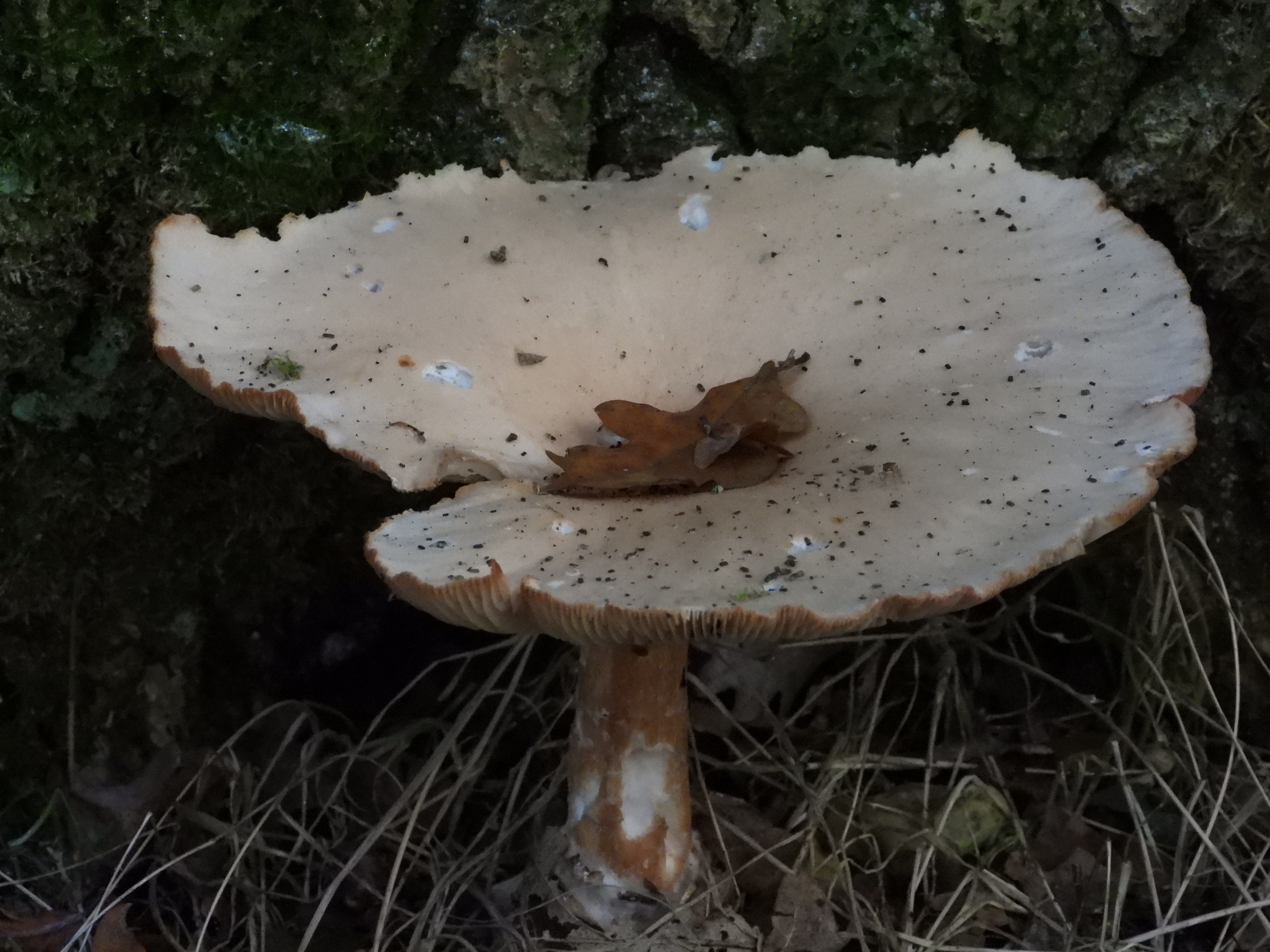
A leisurely two and a half mile walk through Bowdown Woods this time, a BBOWT reserve which is surprisingly situated not far from Newbury and Thatcham, Berkshire and close to a road (although not the way my satnav tortuously sent me, through a long line of industrial estates). I saw all of two other people – one friendly, one somewhat less so. One area is known as the Bomb Site having been used as a wartime munitions store, now covered by young mixed woodland, grassland and heath. A noticeboard explains that Ash dieback (a wind-borne fungal disease) has been a major problem. Wherever possible, they say, the dead wood is left to decay naturally. I am fairly sure that most of the first images below are more Birch polypores in various weird shapes and sizes and stages of development. Otherwise for the most part I am finding fungi now that seem to be quite beyond the abilities of AI identification on my phone or Bing visual search, whilst using the Collins guide reliably is beyond mine. The image at the head of the post is perhaps the best photographically – I believe it to be a Milk-cap of some kind.


This one was the size and struck me as being the shape of a hat which might be worn to a wedding.


I have no idea about the next two but the second looks pleasingly like the stump of a tree.


My favourite find of the day. A tiny, fragile mushroom with almost impossibly delicate pink colouring. It may be Mycena pura or Lilac bonnet. It is apparently both luminescent and poisonous.

These sheet webs will have been most likely made either by a member of the Linyphiidae (sheet weavers, including money spiders) or Stiphidiidae (sheet web spiders) family, both from the Araneomorphae infraorder.


This close-up shows the dense intricacy and beautiful water droplets.


As I was leaving I heard the unmistakeable harsh barking of a Muntjac.

The last few gorse flowers.

I have signed up to the Tree Registry (£18 a year), a database of some 80,000 “champion” trees in Britain and Ireland. Individual entries are highly detailed: genus, species, height, diameter and girth, length of extra stems, recorder’s name, grid reference, owner’s name and address and year planted, when known. Sometimes there are photos. The searches are quite slow and the catch in my part of the world is that I will never be able to see most of the local champions since they are on private land, but Farringdon parish church in Hampshire is not too far from HART Wildlife Rescue and is home to two Yews, one of them, described as a “huge, hollow shell”, recorded by no less than Gilbert White in 1781 and W.H. Hudson in 1902, which it has been suggested may be 3,500 years old. I look forward to visiting them.

On the subject of private land, it is unusual for me to come to the defence of the royal family, but a recent article in the Daily Mirror reports on a closure at Barton Court, home to Pippa Middleton and family and the subject of an earlier fungus foray and post. “Pippa Middleton in bitter local row as villagers slam ‘outrageous’ decision to close lane” screams the headline. Within the same article this is described as a lane and a footpath, but it never was a public right of way, although the previous occupant Sir Terence Conran had no objections to people using it. Certainly the children and I used to cycle up and down it but the footpath at the edge of the estate is still open and the lane only takes you to the road which leads back into the village which has some sharp bends, a lot of traffic and no pavement – not an enjoyable walk. I do understand the need for some privacy, especially given the possibility of predatory paparazzi and lazy tabloid journalism like this.
But having watched Dispatches on Channel 4 last night, although the revelations were not new to me or surprising, the scale of the huge amounts of land and the income it generates for the king and the prince of Wales, in the form of the duchys of Cornwall and of Lancaster, and the special rules which apply (they voluntarily pay income tax on the revenue but are exempt from both corporation and capital gains tax) will have surprised many I suspect. There’s an argument that their and the Crown Estate’s ownership of most of the country’s foreshore and seabed (from low water to a twelve nautical mile limit) and, thanks to Tony Bliar (sic) in 2004, exploitation rights (generating royalties from wind and wave power), is better than its belonging to private individuals and companies so that at least it remains largely accessible and unspoilt. Dispatches proved that this is by no means always the case however, and as Guy Shrubsole whose new book The Lie of the Land is on my shelves waiting to be read points out, theft in the time of feudalism, which has never ended, is the only means by which the royal family and aristocracy came to own land in the first place. Some of the Crown Estate money goes back to the government in the end but that does not apply to the duchys. I happened to learn that money from intestate estates where no relatives can be found also finds its way to the royal family. The totals are not small sums – more than £1m to Charles from Cornwall in one year alone. Don’t they have enough? They could always sell some of their vast art collection much of which none of the rest of us ever get to see – we are not permitted even to see the full inventory of what the Royal Collection Trust’s website describes as “one of the largest and most important art collections in the world”.
The investigation was carried out in conjunction with the The Sunday Times where it has made headline news this morning. The royals do not just rake in money in this way from businesses but also schools, hospitals, prisons, councils, the RNLI, toll bridges, ferries, sewage pipes, pubs, churches, village halls and the military.
On the evening of the day of this walk, I drove to a meeting of our badger group to hear a talk by the manager of Oxford Wildlife Rescue. It was extremely good – he is passionate and down to earth, angrily ridiculing the notion that we are a nation of animal lovers. As I pulled off the motorway, I ran a hand through my hair and encountered a slimy presence. I assumed it was bird droppings, grabbed a tissue and cleaned it off. Once I had parked up and had some light, I opened the tissue to check. It turned out to be a small slug.

It was moving around and apparently undamaged, so I placed it in a hedge and went inside. Removing my coat, I saw a slime trail from where it had started up to the level of my hair. I think it is Limacus flavus, the common Yellow and/or Cellar Slug or Tawny Garden Slug – the mucus was certainly yellow. At least I found the stowaway before I was in company. Slugs are hard to love and before I knew better many years ago I have put down slug pellets and beer traps and even once sprinkled one with salt the result of which was like something out of a horror movie. Later I found that copper tape around pots worked well for plants I wanted to protect. But slugs have their place in the ecosystem like everything else and are an important food source for a number of wild animals. Chickens can and do safely eat them too. The more you leave your garden alone, the more likely the slug ‘problem’ will go away naturally.
Leave a Reply