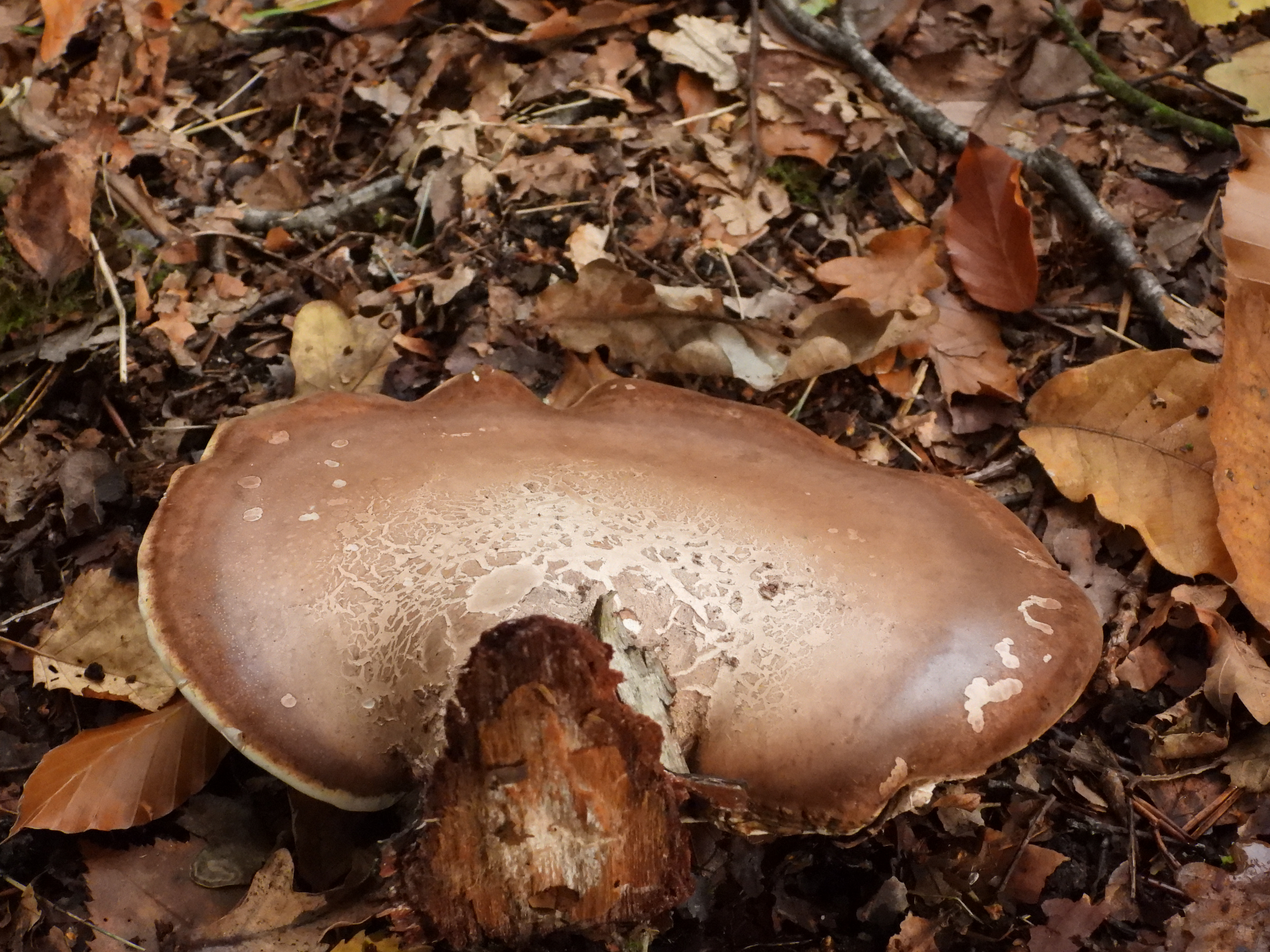
I spent a very happy and sunny afternoon at Snelsmore Common, a local nature reserve renowned for its variety of heathland, mires and woodland. It brought back happy memories – I used to take the children there regularly for walks and cycle rides. Sadly the old fire tower has gone, pulled down because of vandalism and disrepair. Otherwise it is just as I remembered it. There were not many people about but those I did bump into were chatty and friendly. My aim, given the time of year, was to photograph fungi and I did rather better than I had expected. I have spent the last two hours trying to identify them via Google, Bing visual search, Collins Fungi Guide by Steven Buczacki, illustrated by Chris Shields and Denys Ovenden, William Collins, 2023, and most usefully the extraordinary AI abilities of the photo software on my Android phone. I don’t think any are uncommon but attempts at identification here are best guesses at most – it is a very complex matter and there are around 15,000 species known in the UK alone, some 144,000 worldwide. The commonest trees at Snelsmore seem to be Oaks and Silver birch, which helped to some extent. What is certain is that I have had an absolute blast trying. I make no comments about edibility at all, for obvious reasons. I think there is a very simple answer to the question should I eat this mushroom or will it poison me? Don’t even think about it. Assume it will do you harm and only consider cooking or eating them if you are with a proper expert.
That having been said, I am reasonably confident that the photo at the head of this post and the two which follow are Birch polypore, Fomitopsis betulina, the Razorstrop, which are exclusive to Birch trees.


In my childhood home garden we were blessed with a Silver Birch and a Cedar of Lebanon and they remain amongst my favourites – and my father’s who also loved trees. I am very fond of a Sumac tree in my garden now with its drupes and which turns a spectacularly fiery red in the autumn, and Weeping Willows have an extraordinary beauty for me. The markings and textures on these fallen sections of Silver birch wood I find utterly wonderful.


The evidence of shed branches below is pretty amazing too.


This was the first fungus I saw. I have no idea what it is. Initially I thought I wasn’t going to see very much at all, but then I slowed down, got closer to the ground, and once I’d started seeing them I couldn’t stop – they were everywhere.


I don’t know which tree this is either, but I was intrigued by the lumps and bumps. I will come back to Tristan Gooley’s How to Read a Tree, clues and patterns from roots to leaves, Hodder Press, 2024, at length in a future post, but it was so well organised that it didn’t take long to find what I remembered reading.

These are sphaeroblasts. Scientists are far from sure what is going on underneath. It’s work in progress, but usually they are the result of injury, virus or fungus “triggering the buds to overreact”.
I am reasonably sure that this is a puffball.

I am a little more confident that these are Turkey Tails (or Turkeytails – although there is also a False Turkeytail just to confuse us), Trametes versicolor.


This might be Heterochaete delicata about which I can find very little information at all.

This seems to be Heterobasidion annosum.

Then, perhaps, Acanthophysium oakesii or Aleruodiscus oakesii.


Below, a lichen: Phlyctis argena, or Whitewash Lichen (I think). The close-up seems worth posting for the detail.


Not sure what happened to this stump, but I thought the textures were interesting.

I made time to stop, too, and appreciate the autumn colours and the light.

Sometimes pointing your camera into the sun produces a lovely haze or other effects.


I think the little circles here add to the image rather than disfiguring it

These are two other fungi I have been unable even to guess at, but they have very interesting shapes.


A magnificent oak (they are always magnificent really).

More gorgeous autumn colour.


I found this strikingly lovely too.

I turned down the exposure to make this look a bit more … Tolkienesque.

Which sent me off on re-exploring the importance of trees in Tolkien’s books. He was an environmentalist before the word was coined, and the destruction of the English countryside by industrialisation and other despoliations is of course a huge theme of his books. There are the fabulous Ents of Fangorn forest, led by Treebeard, the oldest creature in Middle-earth. Wikipedia describes them as sentient beings who resemble trees, but I am far from persuaded that the trees that we know are not sentient – I think we are gradually learning that in many ways they are. One critic, Corey Olsen, “interprets the song of the Ents and the [lost] Entwives as a myth which warns of the dangers of apathetically isolating oneself in nature, whereas the Ents’ song “In the willow-meads of Tasarinan” is a lament.” It seems that the idea came to Tolkien as a result of his disappointment on reading Macbeth that the trees of Birnam Wood did not actually come to Dunsinane. The Ents are tree shepherds, slow to speak and act, considering a three-day deliberation as unwarrantedly hasty. Following an Entmoot (they are not quick to sense the urgency of the situation much to hobbits Merry and Pippin’s frustration), they march on and destroy Saruman’s Isengard. “In their book Ents, Elves, and Eriador: The Environmental Vision of J.R.R. Tolkien, Matthew T. Dickerson and Jonathan Evans see Treebeard as vocalizing a vital part of Tolkien’s environmental ethic, the need to preserve and look after every kind of wild place, especially forests.”
There are other trees: Old Man Willow in Tom Bombadil’s Old Forest and the two tall Mallorn trees at the heart of Lothlórien. Galadriel gives a seed to Sam Gamgee who later plants it in the Shire. Valinor, a paradise realm, is lit by the two Trees of Valinor, one silver, one gold.
There are many examples of tree deities in human culture and mythology and sacred trees of other great significance. In Germanic culture and especially Norse, Yggdrasil is of particular note, an enormous Ash thought of as central to the cosmos around which everything else exists, its roots and branches extending to the Nine Worlds.
Following these ruminations, things got a little bit if not weird, then definitely uncanny in terms of coincidence. I had intended to go out looking for fungi anyway, but if I had not I would definitely have been inspired to do so by this wonderful post, also about fungi, which also reminded me to slow down and get nearer to the earth if I wanted to see things.
Almost missed them | absolutelynotnormal
In a post published just a little earlier, the author had written entertainingly about a number of small plastic ducks which seemingly mysteriously appeared in and moved around her classroom, a gentle tradition shared with and perpetrated by her students. I had stopped to sit on a bench and lo and behold, glued to two corners, with no apparent rhyme or reason, were these:


I pointed them out to several people walking past. We all agreed it was a very sweet thing to have done.
This fungus is another which has defeated me.

This last, though, I am really pleased about. When I first saw it I thought it might just be some mud someone had scraped off their boots. I only just about bothered to take a photograph. But then, when I got home, I zoomed in. I almost felt as though I had discovered it.


It seems to be common Black Jelly Fungus, Witches’, Trolls’ or Warlocks’ Butter, but the story does not quite end there. It might be Exidia glandulosa which is most commonly found on oak. Also though it could be Exidia plana also known as Exidia nigricans, which doesn’t even get a separate entry in Collins. The two are so similar that they can confuse even the most knowledgeable and some conclude, not unreasonably, that they should be treated as one (athough the species are distinct). With a pleasing circularity in terms of this post, the common, popular names come from … Nordic.
Leave a Reply