As is often the case, this particular tangential pathway began with the answer to a crossword clue, a word I had not come across before: Ringhals. Also known as the Rinkhals, this turns out to be a highly venomous spitting cobra-like snake. The name seemed to me likely Afrikaans, and indeed it is originally a Dutch word and the species is found mostly in South Africa. Sometime you can just tell: driving up to Hull for the Spurn Migration Festival, I remember thinking that I was definitely in Viking territory as a I drove through a village called Thorgumbald. Unlike Cobras, they are “ovoviviparous”, giving birth to live young, between 25 and 30 on average, with 65 recorded. They are hooded and also very good at “thanatosis”, faking death by rolling onto their backs with their mouths wide open.
I could pretty much guess what the word ovoviviparous meant. Viviparous means giving birth to live young, oviparous animals lay eggs. So this must be something in between. Delving further though, Wikipedia gives this definition: “Ovoviviparous animals possess embryos that develop inside eggs that remain in the mother’s body until they are ready to hatch.” That seems very ambiguous. Do they hatch inside or outside the mother’s body? I am not alone in being confused and the word has rather fallen into disuse as a result, with more specific descriptions now in place. Suffice to say, it’s complicated.
This came to me hot on the heels of my friend, who was volunteering at an animal rescue in Costa Rica and found himself looking after parrots, sloths and coyotes (which makes my efforts with huffy hedgehogs, ducks and geese seem pretty tame), telling me that colleagues had successfully relocated a fer-de-lance pit viper, or Terciopelo, which is considered the most dangerous snake in Costa Rica and one of the most dangerous in the world.
Isn’t it strange how things really do tend to come in threes? I am not sure how I got there, but I have just ended up taking out a trial subscription to New Scientist magazine, which has on its website a report that the ‘invasive’ (I always use that word with caution) Aesculapian snake has been found in Britain. It shouldn’t survive in our colder climate, but global warming has helped the species here and it has found hiding places in wall cavities, attics and compost heaps. It has been found breeding in the wild in two places, almost certainly a result of escapes from captivity. It is a constrictor, not venomous, and poses no threat to humans.
Weekly news from BirdGuides includes extraordinary data about Amur Falcons. I would not associate birds of prey with prettiness ordinarily (majestic, beautiful, purposeful and so on perhaps) but these small raptors really are very … pretty. They breed in Russia and China and migrate across India to South Africa for the winter, although their migration patterns are still not fully understood. It is quite the journey – 13,000 to 14,000 miles (this was given as 22,000 km but that doesn’t mean much to me as a pre-decimal baby, any more than hectares do, or at least I cannot visualise them whereas I can visualise an acre). Before they cross the Arabian Sea they need to refuel. They consume huge numbers of fat and protein rich termites (the fungus-farming kind), as many as two billion in two weeks. They used to suffer major losses from trapping and killing but thankfully that has been brought to an end.
More prosaically, arguably, I enjoyed seeing a Mute Swan and her cygnet and a Mallard drake yesterday. Previously I might have said “Oh, it’s just a swan / Mallard / pigeon / gull” but I have tried to stop myself even thinking like that now. There is no “just” about any of them. Interestingly three of those are perhaps the most hated of birds – a lot of people hate Starlings too. The idea of “just a gull” becomes even more unsustainable with news that two previously amber-listed species, the Great Black-backed and the Common Gull have joined Kittiwakes and Herring Gulls on the red list. So have the Great Skua, Leach’s Storm Petrel and Arctic tern. There’s a full list of the at risk UK bird species here:
UK red list birds: Full list of 73 at risk after five seabirds added (inews.co.uk)
Of those we are most likely to see here, even the Black-headed and Lesser Black-backed Gulls are amber listed.
How anyone hates swans is completely beyond me but I suppose those ridiculous old wives’ tales about their being dangerous and capable of breaking your arm (they’re not) are partly to blame. There’s an excellent piece about why people don’t like pigeons here:
The Origins of Our Misguided Hatred for Pigeons | Audubon
We take in a steady stream of Feral Pigeons at HART Wildlife Rescue and I think they are rather beautiful. Wood Pigeons too, although they are more difficult since they become extremely stressed in captivity, sometimes to the point of suicidal. The description of pigeons as “rats with wings” coined by a New York parks commissioner will not have helped, but I thought particularly telling in the above article was the notion that they are thought of as being simply out of place in our towns and cities. We allow trees just a little open patch in a sea of concrete and pavement in which to grow and seem to think pigeons have no right to occupy ‘our’ space. We want nature to stick to our artificial boundaries. They pose next to no health risk although, my car being a constant victim, I can understand that their faeces on statuary and the like is unsightly.
There’s also news in BirdGuides about a Pine Marten reintroduction (I have never seen one and was astonished to learn that they are the size of a cat, much bigger than I had assumed) and that more Choughs have been released in Kent. That’s a bird I would really love to see.
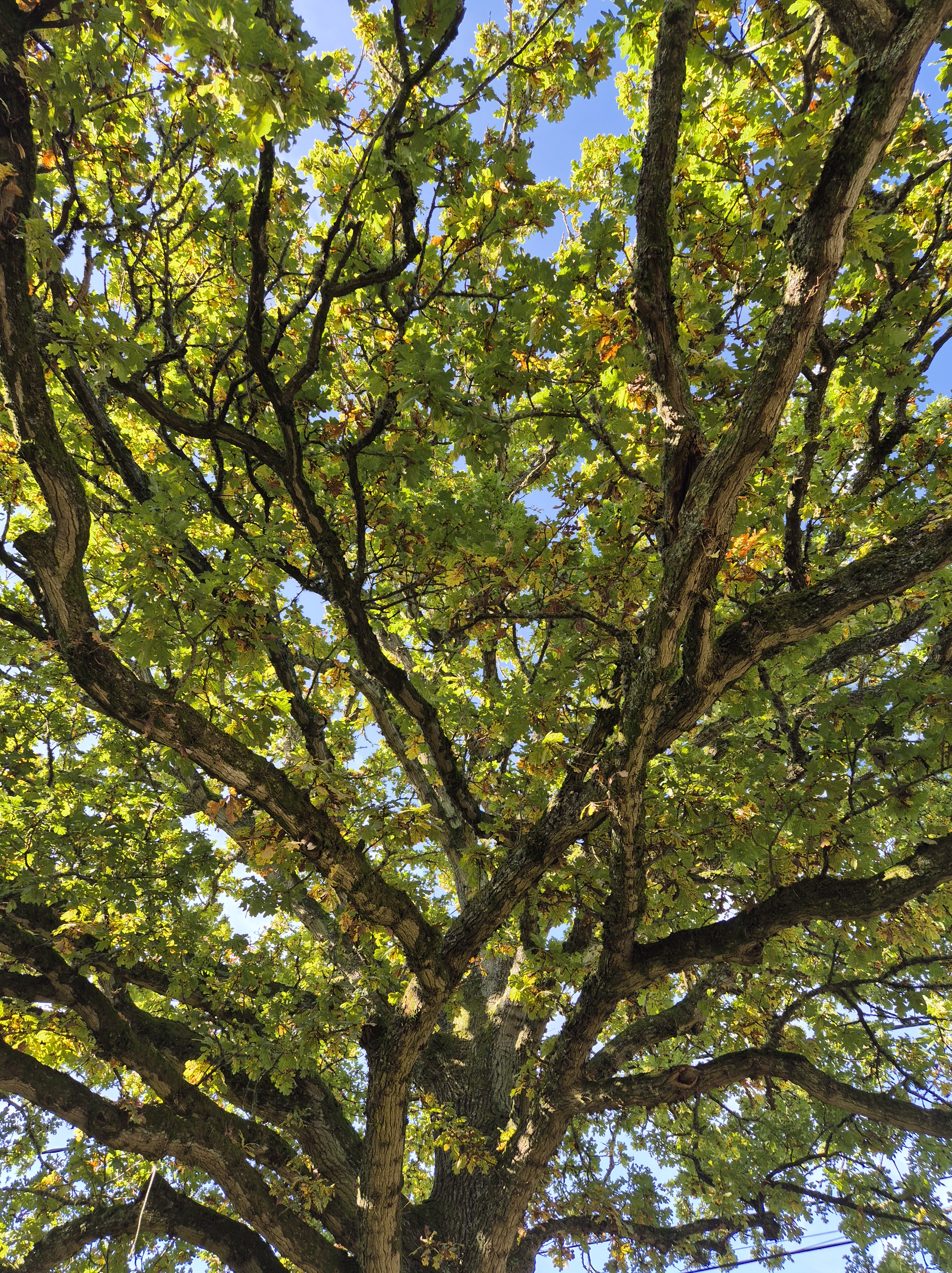
A pub lunch and a short walk along the canal the other day produced further reminders of the wonderful in the commonplace and more opportunities to learn. This glorious oak in the pub garden almost took my breath away.

There’s a maple too.

And, just but only just outside the shadow of its canopy spindle tree saplings (so named for their hard wood, used to make spindles for spinning wool), these flowers, with berries, much darker than those I saw and photographed in another recent post.

I imagine that these may be ‘further along’ since they receive more sunlight. The berries provide sustenance for mice, birds and foxes but are poisonous to us.


As mentioned above, you can’t really go wrong with a well-lit picture of a swan and this Mallard was looking especially handsome.

On my return home, I was surprised to see this water lily still in bloom in late October.

Finally, I came across this quotation: “I have from an early age abjured the use of meat, and the time will come when men such as I will look upon the murder of animals as they now look upon the murder of men.” I wonder what the National Farmers’ Union would make of it given that it is not from some radical modern vegan (or animal rights extremist as they would no doubt like to characterise the speaker) but from Leonardo da Vinci.
Leave a Reply