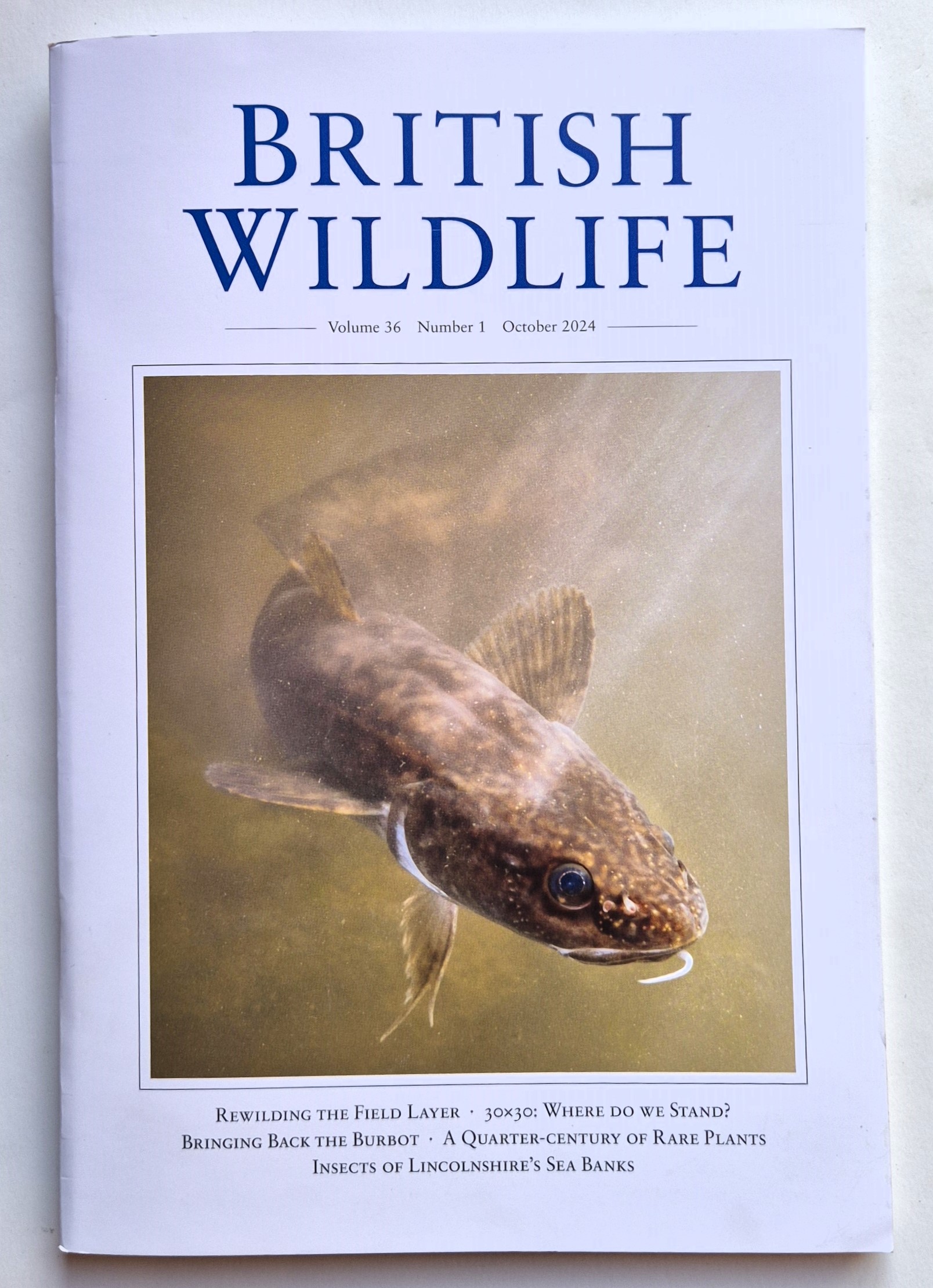
Volume 36, Number 1
Following the first article, “Rewilding and the woodland ground flora”, Brett Westwood declares himself a psammophile, a word new to me, meaning species which thrive in sandy soils. I also learn from him of ventifacts, “glacial drift pebbles smoothed by windblown sand.” What a beautiful, poetic definition. He argues that although such habitats are a hard sell, we should be looking after them since they are home to many species including the Astata boops wasp (wonderfully named as he says), “which stockpiles shieldbugs as a larval larder.”
In “30 x 30: where do we stand?” Richard Benwejill analyses the target, either woefully misunderstood or lied about by Boris Johnson, that we should manage 30% of the land and sea for nature by 2030. As George Monbiot and others have pointed out that 30% should absolutely not include our National Parks, which are wildlife deserts, National Landscapes and Marine Protected Areas, none of which are managed for nature. Whether the government will radically change its thinking and “grasp the scale of effort needed” is something we can only hope for. An RSPB report makes the case for the importance of deadwood (which I have placed and left in my garden for several years now) especially in commercial woodland, for the benefit of saproxylic (another new word) beetles and other species.
The case made for bringing back to UK rivers the Burbot, featured on the cover of this issue, the only freshwater member of the Cod family, is a strong one. They persisted here until the 1970s but, shockingly, disappeared. Perhaps, the authors suggest, they were the canary in the coalmine for the decline of our lowland river habitats. The fish, Lota lota, are also known as Eel-pout, Burbolt, Lingcod, Coney-fish, Rabbit-fish, Lawyer-fish and Weasel-fish.
Amy-Jane Beer concentrates on blanket bogs in this issue whilst Pádraic Fogarty writes about the catastrophic effects of the huge numbers of cattle in Northern Ireland (1.7m) and the republic (6.5 million). Greenhouse gas emissions are a global problem, but there is also the fact that dung direct from the animals and slurry have caused eutrophication (not new to me, but I had to remind myself, an over-abundance of nutrients causing excessive plant and algal growth and consequent oxygen depletion) in two-thirds of estuaries and over half of waterways. As I have previously reported from this publication, Lough Neagh, the largest waterbody in Ireland and Britain, “is now a fluorescent, gunky green mess, its unique ecology collapsed.” That’s not all. Cetacean prey fish, if they cannot see each other in cloudy waters, do not form shoals. And Fogarty is very clear on bTB: “The rise in more intensive dairy farms has coincided with a rise in bovine tuberculosis in cattle. Badgers have paid a heavy price … while farming organisations continue to resist measures that would reduce bTB spread within and between herds.” There are problems, he concedes with overgrazing by deer, but these are localised. Consider instead the nearly five million sheep and the wave of extinction they have brought about. This is in part why I find my currently wildlife volunteering ultimately more rewarding than the time I spent at another rescue looking after domesticated and field animals. We have more than enough dogs and sheep, for example. Hedgehogs, birds of prey, songbirds: these populations are all in freefall. I really like how Fogarty writes: you will see cattle and sheep, he says, “What you will not see are the roughly two million pigs or up to 100 million chickens which are banged up in factory conditions, out of sight and out of mind.” Powerful stuff and a reminder of the intense secrecy of the factory farming industry (and others which exploit animals). The irony of feed having to be imported for these farmed animals should never be forgotten, with its impact: deforestation and overfishing elsewhere in the world. He also recalls a suggestion last summer from the republic’s regulator, the Environmental Protection Agency, that people might consider meat-free Mondays, which was met with such a “tantrum” from farm organisations, that the post was removed. I’ll keep saying it until I am blue in the face – the self-mythologised power of farming interests needs to be drastically curbed. Now would be good.
Timely in terms of my recent visit to Norfolk, Steven Falk writes of the grassy sea banks of Lincolnshire in particular, home to all manner of bees, butterflies, moths, flies, beetles, bugs and orthoptera (grasshoppers and related as I again had to remind myself). There is even a picture of a Sea Aster Bee a couple of whom were pointed out to me in Norfolk – little did I expect to come across this species twice in a matter of weeks. I recalled a couple of conversations with one of the tour leaders with whom I seemed to share many views. In one he became quite heated, as do I, on the subject of David Attenborough (not a conservationist) and Isabella Tree’s book Rewilding – all well and good but one would think she had invented it. She didn’t.
Mark Avery, whom I hugely admire, had been pretty fractious of late. Who can blame him? The Conservative government (I only afford them capital case for clarity, not out of respect), tried to do away with Natural England altogether and imposed such cuts as to in effect very nearly do so. The new Labour governments planning proposals appal him as they do me with their presumption in favour of development (few people seem to dare to express this doubt, fearing I think that they will be seen as in favour of more people being homeless – I would counter that there are other solutions). It is almost as though they had been written by the housing industry – no wonder they welcomed them. As with the water and farming industries, they say they are doing their best for wildlife, river quality, first-time buyers whilst racking up massive profits … but they would say that, wouldn’t they? Mark Avery recalls the howls of protest which greeted the idea that nesting bricks for Swifts, at a cost of £40 each, should be mandatory for new builds. Ministers who believe that the housing industry is as vulnerable as it claims “are unlikely to delve very deeply into the complexities of land-banking by house builders.” I do feel that this wonderful magazine has become increasingly politicised since I began subscribing to it, and I am delighted – the contributors of course understand the urgency.
Guy Freeman in the conservation news section approves the reinstatement of the post of climate envoy, presumably written before the Quadrature scandal broke, see here:
The suppression of protest and a political confession – Animal Wild
He also makes no bones about the illegal, no more, no less, behaviour of various water companies and the frankly terrifying absence of butterflies and wasps this summer. He is much more optimistic about an end to the badger cull than I am and bemoans the fact that the biodiversity net gain rules for the building industry have been honoured more in the breach than the observance, through loopholes, although I would argue that they are merely a sop in the first place (and if you need to ask what I think about the ‘grey belt’ idea, you haven’t been reading closely!) Farmers are furious, he says, but when are they ever not? So are we. A neonicitinoid derogation application is, yet again, in for 2025 already. Labour say they will reject it but we shall see. Europe’s Marine Protected Areas are all very well in principle of course, but a new paper shows that over 80% of them are ineffectual with just 2% highly protected whilst 86 % have low protection levels incompatible with conservation.
The redoubtable Ruth Tingay of Wild Justice and Raptor Persecution UK reports on wildlife crime: all of the usual with no doubt the usual suspects to blame, fox hunting, badger baiting and sett disturbance, hare-coursing, the murder of birds of prey… Also walkers filmed in Cornwall causing the worst disturbance of seals on record creating a stampede of around 250 seals on a beach in north Cornwall.
Lee Schofield a nature-friendly farmer, deplores the bully-boy tactics employed by many ‘traditional’ farrmers. Why, he wonders, are theirs the only voices heard, why are others too intimidated to speak?
From the book reviews, I am extremely tempted by a new monograph on the Osprey by Tim Mackrill, Bloomsbury Publishing/T & AD Poyser, 2024. At £60 in hardback and £35 in paperback, 304 pages and 150 colour photographs, it makes my Animal Wild, hardback, over 280 colour photographs and more than 330 pages seeem quite the bargain at £30. I fear though that for the ever-diminishing number of people who read books at all, £30 is a step way too far. So apologies to Mr Mackrill for failing to resist this comparison – I am sure his book is excellent value and very much doubt I will resist for long.
I have a particular fear that younger generations will not bother to argue, protest or fight for nature because their baseline is so far removed from ours. My children have never known, for example, the small hedge outside the kitchen window where I grew up, which was always positively alive with House Sparrows, countryside walks where the landscape wasn’t silent, but what I do still see, although there have been no Starlings for several years now where they used to be many – Robins, Blue and Great Tits, Great Spotted Woodpeckers, Wrens, Dunnocks, Blackbirds, Magpies, Jackdaws, Collared Doves and Wood Pigeons, a Reed Bunting even, benefitting from my feeders, and their songs and calls, do lift the heart and spirit.

So does this. I have posted photos of it from the garden before, Wild Carrot or Queen Anne’s Lace. Here its umbels are amazing even in their autumnal phase.
Leave a Reply