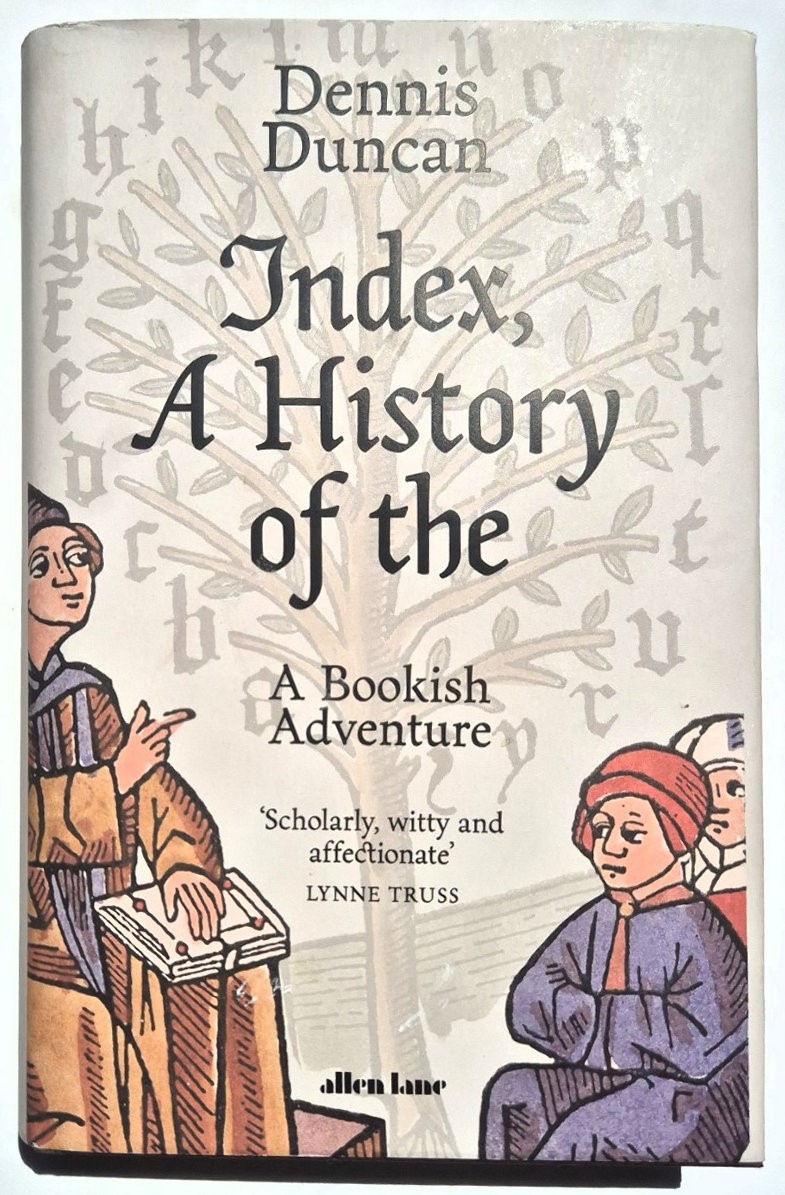
A review of Index, A History of the; a bookish adventure by Dennis Duncan, Allen Lane, 2021.
One of the many things which delight me about this book is the way in which it sets my mind off on tangents and brings back forgotten memories. We enter the territory of the index as a repository of wit or, as Duncan nicely puts it, the “discreet snark”. This reminded of a time when I worked for Sotheby’s in its book department. A highly intelligent and gifted cataloguer of manuscripts, Felix Pryor, decided to have some fun with the index of one of the major English Literature catalogues (he got into quite a bit of trouble for it). There was a section of really good Ian Fleming items. Felix’s index entry for those pages was “Galore, Pussy”.
I may have this completely wrong, it was a long time ago, but someone pointed out to me that a volume of, I think, the Oxford English Dictionary or it may have been the British Library catalogue, was titled, on the spine, “Silk Stockings to Zarathustra”. I remember too my delight on seeing that in a short version of the OED which I used regularly, one of the corner captions in bold was “fuck about”. In both cases, someone was having a bit of fun. I also recall the glee with which, as schoolboys, on being given our first thesauruses, we raced to look up the ‘rude’ words.
Much as with the internet and Google now, there were real concerns that indexes would be deskilling – people would just read them instead of bothering with the whole book.
Duncan goes on to explore the satirical and political pamphlet wars of the late seventeenth and early eighteenth centuries when indexes became ‘weaponised’, but with the bound volumes of the Spectator and Tatler, indexes became fun as well as a kind of advertisement.
Moving forward in time and turning to fiction, we learn that Lewis Carroll, that ingenious lover of word play and word games, unsurprisingly, also had a lot of fun with indexes (Duncan plumps early on for this pluralisation rather than “indices”). He did this from childhood. His unsuccessful novel Sylvie and Bruno carried an index with such wonderfully whimsical entries as “Bed, reason for never going to”, “Eggs, how to purchase”, “Happiness, excessive, how to moderate” and “Sobriety, extreme inconvenience of”. A mention of Alice’s conversation with Humpty Dumpty on the multiple meanings of words reminded me of my dear Malaysain friend Willmie: “The trouble with Julian is that when he uses a word you can never be sure which of three possible meanings he intends.”
A couple of years before the appearance of Sylvie and Bruno, the novel A Man of Feeling by Henry Mackenzie, first published in 1775, was issued in a new edition with an index by its editor, Henry Morley, at the front. It is an “Index To Tears”, with 46 entries constituting a demolition job on what Morley saw as an overly sentimental genre of novel.
Richardson’s novel Clarissa in a later edition had an index enlarged by the author himself included. It is so comprehensive that it was felt necessary also to include an index to the index. Later it was much derided and described as a ridiculous self-indulgence.
Sherlock Holmes, I had forgotten if I ever knew, relied on a vast index, one volume for each letter of the alphabet.
The history of the nineteenth-century Index Society is a rather short one. I love the insignia designed by John Fenton showing a questioning student looking up at a three-pronged fingerpost pointing to the three roads of science, literature and art. It is surrounded by an ouroboros, a snake eating its own tail, to symbolise the chaos outside the indexed world of order. Embarrassingly, the Society’s first publication, What is an Index? by Henry B. Wheatley, was rushed to publication to the extent that it was published without an index, although that was swiftly rectified.
William Henry Poole’s Index of journals and periodicals was monumental, pioneering, long-term and ever-growing, and of extraordinary use to scholars in search of information. He was very much a forerunner.
We move on to the age of the machine, with a diversion on the difficulty even of defining an exact system of alphabetical ordering. Does “Newman” for example come before or after “New York Times”?
Finally, there is much discussion of the value of indexing by computer. Certainly the software can remove much of the drudgery but professional indexers have to know their subject and subjectively read a book as a whole. This question is why I bought the book in the first place. With e-books, embedded indexing is perhaps a way forward – page numbers will not stay the same with a change of font size, for example. To prove the point about the continuing need for human intervention, both a computer-generated and professionally compiled index appear, the first only in part, at the end of the book.
I cannot resist mentioning a discussion of hashtags in the book. To promote her album, Susan Boyle’s publicity team came up with #susanalbumparty. Those words can be split in more than one way.
Leave a Reply