A spectacular new wildlife series on Disney Plus, Queens is narrated by Angela Bassett. The angle is matriarchs. “There’s a reason she’s called Mother Nature.” There is no flinching from showing nature at its harshest, its reddest in tooth and claw – and frankly shocking family betrayals.
The first episode is set in the Ngorongoro crater, of which I wrote in Animal Trust, “… a steeply sided self-contained ecosystem. All the expected prey and predators are present and correct, except giraffes, which have never been able to negotiate the precipitous slopes. The crater is very heavily guarded and so there is no possibility of poaching. We spent a few hours at the bottom, blown away by the beauty of it. Once back at the top we gazed down in awe. I had a sort of spiritual moment, a rare thing I’ve previously only felt a handful of times: being blessed in a Buddhist temple (which left me shaking and happily tearful) was one. I’m an agnostic verging on atheist, but it did suddenly seem as though I were looking down on creation itself. Alan Root felt the same way, writing in Apes, Ivory and Peacocks that “if anywhere deserved that grossly overused name ‘Eden’ it was Ngorongoro”. I’d been thinking about Lucy the fossil, the discovery not so far away of which changed our understanding of human evolution, and the very plausible theories that all of us come from Africa in the end – is that why I always feel so at home on that continent? At that precise moment, I bent my head down to light a cigarette, needing to shelter it from the wind, when the whole world went white. One of my daughters saw it happen: the cheap, poorly made lighter had fallen apart, all the fuel went up at once, and my head was, briefly, engulfed in a fireball. My hair was singed but I was otherwise unharmed, although very shaken. If there is a god, I wonder what the message was supposed to be.”
The Queens are a lioness and a hyena. A sister of the alpha female hyena kills the alpha’s cub as part of the hierarchical wranglings and machinations. There is a lot of threatened or actual infanticide in this series. Female hyenas have a retractable sex organ and so sex is always consensual. The series uses modern music rather than the usual evocations of grandeur, some of it pretty aggressive. It works well. The lionesses hatch a plan – there is no other word for it. Two of the sisters distract a menacing male away by flirting with him enabling the matriarch to stealthily hide her cubs in a safer place. The male is then driven away and four of the five cubs are saved. When the male returns, the mother sees him out of the den, then pretends to be fertile, perhaps in the hope that he will come to believe that the cubs are his. Not sure about that – in this and other documentaries some pretty extraordinary assumptions are made about motives and events that I do not see could possibly be proven.
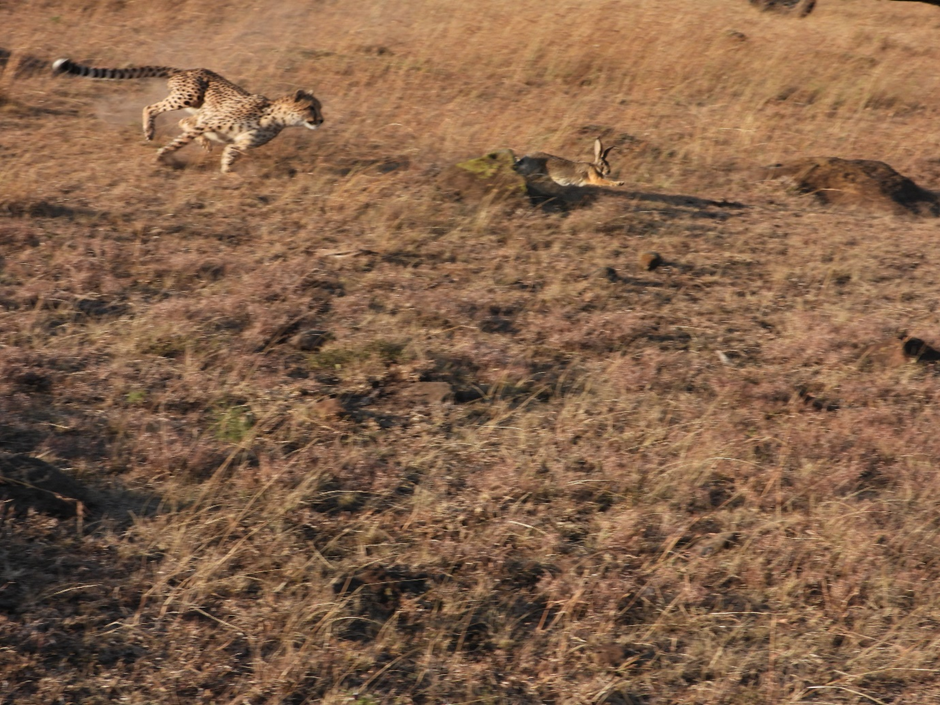
As an aside but still on the subject of big cats, when I was lucky enough to be in Kenya, we saw a cheetah chase and kill a hare. I was asked if I had caught it on camera. No. But actually I had without even knowing it and I found these pictures only when I got home.


As an aside to an aside, I also took this. Chris Packham, who was on the trip, had been talking about infrared photography and I fiddled around with my camera settings to achieve this, below, three cheetah brothers, but I am not sure how I did it. Somehow, I think, it works.
Looking back through those photos from Kenya, I was reminded of how there always seemed to be at least one jackal around. No other animal seems to bother them and I don’t know how they get away with it, especially after I had witnessed a very prolonged and extremely vocal stand-off between a cheetah and jackal.

The second part of Queens is all about bonobos, those close cousins of chimpanzees (and of ours). Known as the hippy ape, vegetarians thought to live in peace and harmony and to be the only ape which never kills (this is still asserted in a Youtube video by National Geographic), and renowned for their bisexual promiscuity, yet another myth was busted. When a group of colobus monkeys arrive, some of the bonobos chase away and distract the adults whilst others kill and eat their young.
Part three concerns the societies of orchid honey bees and leafcutter ants. I cannot bring myself to repeat some of what goes on in their worlds. I found it quite traumatising. Then it’s elephants, my favourite animal. There’s a profound moment when the herd comes to the remains, the bones, of a long dead relative. They caress them with their trunks and spend quite some time with them. What are they doing, if not paying their respects?
Then it’s the turn of Ethiopian wolves and golden-haired gelada monkeys, followed by bears and orcas and finally a celebration of the women behind the making of the series. This last perhaps the most emotionally stirring of all – the story of strong, empowered, passionate and driven camerawomen, female conservationists and rangers breaking down barriers and making a difference. The cinematography throughout, especially perhaps for the bees and ants, is utterly astonishing.
Leave a Reply