Books Old & New
January / February 2024
Two welcome additions to a four feet high pile of books waiting to be read arrive in the post. One is Hamza Yassin’s How to Be a Birder, the joy of birdwatching and how to get started, Gaia, 2023, decorated with the author’s own charming illustrations. The author is a Scottish wildlife cameraman (and winner of Strictly Come Dancing) with long dreadlocks and his story is a remarkable one. His dedication manifested in spending six months sleeping in his car in the ferry car park on the Ardnamurchan peninsula (because that’s where the birds he wanted to see were) before settling there more comfortably. He parked up each night so as to block the “No Overnight Camping or Parking” sign. I had already been won over by his documentary Hamza Yassin’s Birds of Prey shown on the BBC in September 2023. He has a wonderful way of sharing his gentle enthusiasm and joy.

In his introduction he acknowledges how fortunate he has in many ways been but also modestly alludes to how much he gives back. Discussing his bird ringing experiences he reminds me just how privileged I am to be volunteering at a wildlife rescue – to see birds close up, to really notice the beautiful arrangements of feathers and, holding a bird in one’s hand, to marvel, given how little many of them weigh, at the journeys of thousands of miles which they are able to undertake.
Hamza Yassin Photography (@hamzayassin90) • Instagram photos and videos
The other is Wild Places UK; the UK’s top 40 nature sites, Seren, 2022, by Iolo Williams, one of my favourite wildlife presenters. There’s a useful map and index, the text is very well written and the book is bursting with gorgeous colour photographs. The sites and reserves are mostly but not entirely coastal. I hope to visit a good number of them throughout the year ahead.

Like the best schoolteachers, the ones who truly inspire their pupils, the best well-known media naturalists are those who have not lost their genuine sense of wonder and who can share and impart their knowledge and their passion. Iolo Williams is one of those and Liz Bonnin also springs to mind.
My book Animal Wild, Bramble Press, 2023, comes with a pretty extensive bibliography. As with this page of the blog, my intention is not to boast about how well-read I am, rather I am eager to share what has delighted me. Not all of the books have, of course. Some I have found a little dull. In some the science is beyond me. I am not going to single any out in terms of negative criticism, but one or two were shamefully repetitive, another by a very celebrated naturalist who usually writes like a dream was very sorely in need of editing, of the second half at least which seems to have been written in great haste. One, about elephants, simply breezes past the inconvenient truth about the way in which captive, working elephants are treated. Some nature writing can tend to the florid or merely whimsical, but splashes of good humour, especially when self-deprecating, rarely fail to help the narrative along. In one instance I was astonished to discover that I could speed-read. I haven’t tried it again since but that book was not telling me very much I didn’t already know, so I zipped through it, plucking information here and there for the purposes of Animal Wild.
It is perhaps a strange admission from someone who has spent most of his life trying to earn a living from collectable first editions of mostly English and American twentieth-century literature, but I completely lost interest in fiction years ago. It was almost literally an overnight thing. I woke up one morning and I just knew I would never read a novel again. This is it seems not uncommon and I have heard of others and indeed other booksellers having much the same experience in later life. I continue to enjoy biographies and autobiographies and occasionally returning to a much-loved poem, but books about nature and the science of nature now have by far the lion’s share of my attention. I don’t really get audiobooks. I don’t look down on them but they just don’t work for me. Perhaps I am just too easily distracted. But a well-known author with whose papers we have recently been dealing told me that once she had discovered that medium, she was not going to go back, saying even that the physicality of the book, ink on paper, actually now felt like a barrier between her and the author. She also happened to ask whether I thought wolves should be re-introduced to the UK. Absolutely yes. It has happened and is happening with birds of prey and beavers (in spite of fierce objections from the farming and shooting lobbies) and I think that lynx will be next, which will provide a partial solution to the problem of deer populations which even I have to agree are, without any natural predators, becoming unsustainably large. The writer asked me what I would think if someone was killed by a wolf. This would be extremely unlikely to happen (I write about it at some length in Animal Wild) but a friend’s iconoclastic sense of humour prompted his response: “A human? We’ve got 8 billion of them”.
Wild Boar are very much here already and yet another book arrives, Groundbreakers, the return of Britain’s wild boar, by Chantal Lyons, Bloomsbury Wildlife, 2024. I am fascinated by and spend a lot of time thinking about the vexed matters of the reintroduction of native species as well as the issues raised by those classed as non-native and invasive and so I am much looking forward to reading the book. I am not in any way suggesting it is overpriced, but I venture to say that it is a relatively small book without illustrations – at £20 it does make Animal Wild seem pretty good value.

It is funny how things and tastes change with the years. Ornithology was a hobby when I was a boy, but it was forgotten as other interests and life in general took over. Now it is back with a vengeance.
One of the best and most moving books I read last year was Sinéad O’Connor’s autobiographical Rememberings, Penguin Books Limited, 2021, which is written in a style entirely of its own.

I also watched the superb and powerful documentary Nothing Compares (2022), for which with extreme churlishness Prince’s estate would not allow Nothing Compares 2 U to be played. Prince, who wrote the song, does not come out of the book well. I was very much saddened by her death and wanted to include some sort of appreciation in Animal Wild but, in spite of the book’s championing of protest, I couldn’t find a way to work it in. I had been a fan for years, not just for her at times angelic at others banshee-like voice, but for her fierce courage and insistence on protesting and speaking up for the oppressed. Media articles shortly after her death seemed oddly to have been cut and pasted from each other, many of them referring to her as a prophet. I doubt very much that she would have described herself in that way. The journalists seemed to suggest that she had somehow ‘foretold’ the exposure of the abuse of children and the covering up of it by the Catholic Church, but she was exposing it at the time, no matter the consequences for her career. As is so often the way with those who protest by holding a mirror up to society, her vilification was cruel and vicious. Most bizarre perhaps was the comment by the feminist Camille Paglia, saying that Sinead deserved the dreadful abuse she had suffered in her childhood. I truly hope that wherever she may now be that that troubled, battered, beautiful soul has found peace.

From Animal Wild:


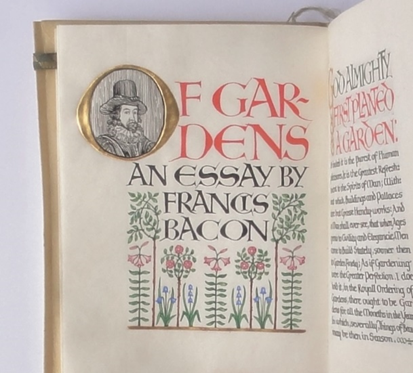
Calligraphic Manuscript. Smith (Percy J.). Bacon (Francis). Of Gardens; an essay. 19 pages calligraphic manuscript in red and black on vellum and one plate, vellum end-papers and blanks, title and first page initials in gold, the former around a pen-and-ink portrait of Bacon, the beginning of each paragraph in red with initials in green, title-page with flowers and trees in green, pink, brown and blue, tailpieces in red and green, colophon with small bluebell device in green and blue. “Written out and decorated by Percy J. Smith”, 1904. Original full vellum, green and gold silk ties threaded through the boards, calligraphic title on upper board. In fine condition.
Percy J. Smith was also a typographer and artist of the First World War. His calligraphic manuscripts are highly uncommon.
This beautiful manuscript was included in our bookselling firm’s centenary catalogue. It sold for a four-figure sum. I was very sorry to see it go. There was also a copy of the Fleece Press edition, 1993, with a perspex engraved frontispiece and plates by Betty Pennell.
Francis Bacon, 1st Viscount St Alban, Lord Verulam (1561-1626), the hugely influential English philosopher and statesman has been called the father of empiricism. A proponent of natural philosophy and the scientific method, he advocated the development of scientific knowledge through inductive reasoning and careful observation of nature, using a sceptical and methodical approach. As a devout Anglican, he also saw it as way of fulfilling the scriptures and glorifying God.
Of Gardens was first published in 1625 by John Haviland for Hanna Barret and Richard Whitaker in the first complete and definitive edition of Bacon’s 58 essays, the last to be published in his lifetime. It has long been a favourite of private presses, most notably the Eragny Press, and calligraphers.
The first few lines are especially well-known and often quoted. It seems worth reproducing too the description which follows of the author’s idealised garden.
“GOD ALMIGHTY first planted a garden. And indeed it is the purest of human pleasures. It is the greatest refreshment to the spirits of man; without which buildings and palaces are but gross handiworks; and a man shall ever see that when ages grow to civility and elegancy, men come to build stately sooner than to garden finely; as if gardening were the greater perfection. I do hold it, in the royal ordering of gardens, there ought to be gardens for all the months in the year; in which severally things of beauty may be then in season. For December, and January, and the latter part of November, you must take such things as are green all winter: holly; ivy; bays; juniper; cypress-trees; yew; pine-apple-trees; 1 fir-trees; rosemary; lavender; periwinkle, the white, the purple, and the blue; germander; flags; orange-trees; lemon-trees; and myrtles, if they be stoved; 2 and sweet marjoram, warm set. There followeth, for the latter part of January and February, the mezereon-tree, which then blossoms; crocus vernus, 3 both the yellow and the grey; primroses; anemones; the early tulippa; hyacinthus orientalis; chamairis; fritellaria. 4 For March, there come violets, specially the single blue, which are the earliest; the yellow daffodil; the daisy; the almond-tree in blossom; the peach-tree in blossom; the cornelian-tree in blossom; sweet-briar. In April follow the double white violet; the wall-flower; the stock-gilliflower; the cowslip; flower-delices, and lilies of all natures; rosemary-flowers; the tulippa; the double peony; the pale daffodil; the French honeysuckle; the cherry-tree in blossom; the damson and plum-trees in blossom; the white thorn in leaf; the lilac-tree. In May and June come pinks of all sorts, specially the blush-pink; roses of all kinds, except the musk, which comes later; honeysuckles; strawberries; bugloss; columbine; the French marigold, flos Africanus; cherry-tree in fruit; ribes; 5 figs in fruit; rasps; vine-flowers; lavender in flowers; the sweet satyrian, with the white flower; herba muscaria; 6 lilium convallium; 7 the apple-tree in blossom. In July come gilliflowers of all varieties; musk-roses; the lime-tree in blossom; early pears and plums in fruit; jennetings, 8 codlins. 8 In August come plums of all sorts in fruit; pears; apricocks; berberries; filberds; musk-melons; monks-hoods, of all colors. In September come grapes; apples; poppies of all colors; peaches; melocotones; 9 nectarines; cornelians; wardens; 10 quinces. In October and the beginning of November come services; medlars; bullaces; 11 roses cut or removed to come late; holly-hocks; and such like. These particulars are for the climate of London; but my meaning is perceived, that you may have ver perpetuum [perpetual spring], as the place affords.”
Leave a Reply