Edward Abbey’s Desert Solitaire, a Season in the Wilderness, William Collins, 2020 (first published 1968).
The renowned and hugely successful (and very entertaining) bookseller Lou Weinstein, then of Heritage Books, had kindly invited us to stay for a night at his log cabin near Flagstaff, Arizona. It was a three hundred mile drive but to people from this part of the world it was ‘just down the road’. I think this was when we very nearly ran out of petrol to the extent that we were turning off absolutely everything in the car until we finally came to a filling station in the middle of nowhere, running on fumes. I remember stopping to buy an American Indian bangle from a roadside stall, sadly since lost or broken. I looked into the eyes of the proud American Indian man who sold it and saw, or believed I did, generations of sadness and injustice.
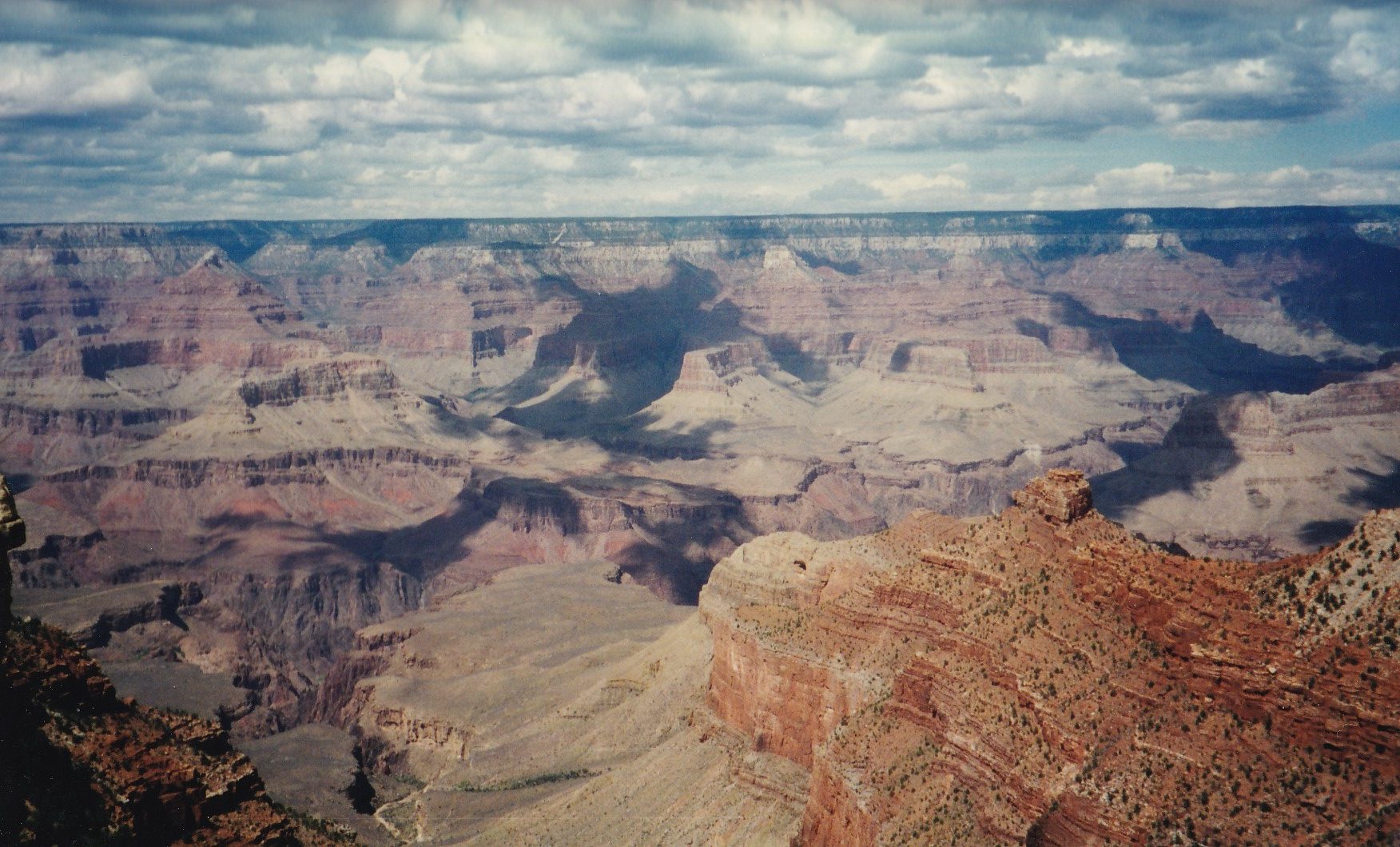
Our next stop was Grand Canyon. It is every bit as awe-inspiring as you would expect.

Cedar Mountain


Finally we went to Abbey’s hated Lake Mead, where we again hired a speedboat to zoom around in, and the undeniably impressive Hoover Dam. Photos below.


Lake Powell (from the previous in this series of posts), it is worth mentioning, was named after Major John Wesley Powell, “the first American to make a systematic exploration of the Colorado River and its environs.” Abbey furiously continues: “Where he and his brave men once lined the rapids and glided through silent canyons two thousand feet deep, the motorboats now smoke and whine, scumming the water with cigarette butts, beer cans and oil, dragging the water skiers on their endless rounds, clockwise.” The naming of the lake does not honour but dishonours the man, he says. Abbey compares the crime of the flooding of Glen Canyon to burying the Taj Mahal or Chartres Cathedral in mud.
After a period at Havasu where he lives a solitary existence, not far from but not among the Havasupai people, Abbey goes in search of a lost tourist who turns out to have perished.
As a lover of bird names it’s good to read “most birds have fantastic names” and Abbey also loves what he describes as the serenade of a den of coyotes. He is in classic form again here: “… we need coyotes, need them badly, in Arches National Monument. As does the nation as a whole, for that matter. We need coyotes more than we need, let us say, more people, of whom we have already an extravagant surplus, or more domesticated dogs, which in all fairness could and should be ground up …” and fed to them.
During the manhunt he looks to the vultures for clues and contemplates, paraphrasing Nietzsche’s “And if thou gaze long into an abyss, the abyss will also gaze into thee” and considers our mortality as perhaps a departure to make way for the new. When they find the body, Ravens are already scavenging it.
In the chapter on the mountain Tukunikivats, he enjoys driving fast, making me feel less guilty about the speeds I was driving at at times during our trip and he also enjoys the challenges of the more difficult roads about which tourists complain so much (we did get stuck in a sandy verge at one point but a kindly American stopped and hauled us out). When he arrives at Moab he describes a welcoming billboard: “Moab, Uranium Capital of the World”, cut down one night by Abbey with a bucksaw.
Subalpine Larkspur, Delphinium barbeyi, a tall plant which has beautiful deep purple blooms, is, we learn, highly toxic and a major cause of livestock poisoning in the rangelands.
The American Pika, a lagomorph, is new to me too, also known as Whistling Hares from their alarm calls.
There’s a list of wonderful place names which I would love to quote in full, but here are a few of them: Dead Horse Point, Desolation Canyon, Queen Anne’s Bottom, Last Chance Creek, Cigarette Spring, Devil’s Pocket, Hell’s Backbone …
He urges tourists to at least wind down their car windows, to get dusty. I remember arriving in Ghana and our taxi driver asking if we wanted air con or African air and we opted of course for the latter. Perhaps this is weird although surely not unhygienic – I don’t have the urge to shower off sand and dust as quickly as possible, I enjoy the sensation on my skin and in my hair, likewise salt when I have been swimming in the sea.
There’s a section about the Mormons (followers of that deeply strange religion). Abbey has a lot of time for them and points out, as I do with, for example, Rastafarianism, that other religions, including or perhaps especially the major ones, are no more or less illogical and ridiculous. He admires their pioneering heroism and community based society whilst not neglecting to mention that Brigham Young had seventeen wives, which he amusingly suggests may be another example of Mormon fortitude.
As the book draws to a close, Abbey stresses that he is not opposed to mankind but to anthropocentricity – amen to that. He and a friend make a perilous venture into The Maze and he astutely observes that “as with anything enormously attractive, we are obsessed only with getting in; we can worry later about getting out”, which could be applied more widely to the human condition. He even quotes from a surprisingly, to me at least, bawdy Robert Burns fragment which you can read here: BBC – Robert Burns – A Fragment
The final chapter recounts his need for company and his journey to New York where he will live and work for the winter. After the excitement of my own first visits to New York, I began to find it extremely claustrophobic and I am surprised Abbey can stand it. But, as he says, the desert will still be there the following spring.
Leave a Reply