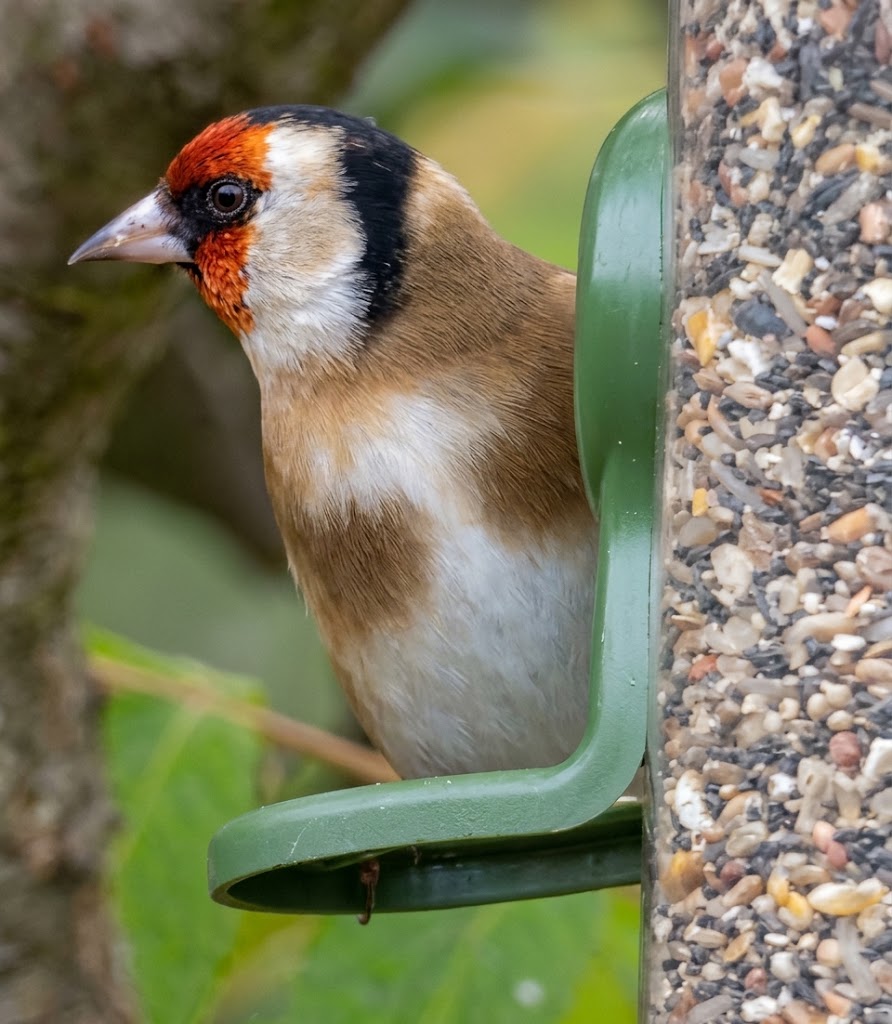
Goldfinch
I have agonised about including the Goldfinch above. It’s only the second time I have used AI to improve a wildlife photograph. I feel compelled to be honest about it. In my defence it was early morning and my camera lens was covered in condensation and I just wanted to celebrate the only Goldfinch I have seen in the garden this year. Meanwhile a female Sparrowhawk has just made an unsuccessful pass across my field of vision.

I bought this gorgeous book yesterday, a major enhancement to Sally Coulthard’s excellent Bird Lore, to which I often refer. Rees (Colin). The Secret Language of Birds, Art, Nature & Symbolism, Thames & Hudson, 2026. The quality is as to be expected from Thames & Hudson, with illustrated end-papers and lovely illustrations throughout.
The Goldfinch seems a good place to start.

European Goldfinch detail from The Sherborne Missal (c. 1400–1407), British Library (Add MS 74236), Public Domain.
This is the earliest Goldfinch (misidentified as a Greenfinch in the Missal, “Grene finch”) image reproduced in the book. There are also Goldfinches by Raphael, Madonna of the Goldfinch, and works by Martinet, Bosch and Carel Fabritius. No wonder, as the author says is in his introduction, the book has been a lifetime in the making.
The bird is associated with the crucifixion, blood from a thorn from Christ’s head resulting in the red parts of the plumage. The Goldfinch has also been seen as a bringer of hope, healing, prosperity and fertility. Sadly the birds have commonly been kept in cages. Rees is incredibly thorough and comprehensive and he mentions Hardy’s poem, ‘The Caged Goldfinch’:
Within a churchyard, on a recent grave,
I saw a little cage
That jailed a goldfinch. All was silence save
Its hops from stage to stage.
There was inquiry in its wistful eye,
And once it tried to sing;
Of him or her who placed it there, and why,
No one knew anything.
With some regret I have decided not to renew my subscription to Birdwatch magazine from February next year. At over £80 (£7 an issue) it’s pretty expensive. As much as I like seeing the photographs and enjoying the bird names, increasingly there is just not enough to hold my interest. There’s a new editor but I have no problem with that. There’s just two much twitching (past and present), too many ‘megas’ (mega rarities). I will miss the weekly e-mails too however. I always enjoy Mark Avery and, most of the time, Lucy Roberts, but it’s too much to pay just for those two contributors. Images of hundreds or even thousands of twitchers crammed together to see just one bird I find a little weird, even disturbing.
Chamois

Source: Wikimedia Commons
My younger daughter is on holiday in Slovenia and having climbed Mala Osojnica for a panoramic view of Lake Bled and the Alps was in touch to say that she had seen a “goat/deer” thing. I found this hilarious but I soon had to eat humble pie. The Chamois (Rupicapra rupicapra) is indeed a goat-antelope. She was completely correct. They occupy a middle ground between sheep, goats and antelopes. Their special hooves make them phenomenal mountain climbers, enabling them to escape predators (wolves, lynx) by ascending near vertical slopes. They are also very fast, attaining speed bursts of up to 50 mph, can jump seven feet high and leap up to twenty feet horizontally.
Rescued Badger
Scientist fights to keep badger he rescued and drinks tea with in the garden | Watch
Rescued badger Harriet: Scientist fights to keep beloved animal
The rescuer, Graeme Wilson, is an ecologist and in spite of his best efforts the badger has simply refused to return to the wild. He found her as a cub, trapped and starving in a cattle trough. She is not captive although Wilson had hoped she might be useful and for educational and conservation purposes. He says, “”I did not want to have a badger or responsibility for a badger, but unfortunately this is what has happened. My only concern is for Harriet’s welfare.” NatureScot however, in its wisdom, has refused permission for him to keep her. They surely have better things to do, such as refusing even to contemplate renewing the Guga hunt licence next year. I can think of former colleagues who would perhaps disagree with me about this and I don’t feel dogmatic about it either way, but Harriet is surely better off and happier with Wilson than behind bars in a zoo. I imagine he would feel that he was letting her down terribly if he didn’t fight to stop that happening.
Sachets of sauce
Burnham poised to ban ketchup sachets from restaurants and cafes
This is pathetic. Well, it’s not a bad idea. Plastic sachets are banned in the EU and it would be good if we were to follow suit – we get through 855 billion sachets a year globally. But a pattern seems to be emerging with Burnham. He concentrates on the relatively minor, such as unfair parking charges, which is all well and good, but sidesteps the bigger issues. Garden centres would be good places to target, I would suggest, to cut plastic waste. When I throw away or even recycle (when possible) plastic pots and compost bags it almost makes me weep. There are sustainable alternatives. 1.5 billion items of horticultural plastic are used every year in the UK including roughly 500 million pots, and by far the majority of councils will not recycle them.
Instead, why not use biodegradable pots (made from coir for example, which was used for the plants for sale at Charles Darwin’s house) which can be planted directly into the soil and paper bags treated with natural resin could be used for compost and the like. Or gardeners could bring their own reusable sacks.
Leave a Reply