Edward Abbey’s Desert Solitaire, a Season in the Wilderness, William Collins, 2020 (first published 1968).
I continue to be utterly enthralled by this book.
Abbey points out that just as with porcupines, deer are over proliferating thanks to human meddling in the form of the removal of apex predators, which is exactly the problem we have in the UK today. We are not learning. Coyotes, he concedes, do eat some lambs. “This is true but do they eat enough? I mean enough lambs to keep the coyotes sleek, healthy and well fed … As for the sacrifice of an occasional lamb, that seems to me a small price to pay for the health of the coyote population.” The ‘sheepmen’, he adds, are in any case heavily subsidised. Classic Abbey.
I love the idea of Magpies being in “handsome academic dress”.
More coyotes, mountain lions, wolves, foxes, wildcats, owls, hawks and eagles are what’s needed and yet the Predator Control Agency has “pursued all of these animals with unremitting ferocity and astonishing cruelty for nearly a century”, using guns, traps, planes and chemical warfare. And tons of indiscriminate poisoned bait and hidden cyanide guns.
Oddly, Abbey recounts his killing of a rabbit by throwing a stone for no reason, leaving him feeling not guilty but strangely elated.
He is living a largely isolated life but the benefits outweigh that: “stillness, solitude and space”, clean air, the views, time to think and feel.
In the chapter ‘Polemic: Industrial Tourism and the National Parks’ he makes a strong case against ‘industrial tourism’ and puts forward various practical alternatives. It is after all, he points out, all about cars and dollars. Banning cars from these places might penalise children, the old and infirm, but with typical acerbic wit he argues that the former need only wait a few years if they cannot yet ride bicycles and the latter have had their chance.
When surveyors come out to his patch he lets them go in peace but he goes out at night and walks five miles pulling up every single one of their survey stakes and cutting their ribbons from the bushes.
In this chapter he mentions Yosemite and Zion National Park which inspired me to revisit and relive a trip I made with my future wife back in the mid 1990s following book fairs in Los Angeles and San Francisco. These are not close to Abbey’s Arches but the latter is at least also in Utah, albeit about as far from it longitudinally as possible within the state – a roughly 350 mile, eight hour drive. I suppose this constituted the kind of industrial tourism Abbey hated since we relied on the roads and this car.
Hiring cars was phenomenally easy then although it became more bureaucratic over time and this was a tenth generation Ford Thunderbird LX, very fast and, we thought, very cool.


These pictures are pre-digital and scanned from 6 by 4″ photos but I hope not terrible.
We did little planning and booked no accommodation in advance. It felt quite a daring adventure. Not only was car hire cheap, so was petrol to the extent there was no need to budget for it. And I channelled my inner Jack Kerouac.
The distances involved were so great and the landscape so vast that I felt my perception of both time and distance quite changed.
Yosemite


El Capitan


Our cabin


This is the only photo which really needed some AI tlc.

He or she is a Stellar’s Jay.
The Devil’s Postpile and surroundings in the California Sierra Nevada

The geometric, hexagonal shapes were formed 80,000 to 100,000 years ago from lava through ‘columnar jointing’.

Chipmunk


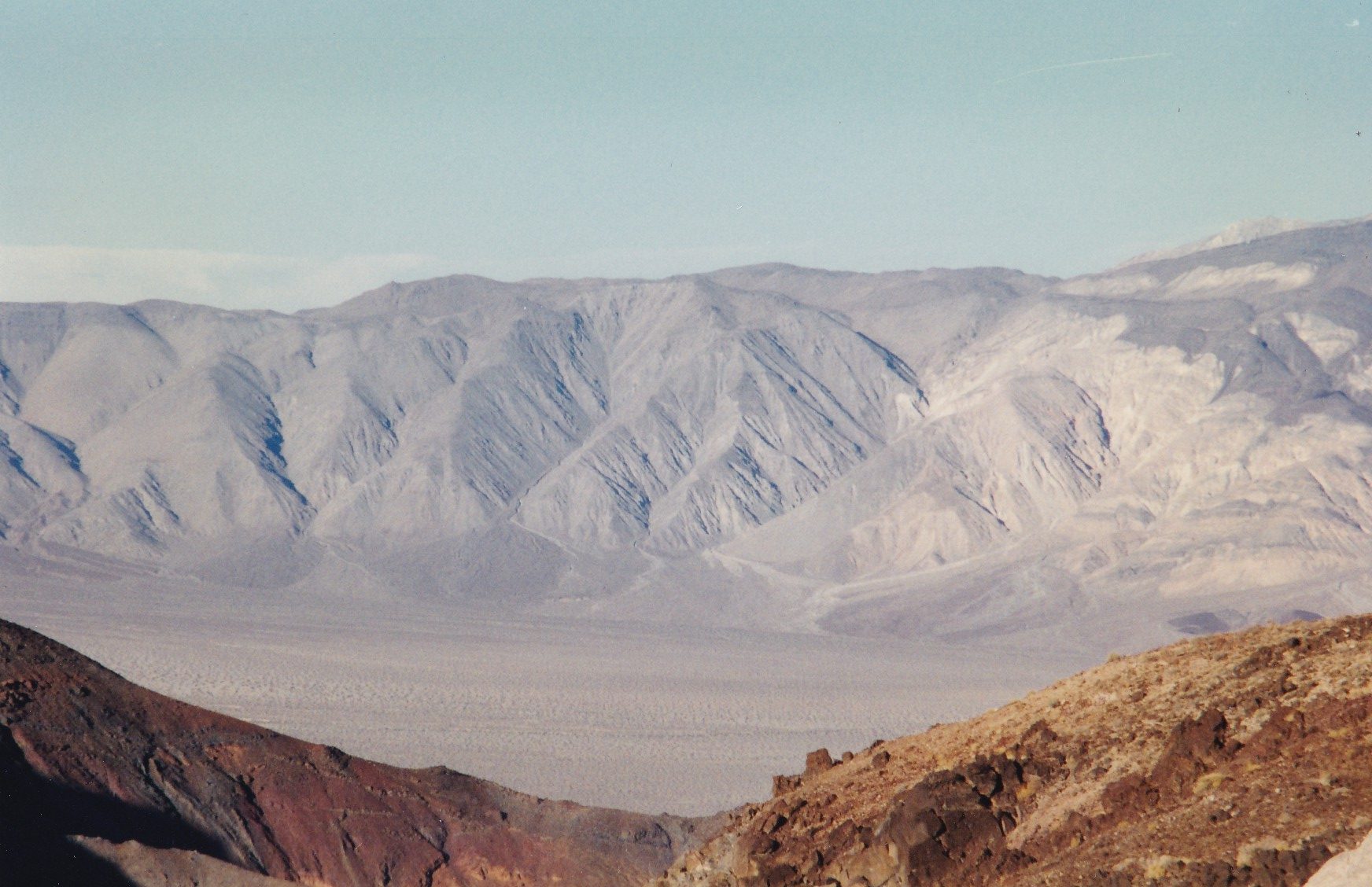
The Owens Valley region with Pinyon Pines (Abbey mentions these a lot). The seeds have been harvested for food perhaps since the arrival of homo sapiens.


Death Valley
We were rather foolhardy in not taking the dire warnings about carrying plenty of water too seriously – people do die out here – but we made it through. Abbey recommends not less than a gallon a day per person. If you cannot go on and have no water, he advises crawling into the shade until someone finds you. “If no one is looking for you write your will in the sand and let the wind carry your last word and signature east to the borders of Colorado and south to the pillars of Monument Valley …” When he ignored his own advice and was in danger of dying from heatstroke he stumbled upon a stream and threw himself into it. “I had no fear of drowning in the water – I intended to drink it all.”


This monument is only four feet tall. It marks the grave of two of the valley’s most famous pioneers, Shorty Harris and Jimmy Dayton. Dayton and his mule team died from extreme heat. Harris was a successful prospector. When Dayton died Harris asked: “Bury me beside Jim Dayton in the valley we loved. Above me write: ‘Here lies Shorty Harris, a single blanket jackass prospector.’”
Abbey describes poisonous wells including the Badwater Basin in Death Valley. It’s the lowest point in North America. It does contain some life but the water, when there is any, is too salty to be potable. Badwater Crater on Mars is named after it.
Sunrise at Zabriskie Point
Zabriskie Point is in part renowned for the counterculture film made by Michelangelo Antonioni in 1970. The soundtrack included music by Pink Floyd, the Stones and The Grateful Dead. The location also features on the cover of U2’s The Joshua Tree. Christian Brevoort Zabriskie was vice-president and general manager of the Pacific Coast Borax Company in the early 20th century. The landscape was formed from sediments from Furnace Creek Lake five million years ago, before Death Valley existed. These are the badlands.


Leave a Reply