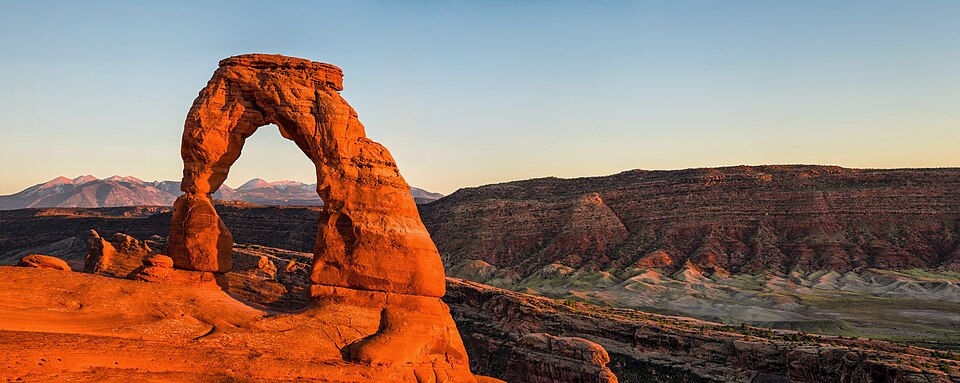
Photo: “Delicate Arch, Arches National Park” by Robbie Shade
is licensed under CC BY 2.0.
It’s a wonderful photograph.
Edward Abbey’s Desert Solitaire, a Season in the Wilderness, was first published in 1968. For more on Abbey, see Alice’s Meadow, Thunderstone, Edward Abbey, Jim Dodge – Animal Wild. The Arches National Monument where Abbey lived and worked was redesignated as a National Park in 1971. There are over 2,000 natural stone arches. Learn About the Park – Arches National Park (U.S. National Park Service). Given my enthusiasm for Abbey’s work dating back many years, it is surprising that I haven’t read this, considered to be his masterpiece, before. The edition I am reading was published by William Collins in 2020 and has a black-and-white image of one of the arches as a frontispiece.
The cover is by Jo Walker:

I am not crazy about it to be honest, although it is not out of keeping with the dust-wrapper to the first edition.
The short reviews preceding the text are on the money. From the New Yorker, “An American masterpiece … part memoir, part meditation on nature, part crusty and slightly mad cultural commentary.” Abbey is described in the Washington Post as “the Thoreau of the American West” and Douglas Brinkley in the New York Times begs Trump to read it, in vain I am sure; I doubt Trump has ever read an entire book, probably not even his own.
The introduction is by best-selling author Robert MacFarlane (Landmarks, The Wild Place and Is a River Alive? and others). I suspect I may be reading him next. It is masterful. This is a “magnificent, maddening, abrasive, lyrical, lackadaisical kick-ass manifesto and dream-vision of a book …” In December 2017 Trump announced his plans “to dramatically shrink the extent of two ‘National Monuments’ in the State of Utah: Grand Staircase Escalante, which he reduced by almost half … and Bears Ears, cut by 84 per cent.” This was primarily for the mining of uranium and the president’s beloved “beautiful” coal.
MacFarlane wonders how Abbey would have reacted and suggests he would have quoted Hayduke, hero of The Monkey Wrench Gang, “My job is to save the fucking wilderness … I don’t know anything else worth saving.”
He points out that Abbey is not without contradictions, which he certainly isn’t, but then who is?
The word “askesis” through me off but it’s the American spelling of the root of “asceticism” and Kantian “noumena” were new to me – a much debated term which seems to mean the things in themselves, independent of external sensory perception.
The concept of species-shame resonated deeply with me – if you’re not feeling it as a member of the human race, you’re not paying attention.
MacFarlane rightly calls out some political incorrectness by today’s or indeed any standards and quotes Abbey’s description of the Navajo as “the Negroes of the Southwest … red black men … like their cousins in the big cities … [they] turn for solace, quite naturally to alcohol and drugs”, although I feel MacFarlane may be rather missing the broader point.
Abbey’s respect for the landscape and its wildlife (not ants though) are there on every page and his calls for the reintroduction of apex predators were ahead of their time. He describes sheep as “hooved locusts” and much as I love sheep, he has a point, preceding George Monbiot’s talk of “sheep-wrecked” landscapes.
The author’s own introduction follows. He does not try to hide his often humorous irascibility. “Serious critics, serious librarians, serious associate professors of English will if they read this work dislike it intensely; at least I hope so.” And then his always evocative descriptive prose takes off, reminding me of why I loved his writing so much all those years ago. I find myself devouring every word. He is happy enough with surfaces, not underlying realities: “Such things for example as the grasp of a child’s hand in your own, the flavour of an apple, the embrace of friend or lover, the silk of a girl’s thigh, the sunlight on rock and leaves, the bark of a tree, the abrasion of granite and sand, the plunge of clear water into a pool, the face of the wind – what else is there? What else do we need?”
Desert Solitaire is, he says, “not a travel guide but an elegy. A memorial.”
Arriving at his trailer as custodian of the Arches, he conjures up his surroundings, the weather, the stillness, temperatures, lightness and dark, with utter beauty. He rejects the personification of the natural world, wanting “to be able to look at and into a juniper tree, a piece of quartz, a vulture, a spider, and see it as it is in itself, devoid of humanly ascribed qualities, anti-Kantian, even the categories of scientific categories.” This seems a noble thought, a way of seeing to which we all might aspire.
He describes rock formations as “corraded”, another new word, but pretty much a synonym of “corroded” but specifically eroded by abrasion by natural forces. He expounds on his respect for wildlife, pointing out the absurdity of suggesting that other animals do not have emotions, “What do the coyotes mean when they howl at the moon? What are the dolphins trying so patiently to tell us?” There’s a description of the mating of two snakes highlighted in MacFarlane’s introduction where the words themselves seem to flow like the movements of the snakes. He is happy to share the trailer with a family of mice, won’t kill a rattlesnake (although he thinks about it) but instead encourages gopher snakes to share his space to deter their more dangerous conspecifics.
Poetry is “nothing if not exact.” My favourite definition of poetry came from an English teacher from my schooldays: it’s the right words in the right place. I will never forget the frankly dumb, blank, uncomprehending stares and derision this was met with when I shared it with friends who were management science students at the time. They also wondered why on earth I studied books, literature. “So you read them then write about them because … you enjoy it?” Well that’s about right and here I am still doing it four decades later.
Botanical life does not escape Abbey’s notice (nothing does I feel): “Stepping carefully around the straggling prickly pear I come after a few paces over bare sandstone to a plant whose defensive weaponry makes the cactus seem relatively benign. This one is formed of a cluster of bayonetlike leaves pointing up and outward, each stiff green blade tipped with a point as intense and penetrating as a needle. Out of the core of this untouchable dagger’s-nest rises a slender stalk, waist-high, gracefully curved, which supports a heavy cluster of bell-shaped, cream-colored, wax-coated, exquisitely perfumed flowers. This plant, not a cactus but a member of the lily family, is a type of yucca called Spanish bayonet.” I would love to quote more but the book is still in copyright (I am careful about fair use but fear I may be pushing the limits here – but I cannot resist quoting and sharing the prose. Copyright matters of course and as a seller of books, letters and manuscripts I am always acutely aware of it, but if you are not passing off someone else’s words or images as your own and you perhaps might inspire others to turn to a particular author or artist …) He goes on to explain that the plant is pollinated exclusively by a particular moth in a symbiotic relationship.

Photo is public domain via Wikemedia Commons.
Pinyon pine populations are victims of porcupines, a situation brought about by the Wildlife Service “which keeps its people busy in trapping, shooting and poisoning wildlife, particularly coyotes and mountain lions” who would have preyed on them.
The chapter ‘Rocks’ opens with this, as also highlighted by MacFarlane: “The very names are lovely – chalcedony, carnelian, jasper, Chrysoprase and agate. Onyx and sardonyx. Cryptocrystalline quartz. Quartzite. Flint, chert and sard. Chrysoberyl, spodumene, garnet, zircon and malachite. Obsidian, turquoise, calcite, feldspar, hornblende, pyrope, tourmaline, porphyry, arkose, rutile. The rare metals – lithium, cobalt, beryllium, mercury, arsenic, molybdenum, titanium and barium. And the basic rocks – basalt, granite, gneiss, limestone, sandstone, marble, slate, gabbro, shale. Most of them can be found in this area. If you look hard enough and long enough. By this area I mean southeastern Utah: the canyonlands; Abbey’s country.”
Leave a Reply