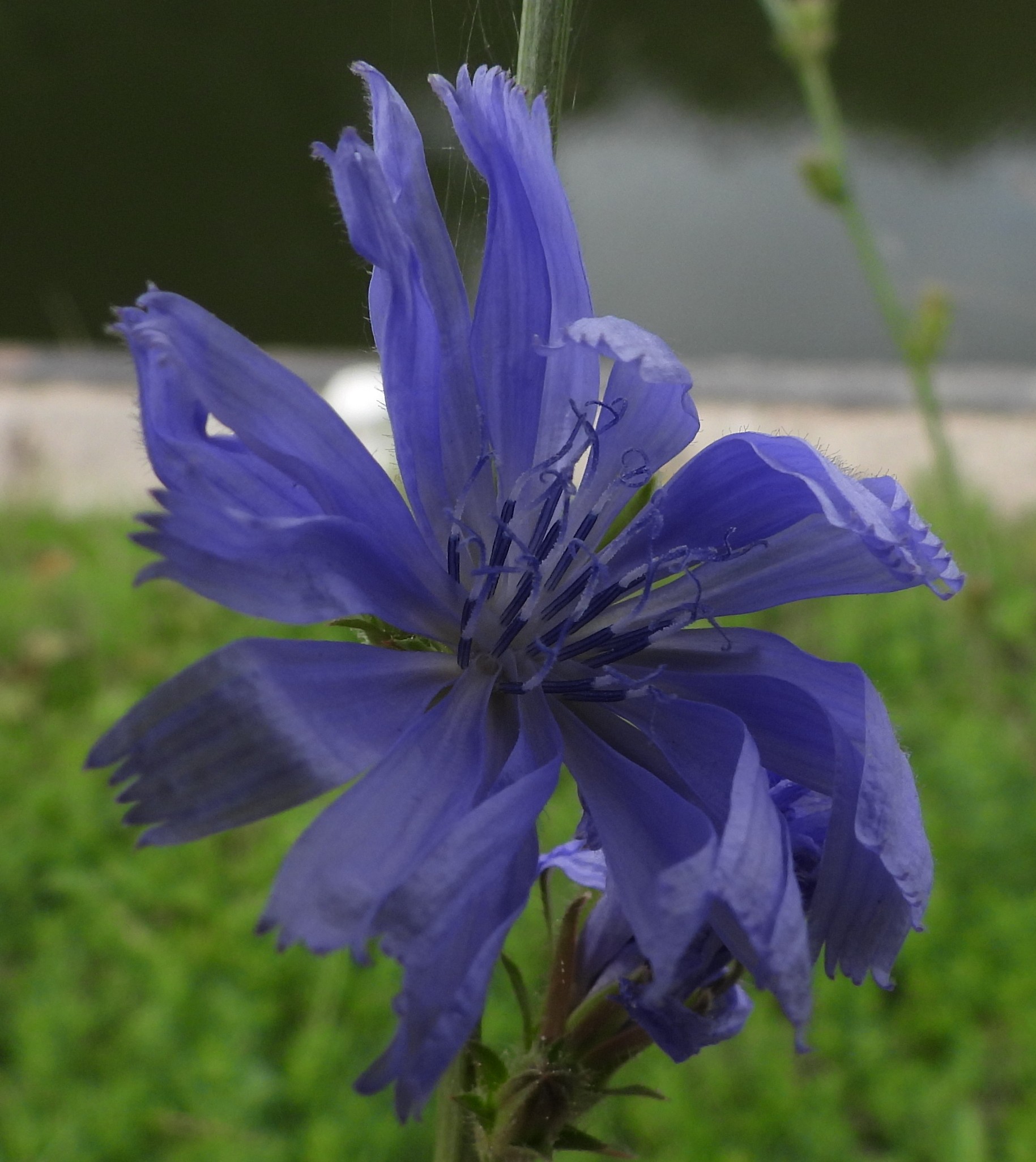
I haven’t quite emulated the gorgeous Wild Chicory photos which inspired me, (Blue dancers | absolutelynotnormal), but I am pleased with these nonetheless. A bit more sunlight would have made the blues of the petals and stamens contrast more strongly.


I took these yesterday during my walk with Chilli the Norfolk Terrier for the Cinnamon Trust. She wasn’t even too impatient while I did it. She was a bit though. She is very stubborn, funny and adorable. As I was leaving I said to the lady with whom she lives that I had been thinking about what would have had happened if Chilli and I had not got along – it would have been unworkable. She pointed her finger at me and said, “She loves you.” Which made my day, week and month.
As I have said, she doesn’t even bark now when I approach the house. That’s whether she actually sees me coming from the front window or not. Unsurprisingly to me, there is a sixth sense involved.
Very happy with this seed head too.

PETA News
A rather dull issue of Birdwatch magazine, for me at least, this month but one of PETA’s best newsletters. I compiled a list of celebrities of various sorts who had gone the extra mile for animals in Animal Wild, to which should be added Dolly Parton, who donated her song ‘Will He Be Waiting For Me” to PETA for a video, William Shatner, who has made a new video, Alan Cumming, who is an honorary PETA director, and Ron Perlman, who has also made a video for PETA about fireworks. Also highlighted in the magazine are PETA’s relentless campaigns to stop animal experiments and live exports, to persuade people to stop buying wool, to end the monstrous use of elephants in circuses, and to ask why Pope Leo has yet to condemn bullfighting. What, in God’s name, is taking him so long? Elephants in circuses in the United States sounds like something from a ghastly past, but on and on it goes. “PETA’s investigations have exposed what the circus industry tries to hide – that elephants don’t perform because they want to but because they’re beaten, chained, isolated and terrorized into submission.” Just as horses in the racing industry don’t run for the love of it, they do it through pain and fear. All we are doing is exploiting their flight response.
Cats & Art

Some while ago I bought Susie Hodge’s Cats & Art, 50 Masterpieces & Their Cat Breeds, Gemini Gift Books, 2025, as a present for my older daughter who adores her rescue cat beyond measure and is taking her first steps into the art world. I have borrowed it back for a closer look.
A brief introductory history does its job well. Domestication probably began in the Fertile Crescent 9,000 or 10,000 years ago – cats protected crops from rodents and we gave them shelter. Cats were famously worshipped in ancient Egypt and to the Ancient Romans they symbolised freedom: libertus sine labore. Later came demonisation. ” In 1232 Pope Gregory IX instructed the Inquisition to watch black cats closely because he believed they were suspicious.” Perceptions in Norse mythology were double-edged.

The goddess Bastet
Depictions in other cultures are common and generally indicative of positive qualities throughout the centuries.
Cat loving artists include Leonardo da Vinci, who “famously regarded all animals as equal.” I don’t think I knew of his advocacy for animal rights: “The time will come when men such as I will look upon the murder of animals as they now look on the murder of men.” And he often freed caged birds. Susie Hodge also mentions Gustav Klimt, Suznsne Valadon, Wassily Kandinsky, Paul Klee, Henri Matisse, Salvador Dali (although I question his keeping of ocelots), and Andy Warhol – I once bought and sold a copy of his 25 Cats Named Sam and One Blue Pussy. I remember the other dealer involved snd I agonising over whether to have any restorative work carried out on the fragile binding. We decided not to and then discovered that the purchaser was going to break the book and sell the prints individually. Bibliocide.
This book is a delightful mix of art history and the history of symbiosis between cats and humans as well as of cat breeds.
There is even a cat in one of Domenico Ghirlandaio’s late fifteenth-century depictions of the Last Supper but he or she is seated on the floor beside Judas, echoing Pope Gregory’s condemnation. He actually tortured people to get them to confirm his statement of 1233 that all cats were symbols of the devil. Leonardo da Vinci was key to changing this absurd perception.
I won’t go on too much and risk spoiling this book for others. If you like cats and art, it’s a must and very much worth buying. But I am astonished at how often cats appear in great paintings (often they are playing, being mischievous) and now suspect I will forever be looking for them. The high quality illustrations often show both an entire painting followed by the relevant detail.
Depictions of people and animals in Islamic art are rare being pretty much forbidden, which I have always felt seems a terrible lacuna for Muslim people, but I like the story that tabby cats have the “M” on their foreheads because Muhammad, rather than disturb his cat, Muezza, who had fallen asleep on his sleeve, cut the sleeve off and stroked Muezza’s head, creating the “M”. A friend who veered from adhering to very strict Islamic rules to none at all was horrified when I gave him a photograph of him and his wife and I could see him almost panicking – he couldn’t put it on display in the house but didn’t want to offend me. It probably ended up at the bottom of a drawer.
Early nineteenth-century European paintings of cats tended towards the mawkish from the examples shown here and, given my recent post about Kelmscott, Martineau’s pre-Raphaelite inspired ‘A Girl with a Cat’ is horribly sentimental in my view to the point of stomach curdling.
In Manet’s Olympia it take a minute to see the cat (a Bombay) at all.
Swedish artist Bruno Liljefors made a point of portraying individual animals, rather than settling for the generic. I love his Johan in ‘Rapp and Johan’, a Russian Blue. Nice to know that Frida Kahlo, whose stunning and rather terrifying ‘Self-portrait with Thorn Necklace and Hummingbird’ includes a black cat looking over her shoulder, “loved all animals”, especially her two cats.
Relating to two aspects of this post, here is what I wrote about Stubbs in Animal Trust:
Stubbs had a profound sense of compassion for the animal kingdom, portraying in Hambletonian: Rubbing Down not the celebration of racing victory for which he had been commissioned, but rather the horse in a state of quivering exhaustion. Stubbs wanted to close the gap between humanity and the other animals, his pictures emphasising animal emotions and demanding compassion. It is interesting indeed that he was a friend of Darwin’s uncle.

Although not exactly posing obligingly for the camera, I was very pleased to see this Coal Tit just now.

The Collins Guide tells me that they “When a trifle agitated may raise a small crest like a tiny ‘spike’ on hindcrown.”
Leave a Reply