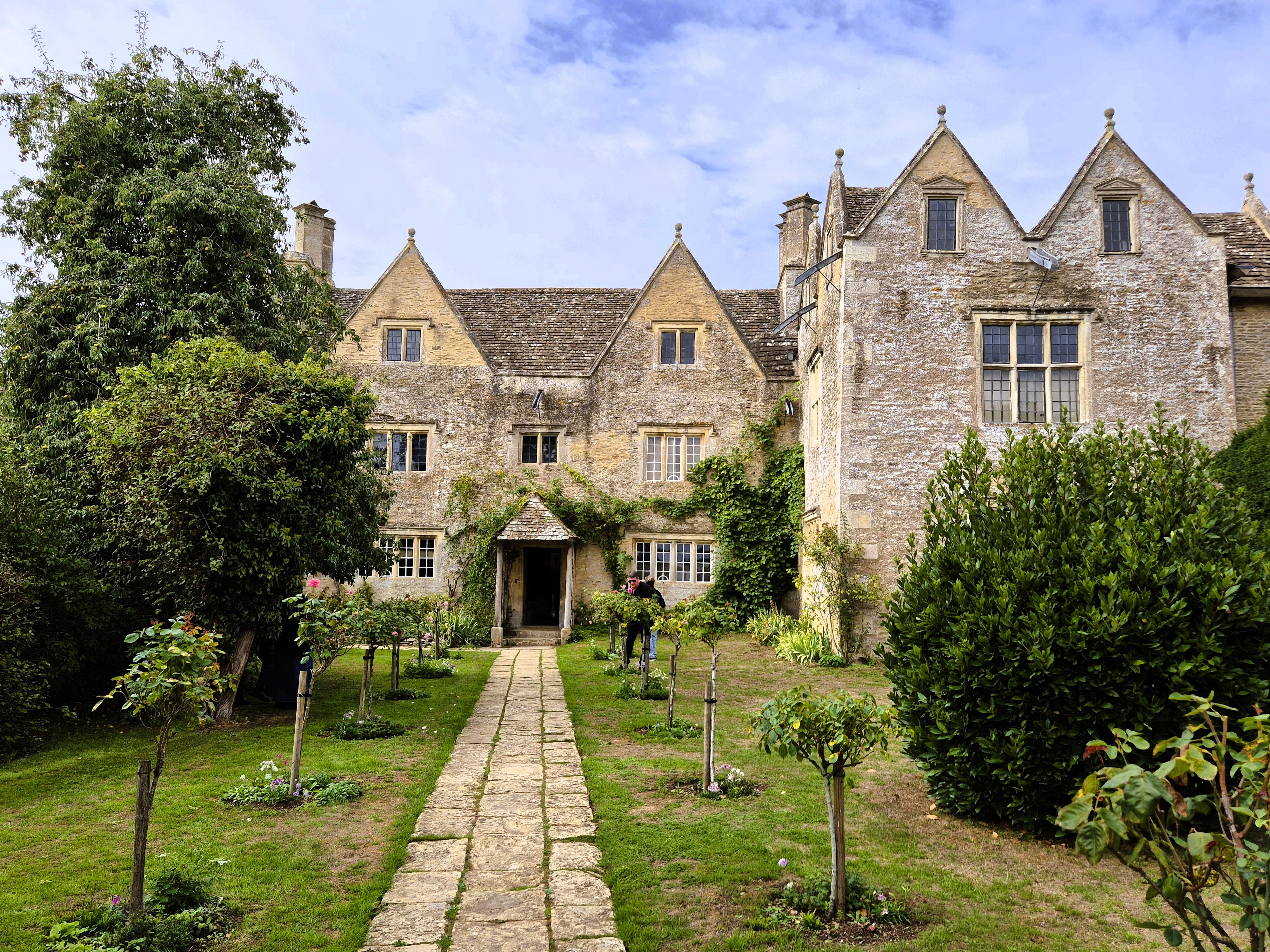
I have been thinking of visiting for a while and when a friend mentioned it a couple of days ago I decided to go yesterday – it’s less than an hour away by car. I am not sorry I did but it is a very strange place.
On the way I noticed signposts to villages with names which were so very eccentrically English. Charney Bassett and Goosey for example. My favourite was Baulking. Has anyone who has known a resident ever failed to ask, “Are you quite happy living there or are you … ?”
There’s a large car park outside the village and it’s a walk not far short of half a mile to the Manor. This carving of Morris is on the front of one of the William Morris memorial cottages en route.

Much of the interior of the manor is extremely dark and gloomy and there is basically zero curation in the sense of information actually telling you what you are looking at. There’s a volunteer in every single room however. They were lovely but like National Trust volunteers, they really are of a type (but not to the extent that librarians are).
Call me a Philistine but tapestries and embroideries (and wallpaper for that matter) don’t float my boat at all so I was in the place for only just over half an hour. Some of the rooms which have a bit more light are almost empty. The longer I spent, the more I realised why I had not visited before: what an absurd, over earnest, self-indulgent bunch those Pre-Raphaelites were.
In one especially dark corridor, these caught my eye. I had to ask about them – from a quick skim they do not merit a mention in the guidebook.

They are Edward Burne-Jones’ charcoal sketches of signs of the Zodiac, the finished versions commissioned for the Green Dining Room at the Victoria and Albert Museum. They are rather lovely.
I also liked these ceramic tiles also by Burne-Jones designed for Chaucer’s visionary poem The Legend of Goode Wimmen, although actually painted by lowlier workshop staff at the firm of Morris, Marshall, Faulkner & Co.

Also these panels of a settle and a rather grandiose clock.


More Burne-Jones, a ceramic panel depicting the Judgement of Paris.

To reiterate, all of this information has come from research yesterday evening, none of it from the Manor.
The star of the show is Dante Gabriel Rossetti’s famous portrait of Jane Morris, wife of William, but of course it is only a copy. She had an affair with him and later the notorious philanderer Wilfrid Scawen Blunt. She came from humble origins and was the inspiration for Eliza Doolittle in George Bernard Shaw’s Pygmalion (and the musical version My Fair Lady).

I started to wonder if even the beds were actually original. I once got behind the scenes at Windsor Castle (in view of a sale for the photographic collection, which it is unlikely anyone will ever actually see) and was told by the senior member of staff that absolutely anything which looked as though it might be from before 1950 was actually a modern replica. The tower is also a fake.
Much else at Kelmscott seemed to me kitsch or chintzy at best. One room was filled with tapestries by a modern weaver which I did not care for at all and found jarring in the context.
My knowledge of William Morris is based unsurprisingly given my bookselling career on his crowning achievement, the Kelmscott Press. It was only when I was enjoying coffee outside by the café that it hit me – there was not a single mention of it, anywhere, and unless I missed something, not a single book in the house. The printing press remains at Morris’ studio in Hammersmith, which is right and proper, but this seemed the most extraordinary omission. In fact the the only thing which really made my heart beat faster during my visit was the landing of a Common Darter dragonfly on my table. Common they may be but I have never seen one before. He was the most extraordinary shade of red which is quite beyond me to describe.
Not that I am actually an admirer of the press. In one of my posts celebrating the centenary of my bookshop, I wrote: “Quite a few booksellers (in particular) and customers have said to me over the years: “I hate private press books”, to which my response was usually, “What, all of them?” I confess (should I only ever whisper it?) to being not the greatest fan of the Kelmscott Press. The Kelmscott Chaucer is undeniably a thing of beauty but I find the Troy and Chaucer types simply very hard to read. One of the booksellers who made the comment above went on to issue a catalogue printed entirely in one of them, but it seemed to me completely illegible.”
This Pear Tree in the garden area by the café spoke volumes to me in terms of epitomising the place – overworked, unnaturally shaped.

I took myself for a stroll around the garden. Not the best time of year for any garden but this seemed something of a desert and felt rather unloved. The stream is silted up with duckweed. Nice sunflowers though and some Japanese anemones and a very fat conker.


You can’t really go wrong with Cotswold stone though and this dilapidated summer house is rather charming.


I had thought I would bring something home from the shop but it was an assault on the senses of overly dense floral decoration and tweeness.
All this makes it seem I hated the place, but I didn’t. It was just all very, very odd.
For the sake of completeness I went for a look at Morris’ grave at the nearby St George’s church. In keeping with the rest of the day I was only certain it was St George’s not from the entrance or anywhere other than a modern electronic money collecting machine inside. The grave, very well hidden behind a bush (a kind couple pointed to it for me – they too had spent quite some time in the small churchyard looking for it) was designed by his close friend, architect Philip Webb (who also designed the settle). Again, I felt distinctly underwhelmed. It can’t have taken him very long. It is extraordinarily minimalist given Morris’ almost frantic over-wrought patterning of everything else.

The Pre-Raphaelite circle was famously satirised by Max Beerbohm, especially in his Rossetti and His Circle, William Heinemann, 1922 (we have a copy in stock). Of Rossetti he wrote, “In London, in the great days of a deep, smug, thick, rich, drab, industrial complacency, Rossetti shone, for the men and women who knew him, with the ambiguous light of a red torch somewhere in a dense fog. And so he still shines for me.” And elsewhere, “They retired willingly into a solemn, damp fantasy world of depressed damsels with six-yard-long necks, staring blankly into an infinite void because someone forgot to invite them to the Arthurian tournament. They laboured under the crushing burden of being intensely, exhaustively profound about tapestries, tiles, and tortoiseshell cats, treating every stroke of a paintbrush as if it were an act of high theological redemption.” They decided upon their own definition of feminine beauty and in the portraits the women seem weighed down by melancholy. The manor must have been a hotbed of pompous posturing, dressing up and playing at being medieval.
These are three of Beerbohm’s caricatures, ‘Rossetti’s Courtship’, ‘Topsy [Morris] and Ned Jones Settled on the Settle in Red Lion Square’ and ‘Spring Cottage, Hampstead, 1860. Coventry Patmore very vehemently preaches to the Rossettis that a tea-pot is not worshipful for its form and colour, but as a sublime symbol of domesticity’.


In the meantime …
My previous post was about Pippa Middleton’s now notorious driveway and what seemed to me the kangaroo court inquiry which found in her favour. Described by the Daily Express as a Channel 4 ‘star’, Kirstie Allsopp has, in her wisdom, weighed in on the debate. For the villagers the route was a crucial link, now locked to all of us. But, says Kirstie, this was a “cruel witch hunt”. I really, really don’t think it was. “I live near Pippa Middleton – planning row has been huge waste of taxpayer money” she says. And, “I have known that house since I was a kid. If you buy a house which doesn’t have a footpath, then you should not be forced to have one.” Well, she can’t know it terribly well since there is a designated footpath on the estate. The matter of the driveway is quite separate.
Apologies for losing the source but I read a lovely critique of Raine Spencer: “Just as dachshunds were bred to catch badgers, so Cartland bred Raine to catch aristocrats.” Far be it from to draw a comparison with the Middleton sisters. I did not know that Dachshunds were used to hunt badgers and in badger-baiting. They were larger versions than the ones we tend to see now. I wouldn’t given them a chance against a badger if they weren’t, although the victims were usually crippled in various terrible ways before the fight.
Raine Spencer was stepmother to princess Diana and now her brother Charles has alleged in his book, Swan Song: Diana, My Sister, that Charles our king made a comment soon after her death that, if true, is nothing short of monstrous. The king has not issued anything which begins to constitute a denial. Spencer said that Charles “went ballistic.” “He started really going for my family as a whole about their sense of duty, bot being adequate enough and ranted for a while. I’ve no idea how long but it was a significant period. And I just listened. And then he stopped and I thought, oh now, he’s going to pull himself together and say something more appropriate. And then, he said, ‘We’ll forget her soon enough’ “.
Worryingly, Kemi Badenoch, who describes the king as her “boss”, says that she will always side with him. Really? Are there absolutely no circumstances under which she would not?
Which brings me to John Humphreys’ excellent documentary The Royals: Time to Go? I certainly think so, I find it astonishing that the monarchy still exists in the 21st century and I have already written about many of the statistics and revelations. New to me though is the fact that Charles claimed public money for Camilla’s clothes and stabling her horses before they were married. Humphreys declares himself a lifelong Republican, influenced by his father who said that he would never bow his head to any man. My parents were very much monarchists but I never understood it. I would happily bow my head to a Buddhist monk or as a sign of respect in Japan or to anyone I felt had earned my respect, but never to someone purely by virtue of their ‘birthright’.
Humphreys talks about the hidden from public view massive art collection, and the Monets, Fabergé eggs, jewellery worth in excess of £500 million and a stamp collection worth £100 million Charles inherited from his mother. He had to pay inheritance tax on precisely none of it.
Talking of inheritance tax, here’s Clarkson reliably being the poster boy for the (factory) farming industry: “To make matters worse the farmer can no longer pass his farm on to the only people who know how to run it – his children – because the Labourites have decided that even if his farm is only medium-sized, he must keep on paying taxes even when he’s dead.” Over a certain level of inherited estate value, so does everyone else.
There was a bit of an uptick for the coronation (with the disgraceful policing of peaceful protestors which took place – I’m with them, Charles is not my king) but support for the royal family has otherwise been on a downward trajectory since 1980. More than one in four of us are now in favour of abolition.
The various Andrew scandals will not have helped – he still denies any wrongdoing but the late queen paid £12 million in hush money nonetheless.
By convention MPs cannot even mention the conduct or influence of the royal family on the floor of the house. Unbelievably they are also exempt from the Freedom of Information Act. Green MP Siân Berry says that there is simply no way to penetrate the veil of secrecy. The king has finally revealed his personal tax arrangements but we don’t know how they are calculated and actual payment is voluntary. He does own The Strand in London and the duchy of Lancaster is worth some £687 million. William has the Duchy of Cornwall. They own the foreshore and a significant portion of the seabed. And “how many palaces do they need?”, asks Humphreys.
Jeremy Hunt is interviewed and is ridiculous. He treats the whole thing as an amusing joke, the royals are “above the fray” and should be “de-politicised” (which is meaningless).
The refurbishment of Buckingham Palace cost £369 million, but none of them live there. There are eleven “working royals” who benefit from the Sovereign Grant but we have no idea how much each of them receives.
Theirs may be described as a purely ceremonial role, but servile deference continues to be the norm.
The Animal Welfare Bill which gave the RSPCA the right to enter private property where animal abuse was believed to be taking place was structured to contain an exemption for estates owned by the late queen.
MPS still have to swear allegiance to the crown, but the crown is subject to no formal code of conduct.
They apologise for slavery and colonisation in which they played such a huge part, but only in terms of “deep personal sorrow” which really doesn’t cut it. See my post about the Royal African Company.
Nicola Sturgeon is wheeled out although surely no one listens to or believes a word she says any more, but she does make the good point that abolition would actually be the kindest thing for the members of the family.
We could get rid of them, it’s not impossible. If we look at the United States, the alternative of course is not always great. But at least Trump is elected.
I note with very weary amusement that Starmer has been u-turning again. He said he would not resign as an MP and promised he would never endorse a resignation honours list. Now he seems set to do both. I do hope he won’t keep popping up to pontificate to the nation like his predecessor Tony Bliar (sic).
In other news …
The Hunt Saboteurs Association has reported on a stag hunt which took place on 26th September this year. Echoing the horrors of the notorious Barle stag hunt 32 years ago, this was carried out by the Devon and Somerset Staghounds. The terrified creature was chased to exhaustion for two hours using relays of pairs of hounds (hardly cricket is it?) until he could barely move or hold his head up. He entered a river which seemed to revive him slightly, but the hunt’s gunman followed him on foot and then shot him. Nothing has changed.
More happily a poacher who was lining up a Rhino in his sights in Kruger National Park, South Africa, was trampled to death by a herd of elephants. They probably knew and remembered him or sensed what he was up to. Another poacher got away but was subsequently arrested.
For the first time in over a century, a new cat species has been discovered, Leopardus tilcayo. This is in the cloud forest region of Bolivia where what was once thought a single species has turned out to be five.
We have been witnessing horrific scenes in our coastal towns. As Ian Hislop and his team pointed out, we are seeing men in balaclavas and black shorts who it is unlikely are unfamiliar with P.G. Wodehouse’s parody of fascist Oswald Moseley’ Black Shirts, the Black Shorts, and attacks on members of the RNLI. I thought of the poignant words from a song by African reggae legend Alpha Blondy:
Ne tirez pas sur l’ambulance
La Côte d’Ivoire est blessée
Finally, I had another lovely walk along the Kennet and Avon Canal this week with Chilli, the Norfolk Terrier, on behalf of the Cinnamon Trust. I was touched that she didn’t even bark this time as I approached the house – she seems to have come to trust me. We saw a Grey Wagtail again and even helped a barge negotiate a lock by closing one of the gates, although Chilli’s contribution to the effort was not entirely of assistance. She did look rather amazed when the boat began to rise up, but not as amazed and indignant as when I gently told her off for trying to zoom off the pavement into the middle of the road when cars were coming. We also saw plenty of Wild Chicory. What a lovely shade of blue.

Leave a Reply