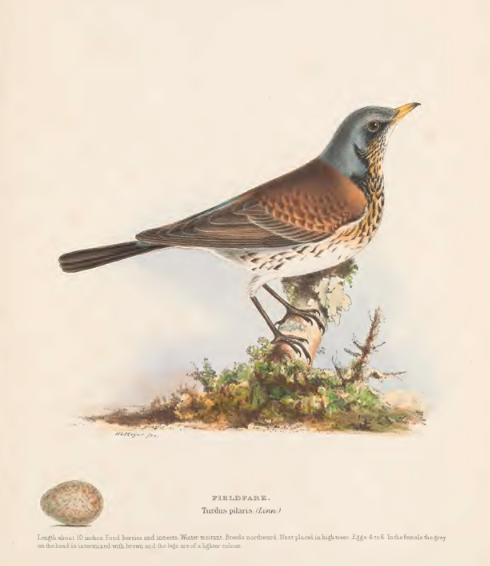
The Fieldfare image above is from Meyer (Henry Leonard). Illustrations of British Birds, c.1835-1844.
Each day, which is every day, when I see my ruined Lime Tree, I feel guilty and apologetic (I do actually silently apologise), even though the butchery was carried out, in my garden, without my permission and in my absence. I feel that I am still grieving for it. And I am still furious. It prompted a feeling I have not had for a long time which it took me a while to put my finger on – the same feeling generated by having been burgled. The completely culpable neighbour clearly hates trees and greenery – I wonder why they chose to live in the countryside. A professional, qualified arborist visited to assess the situation. He was visibly shocked by what he saw and described it as I have as butchery, without any prompting from me. I saw the butcher himself yesterday from the corner of my eye but could not bear actually to look at him. I worry about the ferocity of my response should he try to engage. This anger will not dissipate quickly. It was an irreversible crime against nature, against life, totemic in the Anthropocene.
I have just read Nancy Campbell’s Thunderstone. She is a colleague from way back and this is a mesmerising book which I love in very many ways. I will come back to it but for now dwell on her mention of my favourite poet Gerard Manley Hopkins’ poem below, which is so apposite. My father and then I once owned a holograph manuscript (a fair copy) of it but in hard times and with heavy heart I parted with it. I wish I hadn’t had to. But I held it in my hands many times and that should probably be enough.
Binsey Poplars
felled 1879
My aspens dear, whose airy cages quelled,
Quelled or quenched in leaves the leaping sun,
All felled, felled, are all felled;
Of a fresh and following folded rank
Not spared, not one
That dandled a sandalled
Shadow that swam or sank
On meadow & river & wind-wandering weed-winding bank.
O if we but knew what we do
When we delve or hew —
Hack and rack the growing green!
Since country is so tender
To touch, her being só slender,
That, like this sleek and seeing ball
But a prick will make no eye at all,
Where we, even where we mean
To mend her we end her,
When we hew or delve:
After-comers cannot guess the beauty been.
Ten or twelve, only ten or twelve
Strokes of havoc unselve
The sweet especial scene,
Rural scene, a rural scene,
Sweet especial rural scene.
Collared Doves
I have written perhaps too much about Collared Doves and the special meanings they have for me, but Birdwatch magazine, September 2026, Issue 411, features one on the cover and there is a long piece about them by Ed Stubbs. They first arrived in the UK in the 1950s and spread at a truly remarkable rate to the extent that they were regarded as invasive. It is saddening but unsurprising to me that they are now in decline. For some years I have had a pair visiting almost every day, this year I have seen one pair once and just one other solitary visitor. This is likely due in part to trichomoniasis, but it is thought that there are other factors, I really should write a macro for these: modern agricultural practices, including intensive weed control, the loss of mixed farming, smaller gardens, paved gardens, over tidy gardens, climate change. Collared Doves remain green-listed but, suggests Stubbs, we need more data and we need to pay attention to what it tells us.
Washing machine politics
This is a rather cryptic headline, but I was recently reminded of “The Zanussi Promise”, the story of which I previously told here:
Wildpilot I – two local businesses, Amazon and Currys – Animal Wild
One of them was made by Zanussi and I chose it on the basis of the “Zanussi promise” which guaranteed sending someone out for a repair within 24 hours (or thereabouts). When it went wrong after not very long at all I rang them up. “We might be able to get someone to you on Wednesday in two weeks time.” Our three children were quite small at this point and being without a washing machine for over two weeks was not a minor inconvenience. “What,” I asked, “about the Zanussi promise?” “Ah well, it’s not really a promise, it’s more of an aspiration.”
As implied, I chose a Zanussi precisely because of the promise, having suffered a long and farcical succession of washing machines which broke down or failed completely, sometimes within days of arrival.
As we watch Andy Burnham flip-flopping around like his predecessor, it occurred to me that the Zanussi promise provides an excellent analogy for those from our politicians. We didn’t actually mean it. I am all for taxing the extremely wealthy, but it seems to me outrageous to increase taxes for so many who work so hard or have worked so hard all their lives and have been struggling financially for so long under the policies of successive governments.
Defensive defecation
As well as Hamza Yassin’s superb African Birds of Prey, BBC, I recently watched this on Youtube, This Sperm Whale’s Disgusting Trick Beat 30 Hunting Orcas | Animal Documentary – YouTube.
There was much to learn about Sperm Whales generally – they are the largest toothed whales, the third deepest diving mammal, they have the largest brains on the planet and are the loudest animals of all to boot, even including known extinct animals. Recorded for the first time relatively recently, they are now known to use clouds of excrement as a successful deterrent against packs of predatory Orcas. One of the biggest problems they face now though is the inadvertent consumption of huge amounts of human plastic waste. Fieldfares defend their nests against predators in similar fashion, as do nestling Hoopoes.
Moby Dick was a Sperm Whale. I am about as likely to read that book as Hemingway on bullfighting, no matter how great the prose.
Leave a Reply