Guga hunt
Firstly some seriously good news, the Guga hunt licence for next year has not been granted. As a spokesperson for Protect the Wild says: “A major victory for compassion, for science and for common sense.”
BBC Evening News Covers Guga Hunt Victory!
This will be the first time in perhaps 400 years that this horror show will not take place. Of course there will still be a need for vigilance in coming years but I am sure Protect the Wild will lead the way.
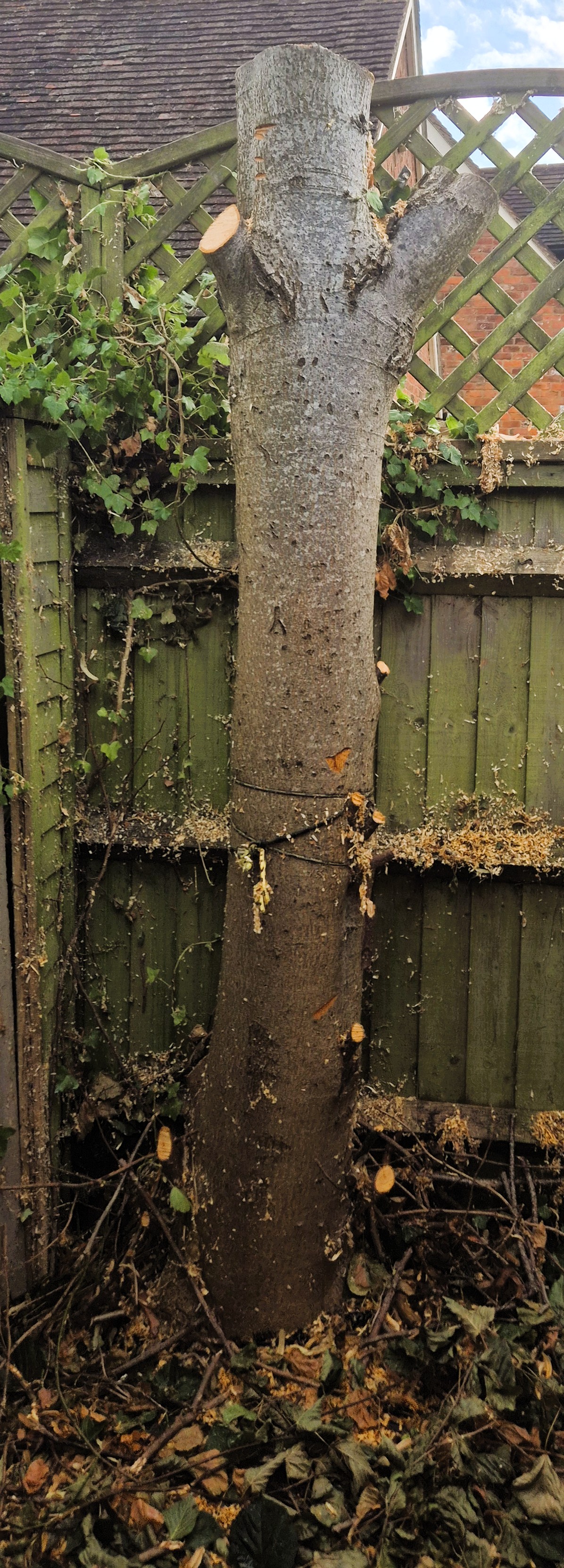
The mutilation of a much-loved tree
On Tuesday I treated myself to a lovely day out in Chichester, see forthcoming post. I have not been out very much lately except locally. Just one day though and I came home to devastation.
A neighbour came hollering to my garden to ask about my beautiful Lime (or Linden) tree whose overhanging branches were, she said, causing problems on her side of the fence. I could not have been more accommodating and did not even ask to see what the issues were. I did express severe misgivings about the contractor she had engaged as he is notorious locally for his savage butchery of trees, over which there has been a good deal of protest, especially recently. However she said that I shouldn’t worry as he would “only remove a few branches”. I offered to pay for it but she insisted on paying half which she did not have to do.
Whilst I was out she came to the house and spoke to a family member saying that the tree was now dangerously lopsided and could easily come down in a string wind, which seems to me arrant nonsense. The contractor was given permission to enter the garden purely to assess the situation and the neighbour was told that no work should take place on our side of the fence without speaking to me first. This is what happened.

The tree was between 20 and 30 feet high. This act of extreme vandalism was without authorisation by anyone. It was a profound shock, like a vicious blow to the stomach, reducing me to tears of sadness and rage, an assault on a friend.
Two days later and I am still incandescent and deeply upset, in a state of grief even. As I have written so often here I absolutely love trees, in particular the Cedar of Lebanon and Silver Birch in my childhood garden, the Sumac in the garden now, and what was the Lime, or Linden. I am almost but not quite literally a tree-hugger. I quoted this just recently: ““Tolkien depicted the trees not as mere lumber but as living beings whose murder causes sorrow throughout the ancient forest of Fangorn.”
I could of course sue but don’t have the appetite for a prolonged dispute between neighbours and it wouldn’t bring the tree back. There has been an exchange of e-mails with the neighbour and all I have had is one of those non-apology apologies – “I am sorry you are upset.” My last e-mail to the neighbour yesterday:
Hi *******,
Having slept on this I find myself no less distressed and furious.
It is especially galling since, when we spoke, you said that you knew how fond of the lime tree I was (who said it was larch by the way?) and I expressed my all too prescient misgivings about the contractor you engaged to remove “just a few branches”.
To avoid ongoing conflict between neighbours, I am not going to pursue any formal action over the destruction of the tree. However, to reiterate, as it was destroyed without my consent, I will obviously not be contributing to *****’s bill, and he does not have permission to enter my land again. Please assure me that no entry will be attempted today in particular since I am out again this morning and in future.
I am deeply saddened by the loss of the tree as no doubt are the Wrens in particular, other birds and other wildlife for whom it was a favourite. Given the circumstances, I hope you will do the right thing and cover the cost of professional and qualified stump removal if I decide to have that done and in any case a suitable replacement tree and its planting in its place.
I have not had the courtesy of a reply, not even to assure me that the contractor will not be back to wreak further havoc and destruction. I cannot begin to imagine what the neighbour and contractor thought gave them the right to do this. The tree was very much part of my happy place, my safe space, the summer house surrounded by semi-wild trees, plants and wildlife, where I write. The gap now left is impossible to ignore. I remember my delight when the tree first appeared perhaps ten or fifteen years ago. I have looked after it carefully with just occasional light pruning. I suppose there is a chance that the tree is still alive and will sprout but it will never be the same.
Update. A little research has confirmed what I thought. The method used known as topping is out of date, destructive and unprofessional. Professional tree care is governed by BS 3998 which strongly advises against it. It is basically the laziest approach and requires zero technical skill, leaving trees prone to starvation and shock, rot and decay. Any new shoots will be weak and, aesthetics aside, the tree will never recover the shape and structure which it has evolved to have. Furthermore the top cut should have been angled to allow water to run off.
Farmyards and rights of way
This is from one of my favourite bloggers, absolutelynotnormal.wordpress.com. :
“The path had wound its way in a particularly unsignposted way through a farmyard that lay between empty, rattling cowsheds, round the corner of a barn which was playing host to some very aptly named barn swallows and up a narrow track running between a fallow field and a field of cows. As someone who lives in an area of the country that is bound about by barbed wire fences and very strictly defined rights of way, I find the Scottish rights to roam both liberating and slightly unnerving. I always feel a little like someone is about to leap out from behind a tree and take me to task for trespassing. Farmyards are places that you just don’t venture in Norfolk; it feels a bit like walking unannounced and uninvited to someone’s living room. The farmer we passed didn’t bat an eyelid though, he just wished us a good afternoon.”
I have been given permission to quote it here. It speaks volumes I think, I have had exactly that feeling walking through farmyards in England even on established footpaths. There is absolutely that sense of being rigidly bound in by barbed wire (sometimes razor wire, that hideous invention) and defined rights of way. I can actually understand why it might be annoying for farmers to have people walking through and wouldn’t mind if paths were diverted to some extent so as to go around the farmyard itself. From the instance above though it would seem that the Right to Roam in Scotland is far from causing the chaos which opponents in England predict in their typical knee-jerk reactions.
A.A. Gill on parenthood
I have now finished Gill’s superb memoir which is as the cover describes an intense and succulent read (the wineglass stain is printed on the cover just to be clear).

He writes like no one else and is particularly good on writing itself, art, religion, addiction, the human condition and much more. Here he is, especially movingly, on parenthood.
“The biggest thing that happens in any life is the life of your children. No tragedy or triumph can compare with the tragedies or triumphs of them. I have never felt such churning fury as when I thought my children were being bullied, or such steepling pride when they do something kind or clever.”
You are only ever as happy as your happiest child. I have felt that steepling pride and that churning fury. I had been away for a week or so and when I returned I learned that one of my daughters had been being bullied at school for the duration of my absence and that nothing had been done. I charged in to the school within a matter of hours and was able to rectify the situation. I even managed to get her annual report changed on another occasion which is apparently unheard of. The shortness of the way she wore her school skirt was mentioned. I thought that absurdly trivial and that it did not belong in the context so I insisted it was expunged, as was a critical reference to her absences which the school knew full well was the result of terrible migraines. I am proud of all of my children in far too many ways to mention.
Here’s A.A .Gill again: “No award, no medal, no mountain peak, no victory can compare with the moment you become a parent … I’d never held a new baby before. She fitted naturally and comfortably into the crook of my arm, like the missing piece of a puzzle. I stared at the small pink face and my head filled with a grace, a golden blessing.”
Crossword
Yesterday’s Guardian cryptic was set by “Omnibus”. I enjoy the solvers’ comments hugely and tend to skim through them before I start. In this case they were overwhelmingly negative and harsh. It was not long before I saw why. I cannot put my finger on it but there was something deeply unsatisfying and irritating about the clues and solutions (I don’t mind if they’re difficult and don’t want them to be too straightforward but they must be pleasing in the resolution, the little epiphany) although the theme of collective nouns was clever. The setter is not popular. There is a suspicion that he or she may actually be a collective of setters. I do not usually comment myself except positively but for this I made an exception. I still don’t understand how one answer, “murder”, can be a synonym for “relish” as indicated by the clue, even as in “I could murder an ice cream might now.”
TV
I wrote recently: “I’ve started watching the second series of The Undeclared War on Channel 4 starring Simon Pegg. It’s not completely terrible but it really isn’t great either and the acting is pretty wooden. I’ve started to think Pegg can’t really act at all. In the first two episodes at least you can almost hear the director saying “Simon, can you do your exasperated face now … now your tired one” – and that seems to be his entire range.”
Well I saw it through to the bitter end and wish I hadn’t bothered. I wanted to know what happened I suppose – nothing very much as it turned out. I am not sure why I have got it in for this show in particular but Siân Brooke who plays Pegg’s character’s wife was if anything even more wooden than him. She sheds a few tears occasionally, otherwise her face seems entirely immobile. No doubt she was instructed to portray a wholly unsympathetic character. Pegg does have to display anger at one point but even then he just seems … tired and exasperated. Only Danny Sapani as GCHQ’s security chief comes out with some credit, but it’s hard to believe that the job would require someone so avuncular. His interrogations involve little more than questions such as “Was it you?” which seems utterly implausible.
I usually watch with sub-titles on these days and am often amused by how often characters scoff when they are doing nothing of the sort and how often music is described as “pensive” which makes no sense at all but always reminds me of Wordsworth’s ‘I wandered lonely as a cloud’ and his vacant or pensive mood.
A bracelet
I came across a little jewellery bag in a drawer with the name “Sehaya” and googled it. Shortly afterwards I ordered what looked like an attractive bracelet made from multi-coloured jasper stones. When I searched my e-mails I found I had ordered exactly the same thing in 2020 but had completely forgotten it. At least I’m consistent if not learning anything – when it arrived I found I didn’t really like it that much. I now vaguely remember the first one breaking and I failed to secure the new one properly and lost it within 24 hours. No joke at £26. But there was a reward, a gift of a tree whereby it seems Tree-Nation have planted an Avocado Tree on my behalf in Tanzania. I learnt a new word from it too, “allelopathic”, which the Avocado is apparently not. It describes an organism that produces biochemicals which affect other organisms in such as ways as their growth and survival, beneficially or otherwise. Also that the fruits are actually large berries.
Update. I found the bracelet. No matter how I tied it (and I was a Cub Scout) the knots unravelled themselves. So now I can return it.
Dr Dolittle
I have often written about Hugh Lofting’s wonderful books and decided to get a Kindle version of The Voyages … to read again on my phone.
From Animal Trust:
Hugh Lofting’s Dr Dolittle books were important. I have a lovely set of first English editions in delightful, colourful dust-wrappers. It was only on re-reading them decades later that I realised what a profound impact they had had. It wasn’t the good doctor’s ability to talk to animals so much as the author’s humanity and recurring arguments for treating animals with compassion and, to an extent, as equals. When a new edition was published by Red Fox in 1991, there needed to be some re-writing to remove or alter characters and incidents which were not considered racist then, but certainly are now. In an afterword, the author’s son Christopher writes about the dilemma. Is it ok to tamper with or censor the classics? Or should children be denied the opportunity of reading the books at all because of a few unintendedly offensive references? Christopher Lofting continues: “After much soul-searching the consensus was that changes should be made. The deciding factor was the strong belief that the author himself would have immediately approved of making these alterations. Hugh Lofting would have been appalled at the suggestion that any part of his work would give offence and would have been the first to make the changes himself … The message that Hugh Lofting conveyed throughout his work was one of respect for life and the rights of all who share the common destiny of our world. That theme permeates the entire Doctor Dolittle series.”

Very strangely and presumably as a result of carelessness the Kindle edition is far from free of racist epithets. The “n-word” has come up twice already (reminding me of Joseph Conrad’s Nigger of the Narcissus, published in 1897). The doctor would probably be a vegan if the books were written now. It jars that a lot of pork sausages and bacon are consumed in the presence of the doctor’s pig with whom he of course communicates. These things aside (which is not to say that they are not significant) …
The quotations below again show just how much of an influence the books were on me in terms of my passions for animal rights and the environment and my hatred of zoos.
“I promised to keep it a secret. And you must promise me never to tell any one. Yes, I discovered the North Pole in April, 1809. But shortly after I got there the polar bears came to me in a body and told me there was a great deal of coal there, buried beneath the snow. They knew, they said, that human beings would do anything, and go anywhere, to get coal. So would I please keep it a secret. Because once people began coming up there to start coal-mines, their beautiful white country would be spoiled—and there was nowhere else in the world cold enough for polar bears to be comfortable. So of course I had to promise them I would. Ah, well, it will be discovered again some day, by somebody else. But I want the polar bears to have their play-ground to themselves as long as possible.”
“Inside was still another garden. I had expected to find cages with animals inside them. But there were none to be seen. Instead there were little stone houses here and there all over the garden; and each house had a window and a door. As we walked in, many of these doors opened and animals came running out to us evidently expecting food. “Haven’t the doors any locks on them?” I asked the Doctor. “Oh yes,” he said, “every door has a lock. But in my zoo the doors open from the inside, not from the out. The locks are only there so the animals can go and shut themselves in any time they want to get away from the annoyance of other animals or from people who might come here. Every animal in this zoo stays here because he likes it, not because he is made to.”
“Have you any lions or tigers?” I asked as we moved on. “No,” said the Doctor. “It wouldn’t be possible to keep them here—and I wouldn’t keep them even if I could. If I had my way, Stubbins, there wouldn’t be a single lion or tiger in captivity anywhere in the world. They never take to it. They’re never happy. They never settle down. They are always thinking of the big countries they have left behind. You can see it in their eyes, dreaming—dreaming always of the great open spaces where they were born; dreaming of the deep, dark jungles where their mothers first taught them how to scent and track the deer. And what are they given in exchange for all this?” asked the Doctor, stopping in his walk and growing all red and angry—“What are they given in exchange for the glory of an African sunrise, for the twilight breeze whispering through the palms, for the green shade of the matted, tangled vines, for the cool, big-starred nights of the desert, for the patter of the waterfall after a hard day’s hunt? What, I ask you, are they given in exchange for these? Why, a bare cage with iron bars; an ugly piece of dead meat thrust in to them once a day; and a crowd of fools to come and stare at them with open mouths!—No, Stubbins. Lions and tigers, the Big Hunters, should never, never be seen in zoos.” The Doctor seemed to have grown terribly serious—almost sad.”
I wondered how it was that the books were first published in America rather than Lofting’s home country. It’s a good story. He was wounded serving in the First World War and moved with his family to Connecticut and so was seeking a local publisher. In 1919 on a ship bound for America he met by chance (British) author Cecil Roberts who was charmed by the letters Lofting had sent to his children from the trenches and introduced him to his own publisher, Frederick A. Stokes.
Leave a Reply