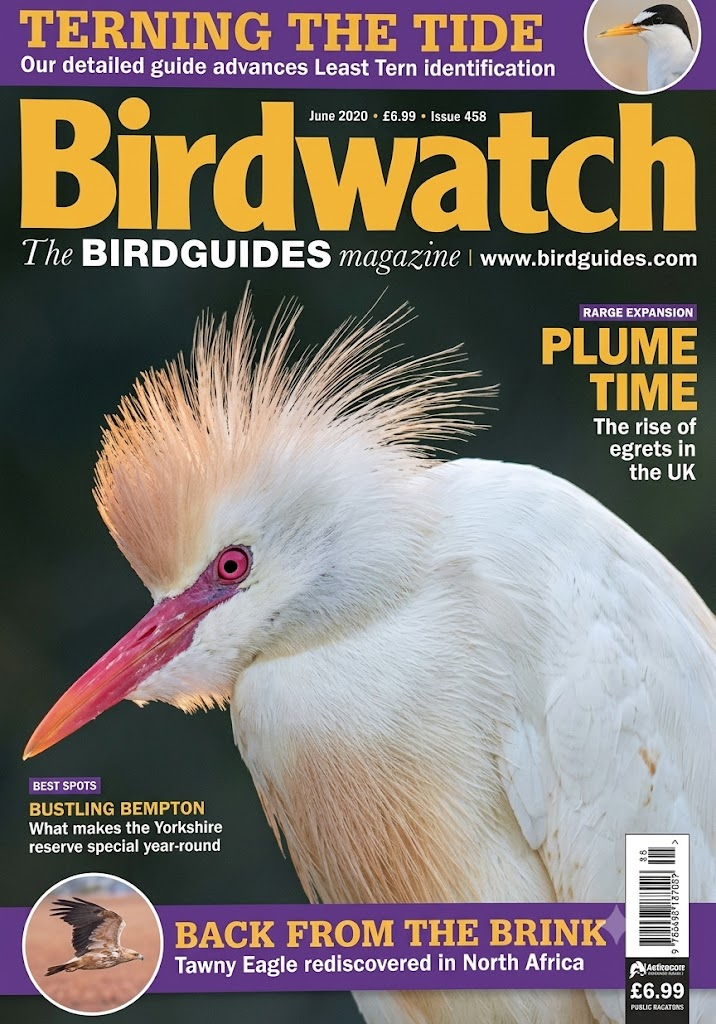
The stack of wildlife magazines waiting to be read has been growing alarmingly. To try and tackle it this is a look at three issues of Birdwatch magazine, June, July and August 2026, issues 408 to 410.
Firstly though an encouraging update on the Guga hunt. Experts at NatureScot have recommended that no licence be granted for next year. Over a quarter of a million people signed the petition. Kudos to everyone involved, especially Protect the Wild. We should know for sure on August 3rd.
In the June issue Josh Jones is much saddened and suffering from sleepless nights – his much-loved local Black-headed Gull colony has been and continues to be under attack by anglers, specifically carp (those “overfed non-native” victims) anglers. Decoys, sonic devices and anti-bird netting (in 2022 Josh watched adult gulls become entangled and die) have all been deployed and the colony was halved by avian flu in 2023. In 2025 not a single Gull fledged from the island which used to support several hundred pairs.
The American Black Tern which I saw in Northumberland has been continuing to visit the Arctic Term colony there and has now mated with a male Arctic Tern and laid a clutch of eggs in 2024 but none hatched. She appears again in the third issue (below) having successfully hatched a hybrid chick this year. It seems she is not alone as other out-of-range or vagrant species have been recorded breeding with their closest matches.
There’s a great article about Bempton Cliffs RSPB where, as well as the flagship species, it’s possible to see an important Tree Sparrow colony and occasionally a Black-browed Albatross.
Tern species are tricky to identify. Niall T. Keogh concentrates on the Least Tern which has a white forehead patch amongst other features. They were once thought to be a subspecies of Little Terns.
It fits with my own sightings of my favourite birds, Egrets (any kind) to read that they are on the rise and expanding their ranges in the UK: “Seeing Great and Little Egrets together is now routine at many wetlands around Britain and Ireland.” Featured on the cover and luckily seen on my recent trip to Devon, Cattle Egret numbers are also on the rise but they remain relatively elusive and localised.

Mark Avery is punchy in this issue on the disaster that has been the privatisation of the water companies. I hope Andy Burnham will not disappoint on this front.
The Dotterel on the cover represents one of Britain’s rarest birds. Unfairly named for their supposed foolishness (they are relatively tame in the scheme of things) and historically much exploited, they are of the plover species and the males have duller plumage since, unusually, they incubate the eggs and need good camouflage. Monitoring is difficult and data poor.
Peter Alfrey writes about his move from London to the Selsey Peninsula for a more nature-positive existence and better birding. I find myself rather envious. I don’t go the seaside nearly enough – at its closest it is only an hour away by car. I haven’t been to Chichester for a long time and nearby RSPB Medmerry Nature Reserve looks very appealing. Other articles tell of the rich bird life to be found on the Shetland Islands and the Calf of Man (a small island just off the Isle of Man).
A Hoopoe in Surrey stood out for me amongst the photos in this issue, a strange looking bird I would love to see.
I once visited Jim Morrison’s grave at Père-Lachaise in Paris (Oscar Wilde and Edith Piaf are there too). A new book by Benôit Gallot explores the wildlife to be seen after some rewilding. It now hosts some 90 bird species.
Good to see recommendations of a slew of books about beetles. I can totally understand why people are fascinated by and want to learn more about them. There are at least 4.072 different species in Britain including, amazingly, 47 different species of ladybird.

It’s a Whinchat on the cover of the third of these issues.
I am not a twitcher or a ticker of bird lists in general but I can imagine the excitement of seeing Britain’s first Western Reef Heron in spring this year. It’s a dark bird “appearing either charcoal-grey or deep blue”, with a white throat, dark legs and bright yellow feet.
Josh Jones points out that the loss of landfill sites whilst welcome in many ways is not so good for birders and in particular gulls.
Mark Avery again tackles one of my bête noires, grouse shooting. He first launched a petition against it twelve years ago and I can only hope that he is right that we are watching the dying throes of the ‘sport’ instead of the birds, the result of petitions and campaigns, a tightening of regulations on burning and climate change making the moors less suitable for Red Grouse. As he says it remains disappointing that the RSPB has been divided on the subject and The Wildlife Trusts disengaged. “They haven’t pushed anything like hard enough.”
David Callaghan writes about shorebird superhighways or flyways, an endlessly fascinating subject for me. “BirdLife International recognises eight land-mass based flyways” (there’s a great map) and “five major global traffic systems”. Hundreds of millions of waders use them. The journeys are becoming ever more challenging.
Two young women founded Birding Girlies and I sympathised with their feelings that the world of birdwatching can be intimidating, although not necessarily intentionally. Everyone else seems to know so much more. But for myself, I go back to the advice I always gave to my children when they were at school – never be afraid to ask questions and there are no stupid questions As Tasha Noble and Alicia Hulland say, curiosity is key rather than a daunting fear of being perceived as ignorant. I did find many of the birders at Migfest, Spurn, snooty and unapproachable but that has very much been the exception rather than the rule in my experience.
Interesting to learn that birds have more neck vertebra than other animals – most mammals have seven, birds can have between ten and twenty-five, enabling to them do things in ways that mammals cannot such as feeding deep underwater, balancing their flight and turning their heads through 270 degrees (owls). Herons are thus able to fold their long necks into an ‘S’ shape enabling sudden strikes to take prey.
Young birds born this year are gearing up for their first migrations. This involves hormonal, physical and behavioural changes, especially building up fat reserves.
Leave a Reply