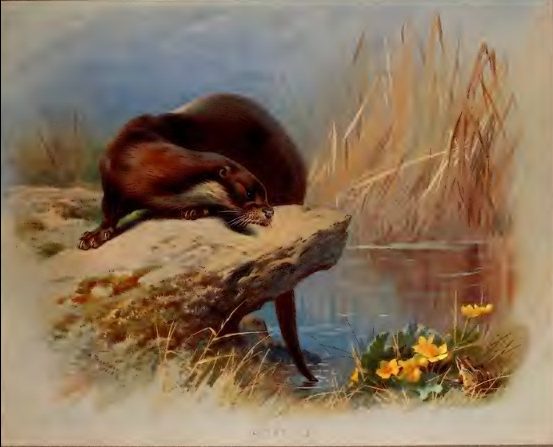
The illustration above is from: Thorburn (Archibald). British Mammals. Two volumes. Longmans, Green & Co., 1920-1921.
Billy & Molly: An Otter Love Story
Channel 4 summarises this programme: “Poignantly uplifting documentary about Billy Mail, who moved to Shetland with his wife for a better life only to find melancholic isolation. Then an otter pup comes into his life… “
I have vivid memories of the film of Henry Williamson’s Tarka the Otter and remember reading the book many years ago, especially the tragic conclusion. Williamson is one of those authors like Wyndham Lewis and to an extent Ezra Pound who fell dramatically out of favour with readers and collectors once his fascist leanings became widely known.
Billy Mail is a gentle man with one those soft Scottish accents which draws you in and his wife Susan is the same. The scenery in Shetland is beyond stunning, the winters dramatic and harsh. The soundtrack is also gentle and never intrusive. Molly appears one day as an undernourished orphan and Billy starts to feed her. She turns out to be quite the fussy eater. We watch as their relationship develops and a bond of trust is formed. Billy buys a freezer just to store the fish she consumes and builds a little house, complete with portraits, including one of Jade, their forbearing Border Collie, and a camera linked to the house. He teaches her to fish for herself. Susan does become exasperated with Billy from time to time but she loves him deeply. Molly, she knows, “made him happy and he made me happy and isn’t that what love is?”
Molly meets a male otter and begins to spend time away. After a prolonged absence she reappears with a pup of her own and returns to the little house.
Eventually though Molly again returns completely to the wild leaving Billy happy for her but with a void in his life.
Then his wife does a wonderful thing. She buys him a wetsuit, mask and snorkel. Now Billy can enter Molly’s world for the first time. From that moment, he says, he knows that he is not alone.
Billy is a deeply caring man, who has not been a father, with a strong nurturing instinct. I have that too. I loved bottle-feeding my children, I loved bottle-feeding the lambs at Trindledown animal rescue and feeding the fledglings at HART Wildlife, above all, as well as caring for traumatised domestic animals and injured wildlife. This is about to get very personal. I love my children more than life itself and am hugely proud of them. They are all three adults now. Do I miss their childhoods, miss those times, their innocence, joy and wonder, bringing joy and wonder back to me? Feel the pain of the relentless march of time? Yes, of course I do. There’s something of a Peter Pan in me and I always wished that girl in The Jungle Book would have left Mowgli alone. I have been lambasted, verbally lacerated for this. I confessed that I have struggled somewhat with their growing up, although that is of course the general idea, to a close relation (not by blood) recently. She said that this was not normal and that I should “see someone about it”. Not in a kind way. I don’t know what made her think she had the right. I was deeply hurt and, I admit, angry, and I still am.
She is one of only two women who are mothers I have spoken to about these feelings who have not completely understood and sympathised. It may be more unusual in men perhaps, but this is normal to me. Is it really something I should feel guilty about? I have spoken to other fathers too who, like me, when their children have left if only to move on to further education, have felt utter devastation comingled with pride. Not to have those feelings is what I find strange and in these recent remarks I know she was not even telling the truth about her own experience. I well remember her sense of being bereft as her fledglings left the nest. I don’t fully understand her animus but I have a pretty good inkling, which I won’t go into here.
She is a very odd person that is for sure. When my father-in-law was dying she mistook what I said when I imparted the sad news and thought I was talking about my wife (who was present) instead. She gave me a brief hug and that was it. Later, she dealt with it by saying that she found the whole thing, her misunderstanding, “absolutely hilarious”. I found her words hugely cruel. Most people I think find me a kind and empathetic person and I am proud of that. I sometimes forget that other people are not necessarily similarly wired. I will stick with who I am, thanks all the same. This was about a month ago and I find myself still reeling from it. I was not in a good place at the time and in any case was in her house or I would have responded more robustly there and then. I don’t know how I will be when I see her next. I doubt it will go well. I have written this in part to try to get it off my chest but also in the hope that the children may read it some day, and understand. As Robert Frost put it, nothing gold can stay.
This misnamed but lovely documentary can be found on Youtube:
Hunting the Poachers: Inside Kenya’s Ivory Trade
It is actually about the work of the David Sheldrick Trust, founded by his wife Daphne and still run by her at the time the documentary was made, home to orphaned elephants and other animals. The camera largely follows French journalist Olivia Mokiejewski who narrates. We see the terrified and traumatised young elephants regain their will to live and learn to trust their keepers, no doubt reassured by the elephants who have been there a while. One of the keeper is asked how that trust is achieved. It’s simple, he says, you just have to have love in your heart.
Leave a Reply