A little bit of admin. I have been becoming increasingly frustrated with WordPress hanging and being unable to save my posts which have invoved a lot of rewriting. The online AI help remains worse than useless and itself simply crashes but it did recommend switching to Chrome, which I have now done, since MS Edge apparently struggles with WordPress. I hope it will be an improvement.
Sewage protest
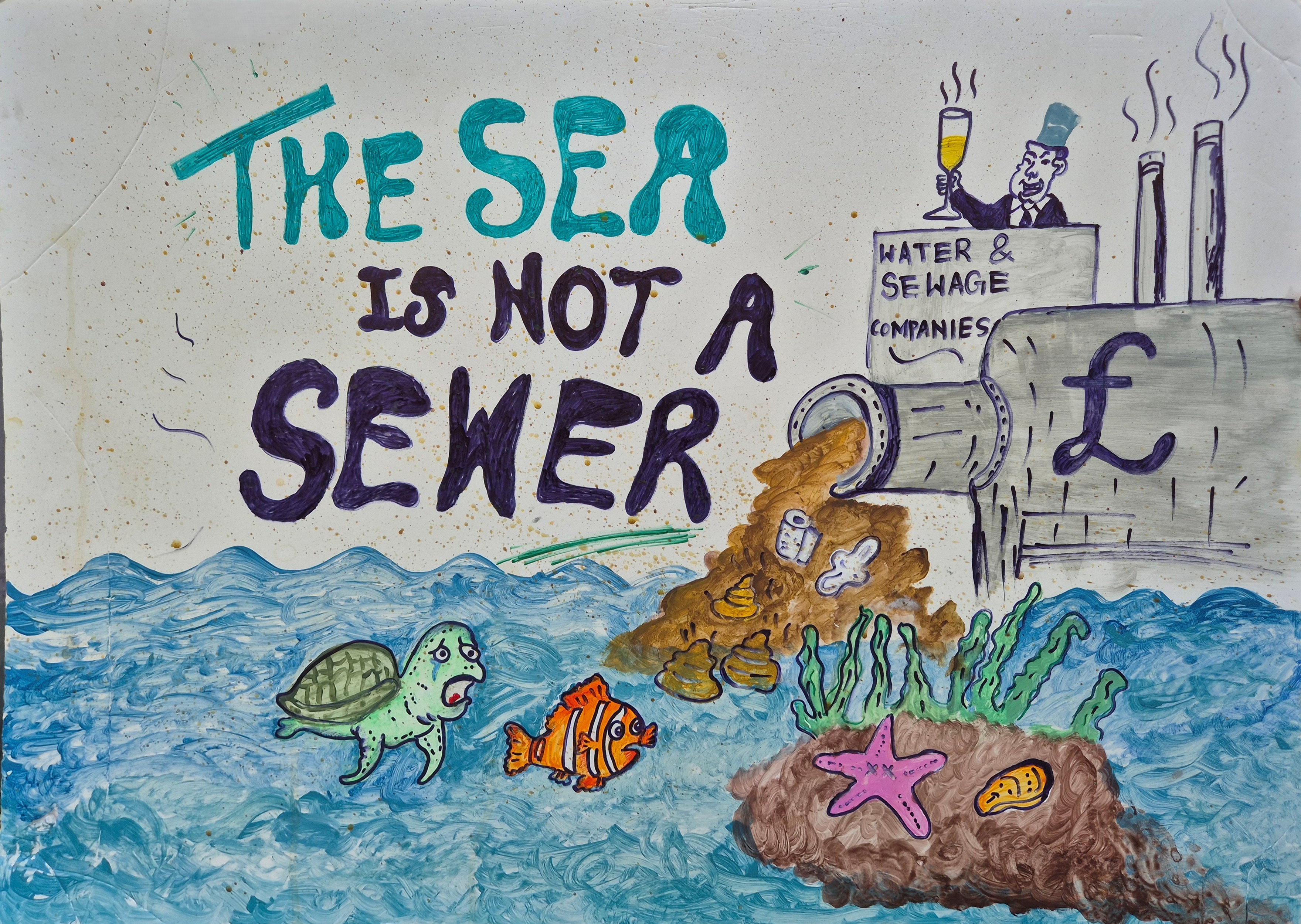
A short visit to the paddle out protest against sewage in Victoria Park, Newbury, Berkshire yesterday, on the banks of the Kennet & Avon Canal. People were very happy for me to take photos of their placards and everyone was friendly.

Apparently about 50 people turned up last year, this year it may have been closer to one hundred. I don’t really understand why people do not protest in their thousands at least.

Nevetheless, fair play to the paddlers, the canoeists and kayakers, shivering on a cold and cloudy day.

And it was good to bump into Jill, a receptionist I worked with at Trindeldown Animal Rescue for a number of years – it was she who first taught me the essential quick release knot when tying a pony or horse in the yard.
This witty sign was devised with, I was told, the help of a bottle of wine.

There were barcodes to scan to register attendance and sign a petition. I also signed a board, writing: “Pollution for profit is a disgrace.” And I picked up a couple of flyers.
One is from Friends of the Thames, asserting the rights of the river. It’s an interesting angle which could be dismissed as ridiculous. I wonder if it should be reframed as our duty to rivers, but this makes the point rather better. The flyer states that “the river shapes our towns, villages and capital city. And to honour this we declare that the River Thames along with its tributaries, aquifers and connected banks, possess the following rights on behalf of the river, now and for future generations.”
The river is seen as “an indivisible living whole from its source at Lechlade to its estuary” and as having legal rights:
- The right to perform essential functions within its ecosystem.
- The right to flow … to be free of unnecessary obstructions that inhibits [sic] the river’s flow and life … to follow a natural course … to flood … to be connected to its tributaries and wider catchment.
- The right to water … to feed and be fed by healthy & sustainable aquifers … to sufficient water and not be over-abstracted.
- The right to be free from pollution. Sewage pollution. Road run-off, chemical & industral pollution. Agricultural pollution (including soil run-off, fertilisers, pesticides and unnatural nutrient loads).
- The right to be free of rubbish … rubbish, fly-tipping and single-use packagaing and plastics.
- The right to conservation … to the protection of existing river and riverside habitats and biodiversity … to protection for riverside trees … to the halting of encroachment and development onto river habitats & marshlands.
- The right to regeneration and restoration … to riverside afforestation, to re-follow its natural course, meander and move … to re-daylighting … to sustainable land management within its catchment … to native biodiversity: removing non-native species, re-planting and re-introducing native species … to the re-naturalisation of riverbanks and if that’s not possible, the provision of habitat in lieu.
- The right to a healthy relationship with humans.
“Re-daylighting” is new to me. It is the re-opening and restoration of water courses diverted underground.
The other flyer is about the poisoning of our rivers by the flea treatments we use on our pets, which I have written about before. The University of Sussex found Fipronil in 99% of samples from twenty rivers. It and Imidacloprid are highly toxic to all insects and other aquatic invertebrates. Fipronil has been banned on farms since 2017. There are non-toxic alternatives auch as Dimethicone.
The bandstand in the park gave me a feeling of intense nostalgia for seemingly more innocent times, probably deriving from watching and loving Trumpton (and Camberwick Green) as a child. There is a certain generation which can never forget the fire station roll call: “Pugh, Pugh, Barney McGrew, Cuthbert, Dibble and Grubb.”

Thomas Hardy’s sundial
I had spotted that this was to be featured in the BBC’s Hidden Treasures of the National Trust. I skipped past the adulatory tour of Agatha Christie’s house and wardrobe, not that I have anything against her. It was the house designed and lived in by Hardy which interested me. He is probably my favourite novelist and not far from being my favourite poet. I was a little taken aback to hear him described as a Victorian writer. I have never thought of him as that and find the term diminishing, but he did write his novels in the reign of Queen Victoria. His poetry came later and he is seen as the founder of modernist poetry, revered by younger poets such as Siegfried Sassoon.
Hardy was trained as an architect and his father and grandfather and for that matter Jude Fawley in Jude the Obscure were stonemasons. This is Max Gate (stock image):

You can see the sundial, also designed by Hardy, on the front of the tower on the right. The programme documents its restoration. The commentary is by Toby Jones and I was a bit disappointed to hear his dulcet tones producing the saccharin, rather twee and very National Trust verbiage. A couple of National Trust women who do seem to be very much of a type pontificated about the wording on the dial: Quid de nocte? “What of the night?” Did it show Hardy’s awareness of his mortality or the dark pessimism which permeates Jude the Obscure? I found all that rather ridiculous – I think it is just a playful and amusing joke – sundials are no use in the dark.
This is also a stock photo. When I visited this Thomas Hardy monument in Dorset a few years ago I was too underwhelmed to bother to take a photo myself. Embarrassingly, I now know that it has nothing to do with the great writer but is a memorial to Vice Admiral Sir Thomas Hardy, Nelson’s flag officer at the Battle of Trafalgar.

Finally a quick Starmer snippet. The promised release of files relating to Mandelson’s appointment as ambassador to the US by the intelligence and security committee has already been criticised by the committee itself for redactions and the withholding of documents not based on the need for national security. The cover-up continues.
Leave a Reply