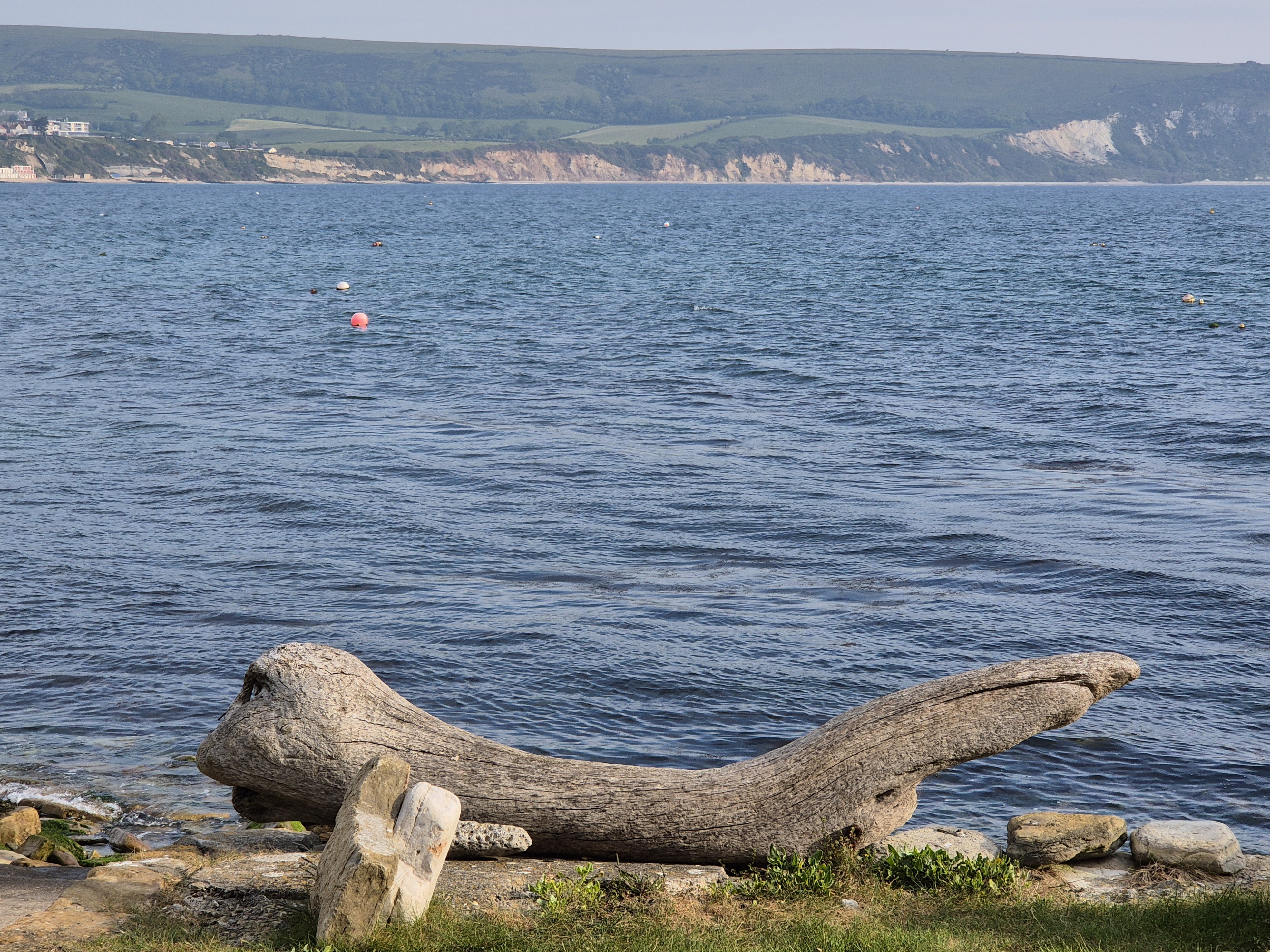
My favourite English county, Northumberland running a close second. Friends had invited me to stay for the weekend at their gorgeous house in Swanage, a place full of happy student memories for me. It is right on the point, the sea just a few feet away. I remembered that the nearby Wellington Clock Tower (1854) on the seafront originated from London. Disassembled in 1867 it was brought to Swanage as ballast by a local contractor and is now a listed building.
The satnav did not take me the way I expected and kept mentioning a ferry (which she pronounces “fairy”) which I thought couldn’t be right and something I really couldn’t be bothered with. It turned out to be a lovely drive with very little motorway. I drove through Bournemouth (the wealthy part) and found myself queuing for … a ferry. It’s a chain ferry which leaves every twenty minutes and the journey lasts only four minutes – and it’s fun. I wound down the car windows to breathe in the sea air and immediately began to relax. There’s a toll booth on exit (it doesn’t cost very much) manned by a hugely friendly guy who I learnt is sadly to be replaced by a machine.

There were very few people about and the drive through the Studland heathland was glorious with gorse flowering in great profusion. Studland happens also to be known for its naturist beach. Then through the familiar streets of Swanage to my friends’ house. They were perfect hosts and just what my rather fragile state of mind needed. We ate supper outside, wrapped up in fleeces and blankets, enjoying the sunset and the sounds of the sea. Herring and Black-headed Gulls flew overhead and we were even visited by two Oystercatchers. In the morning there were Cormorants about too and the next day a Great Crested Grebe. A large group of noisy House Sparrows live behind the house, their numbers reminiscent of those in our garden when I was a child.
The photo at the head of this post and this below showing Old Harry’s Rocks, where my friend and I once became rather worryingly becalmed for just a bit too long in his dinghy, are from the front garden.

RSPB Arne was high on my agenda for the weekend and Saturday was sunny and warm. We didn’t see very much but it didn’t matter at all – it is a very beautiful place with stunning views of the islands in the bay and we were most warmly greeted by a member of staff.


He told us that he had paid off his mortgage, had no debt and had begun to think about a career change, asking himself what he liked doing most – watching birds and talking to people. We did see Robins, Crows, Wrens and from the double-decker hide we watched a Black-headed Gull feasting on worms and picked out an Oystercatcher in the far distance. A Swallow performed his or her hunting aerial acrobatics right in front of the hide.

The view from the hide.


Another Black-headed Gull, probably a first year juvenile.


We (Merlin app) heard many birds I would love to have seen: Siskin, Firecrest, Blackcap, Chaffinch, Chiffchaff, Common Redshank, Song Thrush, Reed Warbler and Golden Plover. A small group of Sika Deer (a very problematic, non-native species) crossed our path. I can’t say they are my favourite or most aesthetically pleasing members of the deer family.


We saw a lot of Rhododenron – beautiful flowers but invasive and likely to outcompete other plants – I imagine they try to control it quite tightly.

The Dragonfly Pond did not disappoint.

This is a Four-Spotted Chaser, most likely a male, not at all “rather dull” as described in one of my Dragonfly books. They are apparently especially aggressive and territorial and indeed this one kept returning to the same stalk. Just to confuse me, my other Dragonfly book describes them as Four-spotted Skimmers.
For once I was the most knowledgeable about birds of our little group and I like to think I managed to pass on some of my enthusiasm and the joys of looking at detail – the closer you look the more there is to learn.
After a Purbeck ice cream at the café (the Isle of Purbeck is actually a peninsula, with some of the richest biodiversity in the country) we headed off for lunch at the Halfway Inn. We ignored / blocked out the fairly busy road which it adjoins and soaked up the sunshine. I had the best whitebait I have had for a very long time and made sure to compliment the chef. These were not out of a packet but obviously fresh from the sea, crisped and salted to perfection. I was told that the prawn cocktail was equally fresh and tasty. I am not sure but think this may have put me off regular whitebait for a while at least.
Ignoring the website warnings that there could be no more visits that day, we headed to Carey’s Secret Garden (which for some very odd reason I had decided was called Dr Carey’s Secret Garden). I have always loved walled gardens and this is a classic example with the red brick retaining the heat and keeping out the large herd of Sika Deer we saw on our arrival.

It is very beautiful and tranquil and also something of a sculpture park. Covering three and a half acres, it was built in 1883 to service the nearby Trigon estate. It was in an overgrown run-down state to the point of being barely visible when it was acquired by John Constantine a few years ago. He is the son of the co-founder of Lush, Mark Constantine, a long-time supporter of the Green Party. It that short time it has been restored to its former glories. The Old-Taddy-Potato-Store is now a café and the Gardener’s Roundhouse Potting Shed also has a history as a writing room.

The southern boundary is actually fenced rather than walled to allow early morning mists and frosts to roll off to protect vulnerable plants.

The philosophy is all about rewilding, sustainability, permaculture and organic methods. There are talks, events, workshops and educational partnerships.

Cistus ladanifer, more commonly known as the Gum Rockrose or Crimson-spot Rockrose.

Yellow Flag Iris.

Calla Lily, Zantedeschia aethiopica. Associated with purity, rebirth and elegance but also very hardy and toxic.

Comfrey. Good for skin and bones and much loved by bees.


Probably a Willow Catkin gone to seed.
The aromatic and edible plants are grown using peat free compost and if you buy any they are transferred to biodegradable pots with wooden labels – something to which all garden centres should surely aspire. Fruits, berries, vegetables, herbs, tea and roses are all grown on a no-dig basis “to help the microbiome of the soil to establish which helps to create a richer and more diverse soil.” In the café there’s a live video feed showing an Osprey on her nest.

This sculpture of an Osprey, “Moment of Flight ” is by Michael Cohdron.

Just outside the garden – no idea how this might have happened.


There’s the old saying that if you live next to St Paul’s Cathedral you never bother to visit and this and Arne were firsts for my hosts. I am sure they will be going back to both.
Back at the house, a Cormorant ignoring the wording.

And a Herring Gull.


The following morning we walked up the hill at the back of the house towards the fabulous Durston Castle, dipping down to the little shingle beach for a few moments of quiet contemplation.
I had noticed a sign to an animal sanctuary in Corfe Castle and so I set off to the Margaret Green Animal Rescue in Church Knowle. This was also a place of tranquility. I knew it would be as soon as I saw the sign asking us to drive slowly because of free range animals and children (note the order of priority). There are several centres in her name. This provides homes for cats, rabbits, ponies, sheep, donkeys, chickens, goats and pigs (who seemed especially happy, fast asleep in their wallows) and there is a beautifully maintained garden of remembrance which brought a tear to my eye and even two wildlife ponds.


Margaret was the daughter of Jerry Green and they founded the centre here moved by the plight of pit ponies who were being slaughtered at the end of their working lives.

After another pub lunch at the friendly New Inn (not terrible but not the Halfway by a long stretch in terms of food), I tried to look around the church (1403) but was frustrated by a padlock, something I have been pleased not to encounter elsewhere of late.

I hadn’t decided what to do next but instead of heading for home carried on along the ridge to Lulworth Cove. This take you through the Firing Range and at times the road (and a chunk of the sea) are closed off entirely. As described by my host, there were indeed tanks “hiding in the bushes”.


Presumably for target practice:


Lulworth Castle was visible in the distance.

The visitor centre at Lulworth is not what I was expecting at all. None of the tackiness of, say, Land’s End, but with very well designed areas giving geological and other information and the kind of shop where I just know I am going to get carried away – and did.
This bracelet is made from Preseli Bluestone from Wales which is basically what Stonehenge is made of.

The dolphin is probably of Serpentine.

And I just found this irresistibly elegant.

Best of all was this geode, in two parts of course, from the Western Sahara, Morocco (an odd purchase in Lulworth but at £80 they seemed a bargain compared to the prices which can be seen for such things in crystal shops). They are quite large – about seven inches across.

At least I managed to resist this mammoth’s foot bone.


The cove itself is picturesque but the rock formation on the far side is highly dramatic. At supper we had wondered what each of us might choose to study now given the opportunity and I plumped for geology having recently read of a geologist who sees what is around him in a very different way from the rest of us. I had reminded myself at the centre of the difference between igneous, sedimentary and metamorphic rock and learnt that the tilted rock in the background was folded as the result of a shock wave from the collision of tectonic plates.


My final stop was the world-famous Durdle Door, one of many reason why the Jurassic Coast is a UNESCO World Heritage Site.

I have been before and on one occasion actually swam through it. I remember the water being so cold that it felt as though my head was clamped in a tightening band of icy metal. The beach was closed because of storm damage although the adjacent Man o’ War beach was open. Too many steps for me.


The light!


Deliciously tired in that good way from fresh air, especially sea air, I drove home in a much rested state of mind.
There were some striking coincidences between our conversations over the weekend and what came up in the book I’m reading, The Lost Paths, which I will mention in the second part of my review. We also asked ourselves why deer have white bottoms (as do rabbits) which hardly make for good camouflage unless you are in a snowy environment. The answer seems to be that they confuse predators and send out a silent alarm signal to other members of the herd.
Finally I have just spotted this particularly colourful Brown-lipped Snail in the garden.


Leave a Reply