Yesterday I finally watched Avatar, the movie released in 2009 which I had avoided on the basis of extremely mixed reviews from friends. The driver was surprising – George Monbiot. I have been continuing with his book of articles for The Guardian (see previous posts), mostly through the section dealing with the super-rich, the ‘pollutocrats’, the corrupt bankers and fossil fuel magnates and the imbalances and injustice which they are happy to see prevail, which for the most part they have engineered. It helps that they control the media of course. He ends his piece about the psychopathy of such people and the self-attribution fallacy (those who make money from finance do it mostly through luck, they do “no better than would a chimpanzee flipping a coin”) with the words: “The undeserving rich are now in the frame, and the rest of us want our money back.” Pyschological tests on senior managers and executives produced results which showed them to have, going by certain indicators, equal or higher levels of psychopathy to those of Broadmoor inmates.
I don’t know if “pollutocrats” is a Monbiot coinage – it’s a good one.
In another piece he tells of asking various free market think tanks who “spend much of their time promoting corporate talking points” who funds them. All but one refused to answer.
He also deals with pointless consumption, neoliberalism and the constant drive for ‘growth’. It is the billionaires who have broken the system – because they could and because it served them to do so.
Of Avatar he says this: “Avatar, James Cameron’s blockbusting 3-D film, is both profoundly silly and profound. It’s profound because, like most films about aliens, it is a metaphor for contact between different human cultures. But in this case the metaphor is conscious and precise: this is the story of European engagement with the native peoples of the Americas.” I agree that the plot is ludicrous (however amazing the CGI) and with its “rightwing critics [who say] that Avatar is crass, mawkish and clichéd. But it speaks of a truth more important – and more dangerous – than those contained in a thousand arthouse movies.”
Lest we forget, Monbiot writes, “In his book American Holocaust, the American scholar David Stannard documents the greatest acts of genocide the world has ever experienced. In 1492, some 100 million native peoples lived in the Americas. By the end of the nineteenth century almost all of them had been exterminated. Many died as a result of disease. But the mass extinction was also engineered.” I also saw parallels with American intervention in Vietnam.
I didn’t hate the movie. It is definitely much too long. I don’t know if I will bother to watch any of the others but will probably succumb.
The alien world of Pandora is undeniably beautiful. But comparisons and even questions about plagiarism kept springing to mind. Certainly the visuals owe huge debts to Tolkien and his illustrators and Peter Jackson. The Na’vi are not entirely dissimilar to Middle Earth elves in terms of their body shape, ears and choice of weaponry (bow and arrow). They communicate with animals although they are not vegetarian (nor are at least some of Tolkien’s elves, see the internet for a lot of detail about this). It occurred to me incidentally whilst watching that either non-human animals have souls or they don’t. If they don’t then neither do we and vice versa. Is it not as simple as that? A neat idea too, probably not original, is that we only borrow energy during our lives – at some point it has to be given back.
There’s also a good deal about connections between trees, a truth we have since learnt in our inchoate exploration of the ‘wood wide web’.
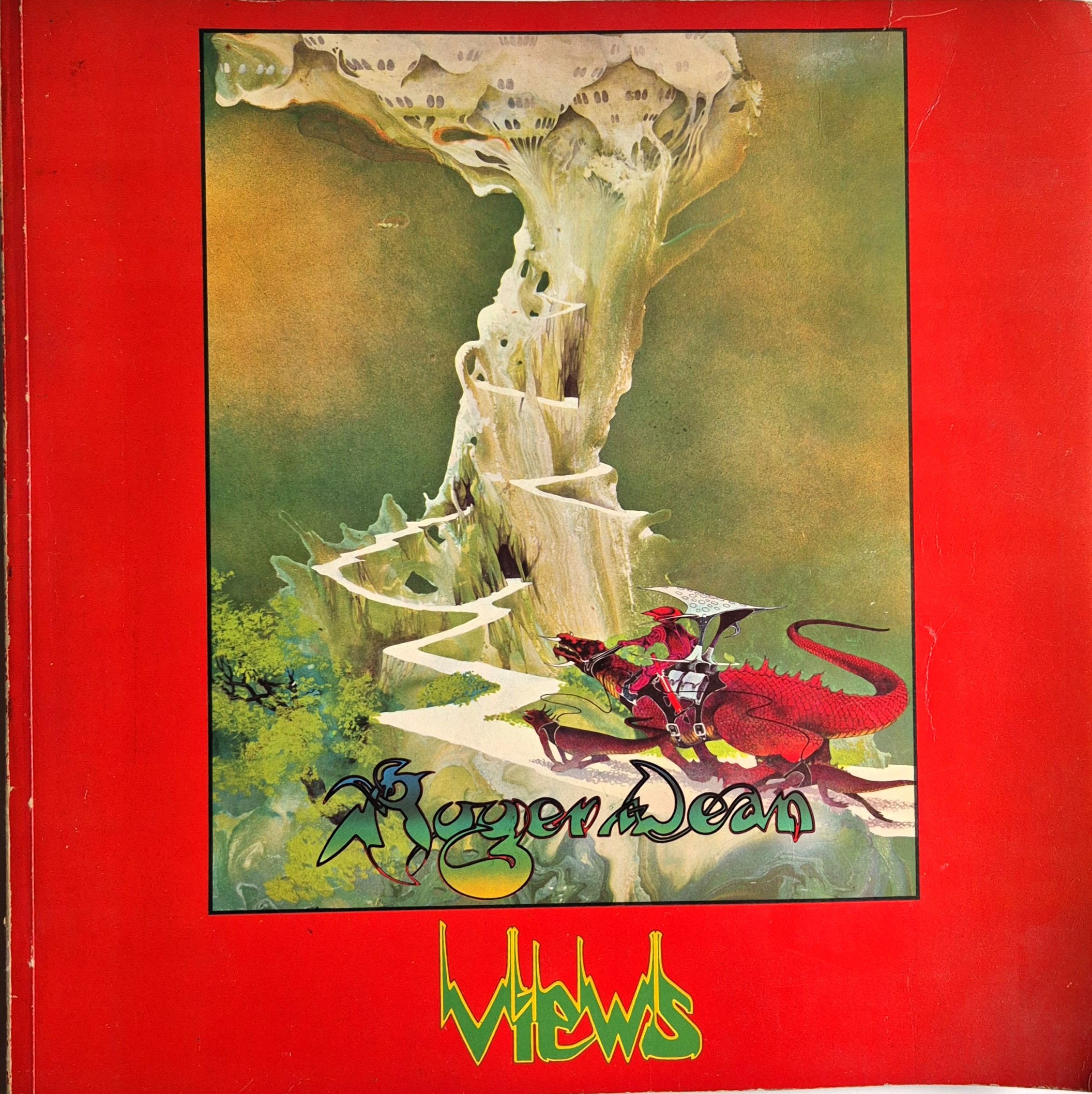
But more than that, didn’t this all look uncannily like the worlds created by the imagination of artist Roger Dean? It turns out he certainly thought so and took the matter, unsuccessfully, to court. It’s not just the landscapes and the trees, the floating islands, it’s the animals too.
Plagiarism is always tricky. Tricky to define and harder to prove. There are influence, inspiration and hommage, and then there’s plain theft. As a dealer in books and manuscripts I have come across three interesting cases of it. Once, when I was at Sotheby’s, a lady rang to ask if we could sell a manuscript of a short story she had written on the basis that it had been plagiarised by Jeffrey Archer, that most dishonest of men. I said I didn’t think we could help but suggested, off the record, that she contacted a solicitor. I believe she did make a claim but Archer denied any culpability. He must have got wind of my criticisms of him, almost certainly from someone I was talking to at a Sotheby’s reception. I appear as Julian in one of his books, literary specialist at Sotheby’s, who used to get drunk and fall asleep at dinner parties, which was not unknown at the time. A colleague fared even worse at the same function, mentioning the scandal in which our beloved chairman Lord ‘Grey’ Gowrie had been caught using a Sotheby’s car and chauffeur to take him to a dodgy massage parlour in Camden Town during office hours. The story was tabloid headline news but unknown to the person we were speaking to who turned out to be his sister. “Oh that is interesting,” she said. We half expected to be out of our jobs the next day.
In another case I will not name the authors involved. Suffice to say one of them is a well-known comedian already mired in allegations of scandalous behaviour. I confess it irks me that comedians and other television personalities seem able suddenly to turn their hands to writing children’s books and detective fiction which become instant bestsellers on account of their fame, not their literary talent. That aside, these children’s books seemed to me to have been lifted in terms of content, style and even typeface from a bona fide author of books for children whose archive we tried (but failed) to sell. I did suggest to my client that it was something he might want to look into but I think he knew it was a non-starter.
The other writer I consider at least something of a plagiarist (possibly) is J.K. Rowling. I tried to read one of her books but found her style clunky beyond belief. The whole Harry Potter circus seems to me a poorly constructed amalgamation of the works of Enid Blyton, J.M. Barrie, Lewis Carroll and others and, of course Tolkien. Here is a detailed analysis of where various of her ideas may have come from: Did Harry Potter Really Steal All These Story Ideas? I think it’s mostly pretty damning. Again there was an unsuccessful lawsuit against her (by the estate of Adrian Jacobs).
To get back to Roger Dean. I still have his book Views, Dragon’s Dream Ltd, [1975], shown at the head of this post, which I probably bought around the time of publication.
The first vinyl album I ever bought was Yes by Yes. I realise this is very far from a claim to having lived my early teenage years in a very cool way. It gets worse, the first album I bought in any form was a cassette of Gilbert O’Sullivan’s I’m a Writer Not a Fighter. Ah well, we all have embarrassing skeletons in the closet. Dean’s version of the ‘bubble’ typeface became iconic for them.

Yes were prime originators of the genre known as prog(ressive) rock. I’ve tried listening to some of their early work today and frankly it doesn’t age well. They were sometimes boring, self-indulgent and pretentious and their songs and albums, like Avatar, are often far too long. But they had their moments and I do not decry them completely. Their fourth album, Fragile, below, however, the first with Dean’s artwork, I simply couldn’t listen to this morning. I loved it at the time of release.

Other Yes albums to feature Dean were Close to the Edge (1972), Tales from Topographic Oceans (1973), a particularly meandering and dull double album with a meaningless title, Yessongs (1973), a triple live album, God help us, Relayer (1974), Drama (1980), Union (1991), Keys to Ascension (1996) and The Quest (2021).
Dean also created covers for other prog rock bands including Asia (whose line-up included Yes guitarist Steve Howe), Osibisa, Budgie, Uriah Heep and Greenslade. I am pleased to be reminded that Dean loves badgers and has portrayed them beautifully (detail below).

I don’t mean to be too dismissive of prog rock and I still have a certain fondness for it. And this is the second time in a week I have been taken on a welcome, nostalgic trawl through my record collection, this time by a most unexpected route. I definitely still have a soft spot for the work of Roger Dean. And I really miss gatefold album sleeves and covers that were full of information, lyrics, lists of players, acknowledgements and credits. With Spotify, if I like the sound of a certain drummer, there is no trail to pursue.
Here’s one I forgot to include yesterday, Dean’s design for the Vertigo record label, seen here on my copy of Black Sabbath’s Never Say Die.

Leave a Reply