Winchester Science Centre, which opened in 2002:

I very rarely use AI on my photos, hardly ever in fact, but I did here to remove the parked cars from the foreground because who wants to look at those? AI is brilliant for this. I confess it was very useful for perfectly translating the bookseller’s description of the Desmoulins manuscript in yesterday’s post. From a photo!

I read about the immersive Van Gogh experience in The Times and since Winchester is not far away I went to the planetarium yesterday. The centre is a charity, mostly run for the benefit of schools, so I didn’t much mind the not inexpensive price of admission, £32. Apparently they also have immersive Pink Floyd and Led Zeppelin experiences which I will definitely be checking out. The staff are young, enthusiastic and friendly.
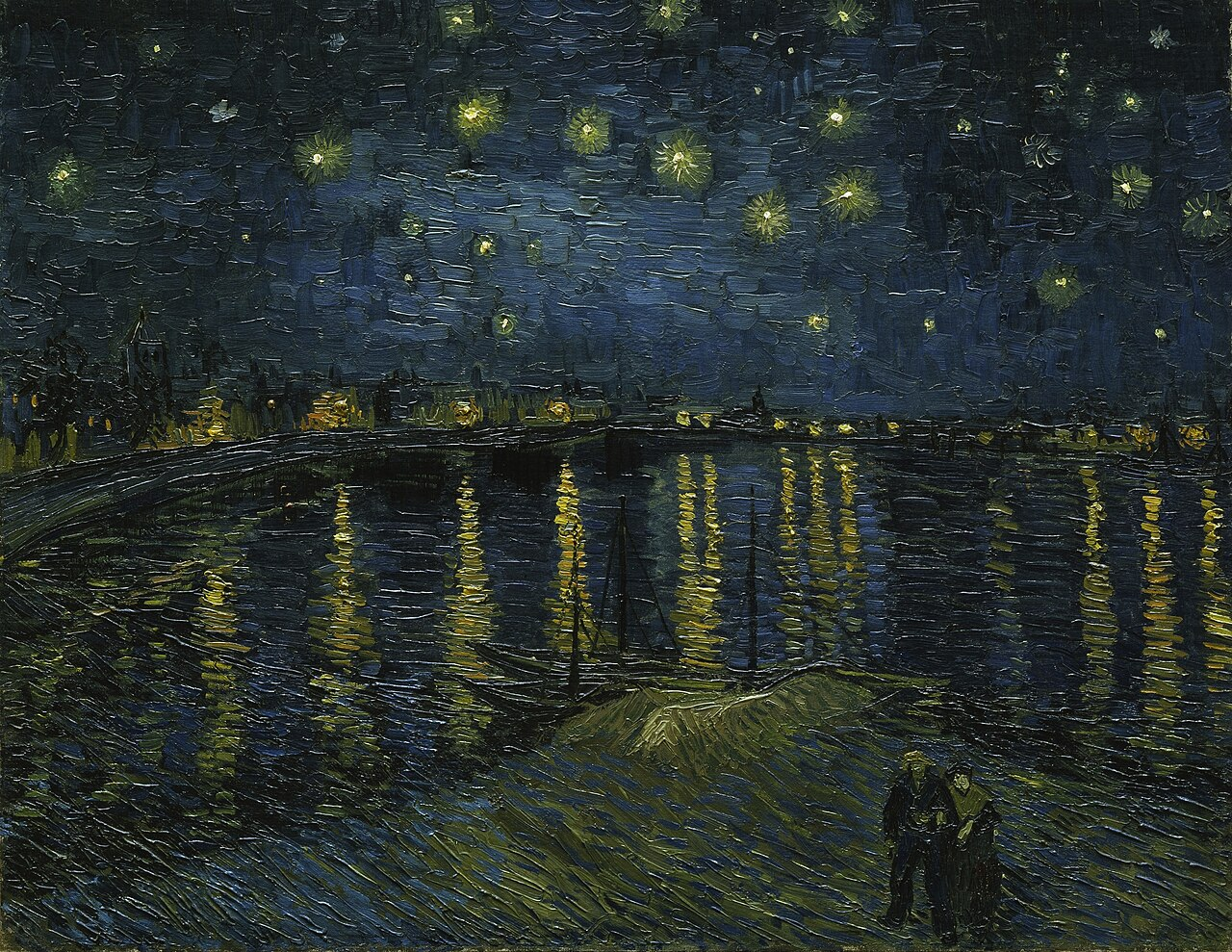
I learnt a great deal about (or was reminded of) Van Gogh’s life and work in a wonderful way. The projection lasts for 45 minutes with perfectly chosen music to accompany the swirling images. I can’t imagine how it is achieved, but here crows fly across the skies, windmills turn, leaves fall, trees move in the wind, reflected light shimmers in the dark water in ‘The Starry Night over the Rhône’ at the head of this post, my personal favourite), stars twinkle and pulsate and a steam train even moves across the painting. How do they do that?
You can see the birds and windmills moving:
Leaves falling:
…
It seems incredible now that Van Gogh’s talent, if that is even sufficient a word, his genius, were scarcely recognised in his lifetime given his popularity and the acknowledgement of his importance today.
Additionally given on the ceiling are short biographical details and quotations. I had not really realised how essential nature was to the artist.
“Try to walk as much as you can, and keep your love for nature, for that is the true way to learn to understand art more and more. Painters understand nature and love her and teach us to see her. If one really loves nature, one can find beauty everywhere.”
“I’ve got nature and art and poetry, and if that isn’t enough, what is?”
“If we study Japanese art, you see a man who is undoubtedly wise, philosophic and intelligent who spends his time how? In studying the distance between the earth and the moon? No. In studying the policy of Bismarck? No. He studies a single blade of grass.”
As I repeatedly quote, the closer you look the more there is to learn – and the more beauty to appreciate.
This is Van Gogh’s pink peach tree, a postcard of which my daughters brought back for me from Amsterdam.

There’s a café and a shop. I didn’t go too crazy in the latter, although I did feel myself regressing to childhood wonder. If Christmas was approaching and the children were younger I would have filled their stockings several times over.

I bought this beautifully illustrated pocket guide to the periodic table, useful for crosswords and also, even at first glance, a real education. There are 118 elements, one of them produced as recently as 2009, Tennessine. It’s radioactive, difficult and expensive to create, and the half-life for its most stable isotope is 51 milliseconds. We know little about it. Each element is shown with a list of its various properties, but with Tennessine the atomic mass is only estimated, melting boiling points are only predicted, density extrapolated and appearance is “unknown”.
We don’t know much about Meitnerium, discovered in 1982, either, but is the only one to be named after “an individual non-mythological woman”*, Lise Meitner, the Austrian-Swedish physicist who co-discovered protactinium and the process of nuclear fusion. The second of those is pretty amazing given that I and I suspect most people have never heard of her. *Curium doesn’t count because it was named after Marie Curie and her husband.
Of the 118 elements, 94 occur naturally on Earth, the rest are made synthetically from nuclear reactions. The structure of the table itself is based on the ‘periodic law’ first formulated by the Russian scientist Dmitri Mendeleev in 1869. Remarkably his version of the table included gaps for elements not yet then discovered.
I also acquired the inevitable fridge magnet, the pair of magnets also pictured below which we’ve had before, long since lost or broken. If you throw them into the air a finger’s width apart they join and come back down with a pleasing, soft rattle.


The sunshine print-paper looks like fun but I will have to wait for a sunny day. It made me think of the famous nineteenth-century nature-printed books. They are pretty rare and valued and I have only come across these two a handful of times. The ferns were not inked direct, they were pressed into soft lead by means of heavy rollers from which a copper mould was made to produce the plate. Printing was done in a single pass with the different coloured inks applied by hand.

The Ferns of Great Britain and Ireland, Bradbury and Evans, 1855-1856, to all intents and purposes the first book of its kind, appeared in parts in a large folio edition (there is a later octavo version). The printing of the fifty-one plates was overseen by Henry Bradbury. The text by Thomas Moore (curator of the Chelsea botanic garden and co-editor of Gardener’s Chronicle) was edited by the eminent botanist and horticulturist John Lindley.

There was a dispute over patent and alleged insufficient acknowledgement with Alois Auer, director of the Imperial Printing Office in Vienna and his associate. Auer called Bradbury a liar and a dishonest drunk in print. The three-dimensional impression is created by the printing process which left a raised texture on the paper. I think they are gorgeours and vividly remember seeing them for the first time.

Bradbury committed suicide before all his planned work in this field materialised but he did go on to publish W.H. Johnstone and A. Croall’s The Nature-Printed British Seaweeds: a history, accompanied by figures and dissections, of the algae of the British Isles, 1859-1860, above, which appeared in four volumes.
Both now command four-figure sums.
Leave a Reply