It is impossible to overstate the importance of drummer Sly Dunbar and bassist Robbie Shakespeare in the story of Jamaican music. The Riddim Twins played with and / or produced songs and albums by just about every reggae artist around. These are just some of them:
Peter Tosh, Culture, The Mighty Diamonds, Dennis Brown, Gregory Isaacs, Ini Kamoze, Junior Delgado, The Tamlins, Chaka Demus & Pliers, Beenie Man, Luciano, Shabba Ranks, Buju Banton, The Wailing Souls, Junior Murvin, Jacob Miller, The Itals, Horace Andy, Sugar Minott, Yellowman, Half Pint, Linval Thompson, Ken Boothe, The Viceroys, Bitty McLean, Bunny Wailer, Ijahman and Alpha Blondy.
They didn’t always play together but they did on all of my vinyl albums pictured here (and many others I collected, often more obscure).


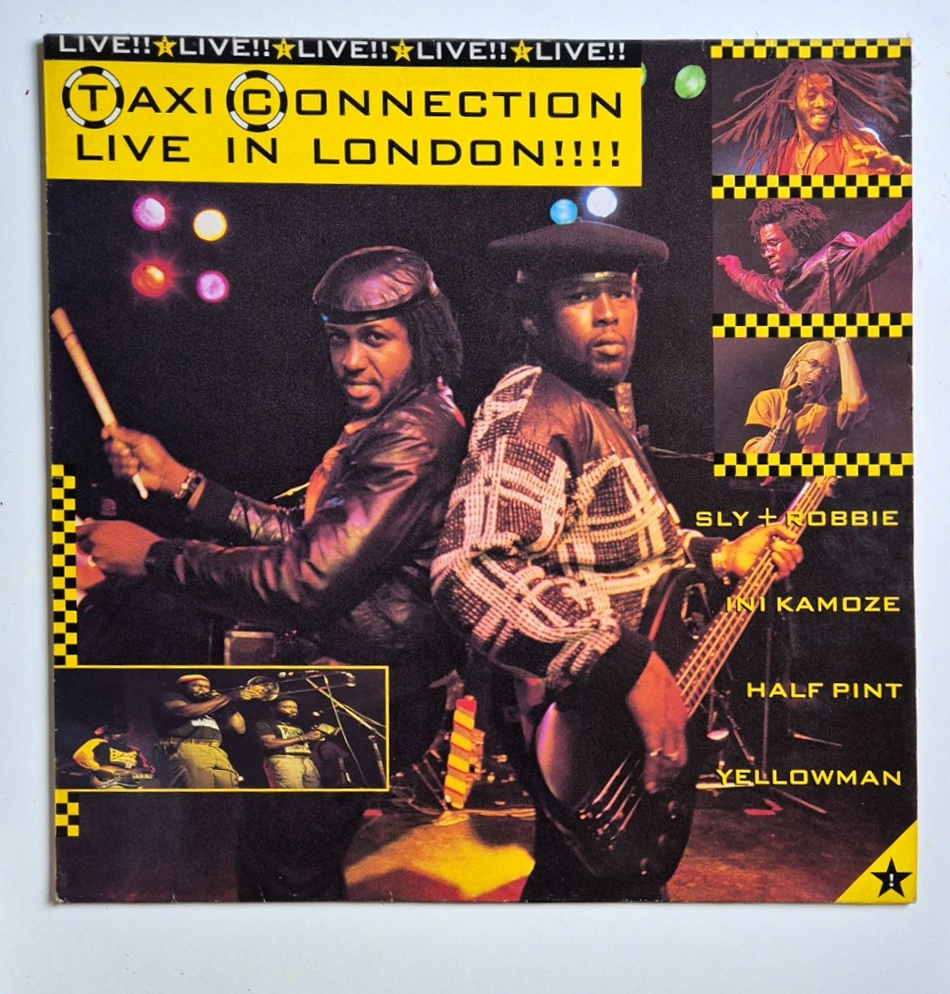
They also formed the Taxi Gang. The album pictured at the head of the post is from my own collection, as are all the others. Taxi Connection: Live in London. It’s on Island’s Mango label. I had not realised how rare it seems to be. It isn’t on Spotify at all and even Gemini could only find an image of a Japanese version of the cover. What makes me especially, happily nostalgic is that I was there – I was at the Town and Country Club on that very night in December 1986, seeing Half Pint, Yellowman, and Ini Kamoze (a particular favourite of mine), all powered by that extraordinary, unique rhythm section.

Then there was Black Uhuru.


Chris Blackwell (aka Chris Whitewell) apparently wanted them to spend more of their time devoted to the band but they were bigger than that and their distinctive, innovative and yet always instantly recognisable style was in huge international demand, from such giants as the the Stones (in particular on their underrated album ‘Undercover’), and albums including Jagger’s solo effort ‘She’s the Boss’, Bob Dylan’s ‘Infidels’, Joe Cocker’s ‘Sheffield Steel’, Grace Jones’ ‘Private Life’ et al., Alpha Blondy’s ‘Jah Victory’ (just to mention him again), Serge Gainsbourg’s controversial ‘Aux armes et caetera’ (it was seen, with the title track’s witheringly sarcastic commentary on the French national anthem, as unpatriotic which, if you look at it in a blinkered way, it unapologetically was) and latterly Sinéad O’Connor’s album of reggae covers ‘Throw Down Your Arms’ (which also doesn’t seem, inexplicably, to be on Spotify – it definitely used to be, the video link below is now seemingly the only way to hear it, which is very sad whatever the licensing issues may be). Sinéad O’Connor had an affair with Robbie Shakespeare. I was at one of the gigs on the tour (also at the Town and Country I think) and it was magnificent. I have most of these albums on vinyl – there is a lot that is not on the not so all-conquering Spotify.


Sinéad O’Connor – Throw Down Your Arms – Album Full ★ ★ ★
This is an excellent article – I have just made a playlist of the tracks (with more than a few additions – link at end of post).
This tribute is also well worth watching.
Legendary Drummer Sly Dunbar Passes Away At 73https://www.youtube.com/watch?v=PIeOwWX7UJY
Incredibly, it’s estimated that Sly and Robbie played on over 200,000 tracks. They didn’t always play together but they did on all of my vinyl albums pictured (and many others, often more obscure).
It was Sly and Robbie who got me into reggae in the first place, as I wrote in Animal Trust:
My relationship with reggae music began in Manchester. I was a student there in the early 80s and in my third, last year, I used to go to see friends in Moss Side most Friday evenings, usually not returning until the morning. They played all kinds of music I’d never heard. Joy Division was a favourite with them but it never truly worked for me. Then there was – Black Uhuru. They’re a long way from my favourite band now, but they, not Bob Marley, were my introduction to reggae. They blew me away, right away.
What was that drum and bass, and who were they? Sly (Dunbar) and Robbie (Shakespeare) of course, and once I started looking into them, their careers, their music, I was lost. In a good way.
Some nights we ventured out from Moss Side to go to a club called The Band on the Wall at the back of Piccadilly. Friday night was usually reggae night and I utterly, utterly loved it. There was a beautiful, chilled atmosphere, a sense of together-ness, and a hint of danger – two Rastas always guarded the gents where the weed deals happened and you had to walk up and wait for them to step aside before you could go in. Sassy, fun, northern girls too.
One night two, tweed-jacketed undercover cops came in – the DJ immediately switched to a track intro which was simply a recording of a police siren (with a bassline underneath of course), just in case anyone hadn’t noticed these absurdly unsubtle interlopers. Baggies were quickly but casually stashed into the gaps in the velveteen-covered benches, everyone was on quiet alert. They left after ten or fifteen minutes, the DJ pronounced “All clear” – and everyone started dancing again.
A local reggae band played another night, all their own songs. Really good. But the pure magic was right at the beginning and I’ve never heard it done so well. One instrument starts it, maybe a light drum beat, then the guitar “Chenk, chenk”, after a bit longer the keyboards, one at a time, taunting you. You knew the bass was coming, the suspense was electrifying, wait, wait, wait, it’s coming … “BOOM”. And with that the whole band unifies (I love how many musicians there so often are, I’ve counted at least eighteen many times) and it all kicks in.
As one of those UB40 Brummies said, it’s the only music that truly moves me. It’s the only music that uplifts me, consoles, calms me. Gives me a sense of oneness. Of course it isn’t for everyone, but I do struggle to trust people who dismiss the entire genre out of hand.
Burning Spear himself, in my view the greatest reggae artist of them all (who also features on my keyring alongside the elephant and the fox) said “reggae music insist”. It is like a drug sometimes – I get a deep, deep need to listen to reggae and it’s a rush and a release when it comes. And as Bob Marley sang, “One good thing about music, when it hits you feel no pain”.
Burning Spear gigs, of which I have been to around twenty, are transcendental, spiritual experiences of utter purity. Spear is Ras Mahatma.
Hugh Laurie, in a documentary about his relationship with it, asked (himself) how a middle-class white boy like him could love the blues so much, have the temerity to perform it, make some sort of claim on it as his music. His answer was that he couldn’t justify or explain it, his critics were right, but what was he supposed to do about that?
I’ve always loved protest music (Bob Dylan, Joan Baez, Thievery Corporation, Simone Felice (a howl to rival Ginsberg’s), Afro Fiesta, the last such an uplifting and deeply positive form of protest – just listen to the harmonies on a version of Rivers of Babylon with Ghanaian Rocky Dawuni, performed just with two guitars and three beautiful voices, oh my, oh my – it literally sends shivers right through me, as does the Playing for Change version of Bob Marley’s “Redemption Song”, although the original of that one does that to me too. There is something joyful about all of the Playing for Change productions, however plaintive. In 1991 I was heartened and disappointed at the same time when the only protest song about the Gulf War was not by some up and coming young band but the ever magnificent Rolling Stones. I felt that it shouldn’t have been their job at that point. Reggae is of course protest music, at its very core. Even when it isn’t explicitly Rastafarian, Garveyite, the very rhythm is political, the antithesis, the inversion, the exact opposite of baldhead (non-Rasta) rhythm. As well as, literally, the rhythm of the heart. Is reggae simple? Well, it is and it isn’t. It doesn’t matter. It’s the beauty, the alchemy, of all those rhythms of different complexities, coming together. As one. That’s the point. Reggae is both joyous and a universal protest music for oppressed and colonised/colonialised people everywhere – right around the globe.
It’s almost easier to think of reggae tracks which don’t feature Sly and Robbie. There are and have been other reggae drummers of course, most notably to my mind Leroy “Horsemouth” Wallace, to be seen in the film Rockers (as is Robbie Shakespeare), credited with inventing the ‘rockers’ rhythm and inspiring Sly Dunbar to take it worldwide. His style is also very easily recognisable, playing with Burning Spear, Ijahman and many more, always driving the rhythm forward, almost slightly ahead of itself. A shining example is the track ‘Jesus Selassie I Keepeth My Soul’ from Ijahman’s Africa album or even better on Over Europe Live.
Sly and Robbie’s rhythms draw you in, hook you, as above, they insist. Sly once said that they pretty much dictated what went on in the studio no matter how big the star with whom they were collaborating. Except for Peter Tosh – he was “too arrogant”.


Finally one obscurity, a single I came across by chance amongst the Stones albums, original Jamaican pressing. I’ll have to see if I have the thing in the middle I need to play it.

Update: yes I do have that thing and it’s fabulous. It’s the backing track of the A side which is ‘Police Man’ by Culture, here named “Joseph Hill and The culture”.
I am pleased with this pretty comprehensive and varied playlist, dare I say rather better than anything Spotify has to offer. But it’s the tip of the iceberg. Let us hope that wherever they are now, Sly and Robbie are jamming in peace.
This has been a labour of love.
Playlist:

Leave a Reply