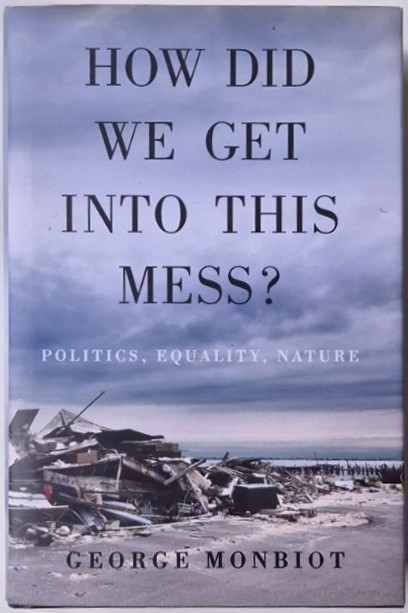
George Monbiot’s How Did We Get Into This Mess?: Politics, Equality, Nature, Verso, 2016, continues to shine.
In ‘Civilisation is Boring’ his prose really takes flight, soars and sings. He quotes the pioneering conservationist Aldo Leopold: “One of the penalties of an ecological education is that one lives alone in a world of wounds … An ecologist must either harden his shell and make believe that the consequences of science are none of his business, or he must be the doctor who sees the marks of death in a community that believes itself well and does not want to be told otherwise.” Monbiot adds: “I remembered that when I read the news that the world has lost 52 per cent of its vertebrate wildlife over the past forty years. It’s a figure from which I’m still reeling. To love the natural world is to suffer a series of griefs, each compounding the last. It is to be overtaken by disbelief that we could treat the planet in this fashion. And, in the darkest moments, it is to succumb to helplessness, to the conviction that we will keep eroding our world of wonders until almost nothing of it remains.” That is an all too familiar feeling.
From our primal origins in the savannahs we still carry “a ghost psyche, adapted to a world we no longer inhabit, which contains – though it remains locked down for much of the time – a boundless capacity for fear and wonder, curiosity and enchantment. We are pre-tuned to the natural world, wired to respond to nature.”
The problem lies in our ability to compartmentalise, boxing ourselves out of the natural world.
I think I have made the point before, but why are SSSIs (Sites of Special Scientific Interest) only of scientific interest – they are so much more than that? The word “reservation” suggests alienation and Monbiot gives us an old Native American joke: “We used to like the white man, but now we have our reservations.” He also quotes from the inexplicably unfashionable Auden’s poem ‘Et in Arcadia Ego’, also the subject of the famous Poussin painting:
Her jungle growths
Are abated,
Her exorbitant monsters abashed,
Her soil mumbled …
the autobahn
Thwarts the landscape
In godless Roman arrogance …
The farmer’s children
Tiptoe past the shed
Where the gelding knife is kept.
We choose not to see.
In ‘The End of an Era’ Monbiot talks of the consumption machine, the pointlessness of those global climate summits, and later argues against the ‘population myth’. The populations of poor countries may be burgeoning, but it is not they who cause all the damage, that is in the realm of the excesses of the super rich.
In ‘The Dawning’ he writes of our sheepwrecked landscapes. I love sheep and I suspect Monbiot has tongue firmly in cheek when he professes to hate them, but of course we have far too many of them and the farming of them causes incalculable damage. I am fond of dogs too and would help any animal in distress, but one of the reasons I switched to wildlife rescue is that whilst we have a surfeit of dogs and sheep, we don’t have nearly enough wildlife.
On animal farming, we again choose not to see: “Familiarity can render any kind of horror invisible, and the common modes of livestock production are no exception. It is the unfamiliar that attracts opprobrium, even if it inflicts no harm.
The great majority of farmed meat, in my view, is unethically produced. The treatment of farm animals, particularly intensively produced pigs and chickens, is a suppurating open secret, sustained by tacit consent in a nation that purports to love animals and lavishes affection on dogs and cats. Pigs are just as intelligent and capable of suffering as the pets we treat almost as if they were children.”
I have made this point countless times. My mother lavished affection on our little dog but happily consumed veal and foie gras, both of which I refused to eat from a very early age.
‘Sheepwrecked’ is actually the title of one essay. It’s a great word, perhaps a Monbiot coinage. The old notions of the pastoral idyll, the idea of the lamb of God, seem to block our willingness to know how heavily subsidised sheep farming is. In Wales in 2010 the average sheep farm received a subsidy of £53,000 but the average net income was £33,000. It’s madness. This tallies with my constant refrain that the farming industry mythologises itself and although often no doubt extremely hard is exempt from the restraints and taxes imposed on other businesses.
The soil crisis both in terms of fertility and flooding is a subject especially close to the author’s heart (he has written an entire book about it).
“So goodbye fertility. Goodbye to the land’s capacity to absorb and filter water, hold carbon and support crops. Goodbye to clean and healthy rivers. If the NFU and the British government had set out to damage the interests of this country they could scarcely have done a better job. Their work is a monument to short-termism and stupidity. Remember, next time you hear them say that Britain should produce as much of our food as it can, how they have helped to destroy our capacity to do so.”
Describing Owen Paterson as “the worst Environment Secretary this country has ever suffered” (he may have changed his view a decade later given some of the incumbents we have have suffered since this book was written), he quotes this idiocy: “‘I am absolutely clear that we have a real role to play in helping hill farmers to keep the hills looking as they do.” Bare and lifeless then. A report by Animal Aid a decade or so ago revealed that grouse estates in England, also barren landscapes which cause flooding (and many other environmental problems), received some £37m in public money in the form of subsidies although they only serve the very wealthy.
The land does not exist only to support landowners and farmers, waterways are not there to just ‘get rid of water’. Straightened rivers, the destruction of trees in the hills and insensitive farming methods cause terrible damage and yet it is all paid for at public expense.
Birdwatch

In Birdwatch, January 2026, Issue 403, Mark Avery makes no bones about the current government’s condemnation of wildlife for allegedly stifling the economy. As he says, this was no slip of the tongue and those who care about these things will not forget it. I recall very clearly my genuine shock when Reeves and Starmer said them.
The cover features a Snow Goose which, to my surprise, is “one of the most abundant … species of wildlife in the world.” Those in the UK are not necessarily escapees from captivity but may be vagrants from North America and there are also small but established feral populations. In America, flocks may gather in their tens of thousands or millions. Another piece in this issue in similar vein reports on American Wigeon in the UK.
Leave a Reply