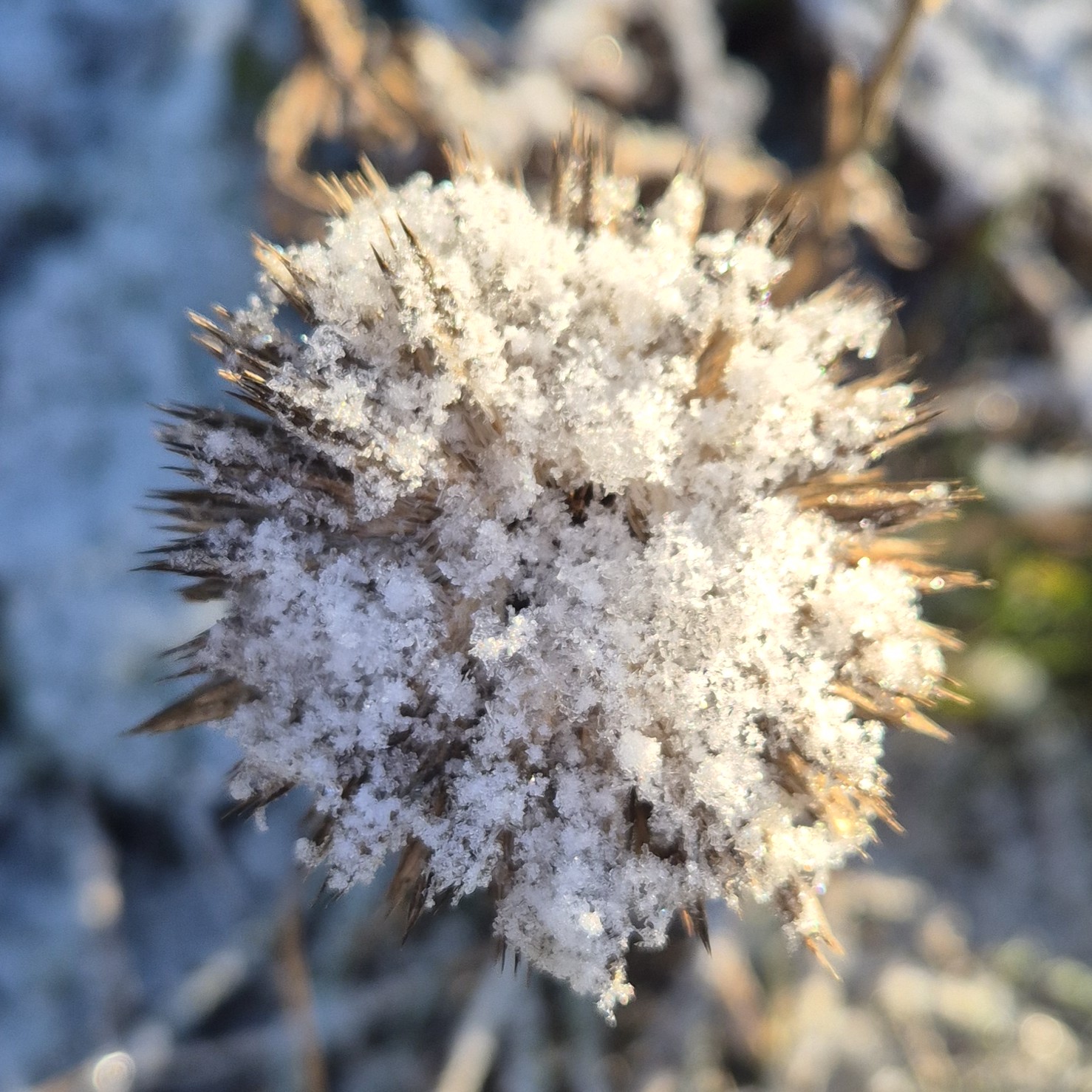
Above, a little celebration of snow in the garden. The other photos in this post are from a folder on my PC which I had forgotten and were taken in 2018. I used a trailcam a lot then and seem mostly to have recorded squirrels, but I had not remembered the visits of a Jay. Starlings were also present in numbers on a daily basis back then.

The December issue of Birdwatch magazine (402) has a Rough-legged Hawk on the cover, and is almost entirely devoted to rarities and twitches, but there are always the amazing photographs. And as more often than not I enjoyed Mark Avery’s piece. He suggests that wildlife charities would be better off without their royal patronage – that is far more beneficial to the patrons in the form of greenwashing them when they should be being called out for their continuing devotion to shooting grouse and pheasant with all the concomitant damage to wildlife and landscape which that entails. Many RSPB staff, he says, had uncomfortable encounters with prince Philip who showed his displeasure to Avery himself at the RSPB’s exposure of the two witnessed deaths of Hen Harriers at Dersingham Bog in 2017.
Alan Tilmouth makes me want to again enjoy the wildlife of Northumberland and we are seeing a rise in numbers of Bonaparte’s Gull in Britain and Europe, unusual in that it almost always nests in conifers. It’s terribly sad to read the celebration of White-tailed Sea Eagles return to our skies given recent news (Empathy and gratitude; foxes, raptors, swans, cows, deer, legal matters and more – Animal Wild).

Articles on gardening and photography (especially with regard to AI) are interesting and even more so is to learn that birds, like us, can be left- or right- ‘handed’ or footed. They can use each eye for different tasks such as searching for food or scanning for predators, whilst Northern Gannets are consistent in the way in which they turn before beginning a dive. Crossbills beaks cross to the left or right which determines how they go through a cone looking for seeds.

I am grateful to Lucy McRobert for recommending the film Listers: A Glimpse into Extreme Birdwatching, available on Youtube. It’s an affectionate documentary about two kind and gentle stoners who travel round America with almost no knowledge at the outset, becoming highly adept at spotting and identifying the many species they catalogue on their long, rather haphazard road trip around America.

Thylacine
The latest post from Chris Philpott has once again struck chords in me.
Lessons After the Last Thylacine | Wild Island
The Thylacine, aka Tasmanian Tiger and Tasmanian Wolf was a carnivorous marsupial native to Australia, Tasmania and New Guinea. The last known Thylacine died in a zoo in 1936. Otherwise they were wiped out possibly because of the introduction of Dingos and by various factors but especially farmers in Tasmania who saw the animals as a threat to their livestock – bounty hunting was introduced in Tasmania, their last redoubt, in the nineteenth century. They did look wolf-shaped with tigerish stripes on their backs. Their name derives from thýlakos meaning “pouch”.
Chris sagaciously makes the point that “Extinction is rarely dramatic” – it is often a gradual, unnoticed process. The decline of the Thylacine was well-known however, inaction and the postponment of action brought about their end. Rarity, says Chris, is a warning sign which should not be ignored. Extinctions happen because “the systems meant to protect … fail to intervene in time.” “The more enduring value of the Thylacine lies not in what might be imagined after its loss, but in what was ignored before it. … What it leaves behind is simpler, and harder: a clear demonstration of what happens when action is deferred until absence becomes permanent.”
“Extinction is preventable, until it is not.” It has been a constant refrain of this blog and even the subtitle of Animal Wild: “a celebration of wildlife and a clarion call.” These matters are urgent, they require action now. Timid governments all too often in thrall to the powerful lobbying groups – farmers, the building and road-building industries, those who kill for fun – seem forever to be kicking things into the long grass, allowing transition periods for threats to our ecosystem to be phased out. The absurdly protracted banning of lead shot is a classic example. These delays may appear to come from a place of reason, but we don’t have time for them. It will be too late.
Penguins in prison
Another example is that of the Gentoo Penguins imprisoned below ground at the London Aquarium. See Ivy flowers, WordPress nags, a canal journalist, chuckwallahs, Wild Justice, planning, autumn leaves, penguins in prison, a butterfly healer, Hamza Yassin, Hitchens and Fry on the Catholic church, and first fungi of the year – Animal Wild. After much protest there was only silence from Sea Life but now they have said they have made “meaningful progress in identifying areas for action”. How mealy-mouthed is that? They have committed to nothing except to discuss the matter further. Protect the Wild will be keeping a close eye on their progress.
HS2
I wrote about HS2 at length in Animal Wild. Unsurprisingly, except to its political supporters, much of the unneeded and unwanted project has now been cancelled. But the damage has been done. Some compulsorily purchased homes now sit empty and are falling into disrepair. Many are being rented out which an HS2 spokesperson describes as “income for the taxpayer – ultimately offsetting costs incurred by the project.” It’s a drop in the ocean of wasted money and resources.
HS2 made me sell my home, two years later it’s empty with the doors hanging off
Pheasants
Protect the Wild are also drawing attention to the factory farming of pheasants: “Almost unnoticed by the media was another issue that has relevance to this Substack, poultry breeding cages. That’s because poultry’s ‘sister sector’, the shooting industry, absolutely parallels its treatment of birds.” Representatives from PtW and Animal Rising were refused permission to hand in a letter to the Home Secretary on the technicality that they did not have a named contact in the building.
I wrote in Animal Trust:
I used to eat pheasant, in the mistaken belief that their lives were at least better than those of farmed animals. But the truth is out of the box now, and it can’t be put back in. The battery farmed chicks have tape or brail put over one wing for months on end to stop them flying away and plastic devices (bits) attached to their beaks to stop them from pecking each other (this information only emerged after a liberation – the pheasants, we were told, would not be able to survive outside for those reasons; they didn’t seem to realise how damaging the revelations were).
Woodcock
A BirdGuides headline announces that Woodcock decline on a Scottish island has been linked to shooting activity. “…the breeding population on Colonsay, Argyll, has declined to the point of extirpation. Accordingly, the paper concludes by calling for a review of the extent, scale and intensity of shooting of Eurasian Woodcock in Scotland.” Is there any living thing these people don’t want to murder for ‘sport’? I confess I ate Woodcock once in a posh restauarant in Mayfair many years ago. I didn’t know anything about the bird but remember there was not really very much meat and my horror on realising that the skull had been tucked into the rest of the body, which seemed to symbolise how unnecessary and awful it is to hunt these birds at all.
Ticks
The rise in numbers of ticks in the UK owing to climate change has inevitably seen a rise in the associated risks, including alpha-gal syndrome, an allergy usually to red meat and most dairy products. It can be fatal and there is no cure. A Scottish sufferer who had carefully made a dairy-free apple crumble had not been aware that the sugar she used had been refined with cow bone char. Skulls and spines are no longer used to prevent the spread of Creutzfeldt–Jakob disease. The old joke about how to tell if someone is vegetarian or vegan (don’t worry, they’ll tell you) arises because it really is extremely difficult to avoid animal products altogether. I was astonished to discover at a local vegetarian market some years ago that wine is not vegan by default. Various animal products are used in the clarification process known as fining, including isinglass from fish bladders, gelatin, casein and egg whites. To my eternal shame I am neither vegetarian nor vegan, forswearing only red meat, but this is an egregious example of the need for more honest labelling throughout the food and drink industries. As with factory farming, at least allow us to make informed choices.
Leave a Reply