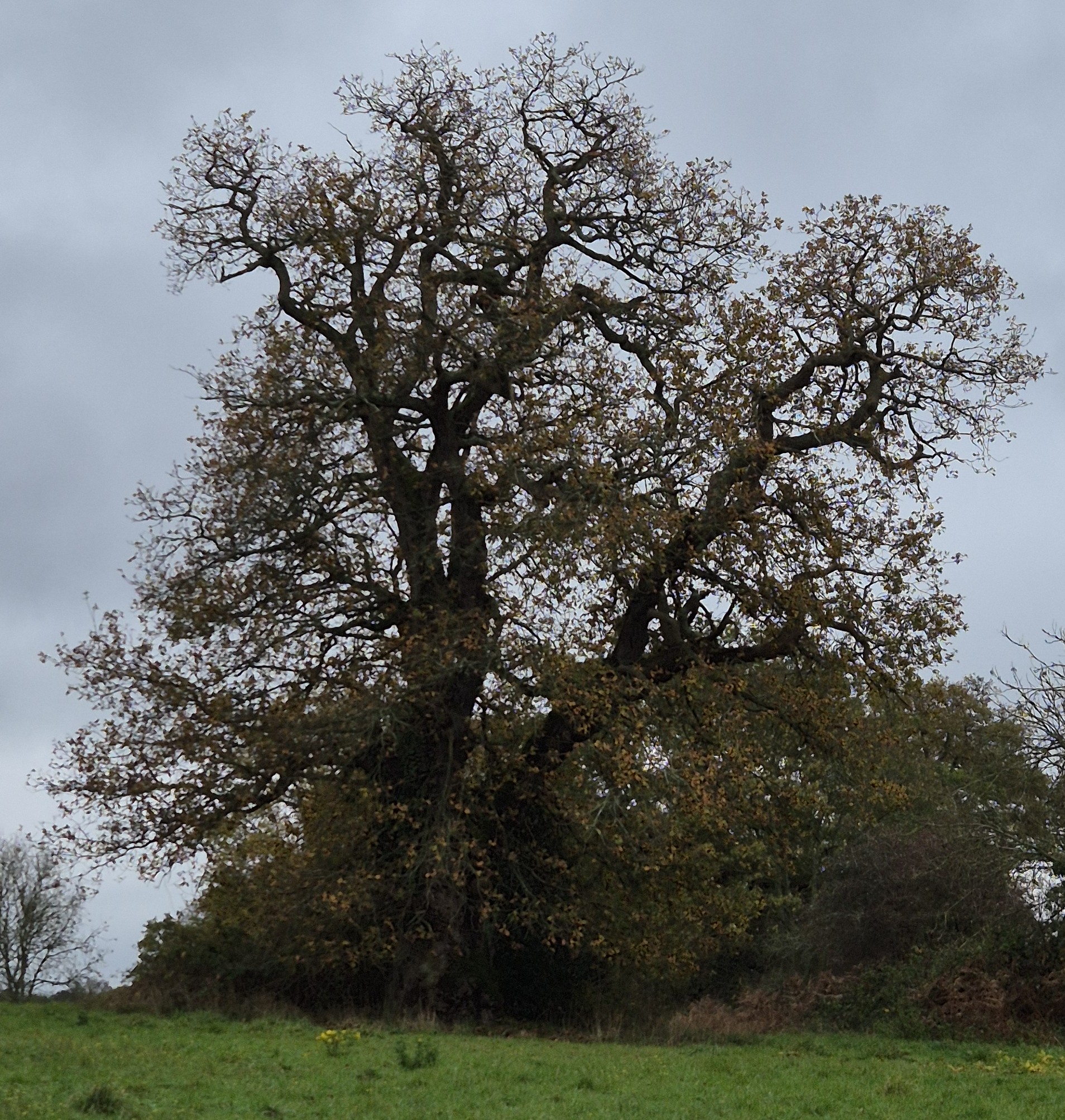
Another adjectival word for oak trees is, delightfully, “quercine”. It’s an oak at the head of this post.
For once I see no harm in revealing the location of our badger group’s planning and infrastructure related survey: Sandleford Park in Newbury. This has been hugely controversial since 2012. The original application was for 360 new houses, now it’s for potentially 1,440. Apart from any other considerations, such as the destruction of ancient woodlamd, it is the setting for Richard Adams’ Watership Down, in which the rabbit warren was … destroyed by developers. So in a few years time it is likely that everything below will have been obliterated.
Our brief was to look for evidence of badgers and setts. We did not find the main sett until near the end of the daylight, although we had seen latrines and any number of runs across the fields as well as a couple of subsidiary or outlier setts which we already knew about We were pleased to find it (some twelve to fifteen holes) but saddened by it’s great proximity to the proposed development.
We saw Hares, Muntjac, Buzzards, Pheasants, Linnets, Redwings, and heard Nuthatches (which sound as one of our more ornithologically knowledgeable members said like a referee’s whistle).
Most of the identifications below were provided by AI, specifically Google and Gemini. Gemini is my preference and it seems to have improved remarkably in very short order in terms of identifying fungi. I wonder if that is because lots of people are asking about them at this time of year. Does it really improve so much so fast? Probably yes. But it also went a bit mad. It went off ‘on its own’ answering questions I hadn’t asked, suggesting mushroom recipes, nearby walks and even train times. I had to close it and start again at one point. It was also rather obsequious, praising my photography and capture of “a whole ecosystem”. It did provide a great deal of useful information however.
I would still certainly take identifications below with a pinch of salt.
There is, incidentally, a new album out by Stick Figure, a reggae band I love and have seen live. Not for the first time, the tracks include a respectful tribute to roots reggae songs of old. This time it’s Burning Spear. I couldn’t quite put my finger on which track they were using, so I asked Gemini. I gainsaid both the first and second answers, each of which was repeated. A quick check revealed that it was the classic ‘African Postman’, and a fine act of homage it is. Gemini accepted my own answer and, sort of, promised to try harder. If there’s one thing I know about it’s the music of Burning Spear. It’s somewhat worrying that the errors were obvious to me but authoritatively made. It reminded me of newspaper stories about old, rare books and manuscripts – an area where I do have a certain expertise. Almost invariably, crucial details were simply wrong.
To the fungi. Much to see and almost no overlap with those I saw at Savernake Forest a few weeks ago.

Oak Crust or similar
Two very large fungi:

Hen of the Wood (Grifola frondosa)

Hoof Fungus or Tinder Fungus (Fomes fomentarius) or Southern Bracket or Artist’s Conk (Ganoderma australe)


White-footed Parachute (Marasmiellus candidus)
But Gemini wisely adds: “Due to their small size and lack of distinguishing features, many tiny white fungi require microscopic examination for a definitive species ID.”
It also helpfully pointed out that these four species serve different, highly specialised functions. Hen of the woods kills weakened trees, decomposing and consuming cellulose and lignin evenly. The bracket causes decay in the heartwood, the Oak Crust, a secondary or late stage coloniser, affects the outer layers of dead wood and bark whilst the Parachute works on twigs, leaves and fine debris.
“In short, your photographs captured a beautiful cycle of decay, where each fungus has a specific niche in breaking down the mighty oak, from its roots and core to its fallen branches and bark!”

Probably a type of Bonnet Mushroom


Large and colourful Red Banded Polypores (Fomitopsis pinicola)
These cause brown rot in the wood, primarily breaking down the cellulose leaving the lignin behind.

Hairy Curtain Crust or Oak Curtain Crust
To be sure which, it seems, you must cut into and if it ‘bleeds’ ‘red then it is the latter.
The next two were brightly colourful.

Possibly one of the Russula (Brittlegills), most likely the Yellow Swamp

Another Bonnet Mushroom, possibly Yellow Fieldcap

My favourite of the day, the Shaggy Parasol (Chlorophyllum rhacodes) or a Parasol Mushroom (Macrolepiota procera). The smaller fungi at its foot may be Waxy Caps

Common Garden Slug from the Arion genus

Oak Cherry Gall
Found on the underside of an oak leaf as is typical, these are caused by the “entirely harmless” Oak Cherry Gall Wasp. The female wasp lays an egg on the leaf’s central vein or a large side vein and the plant tissue reacts by forming a protective gall, providing both shelter and food.

Yarrow (Achillea millefolium)
I am surprised I haven’t noticed this beautiful plant before. The genus name derives from Achilles who apparently was taught to use its astringent properties to treat battle wounds, hence it’s alternative names of Soldier’s Woundwort and Bloodwort.


Lesser Celandine (Ficaria verna, formerly Ranunculus ficaria).
A member of the buttercup family, known of course for their flowers’ highly reflective surfaces. Mild weather has caused its persistence to mid-November – it appears in spring and has usually died back by now.


Oakmoss Lichen (Evernia prunastri) not a moss
I am reminded that liches are composites of fungus and alga in a symbiotic partnership. They have no roots as such, using rhizomes for attachment only, able to grow pretty much anywhere, albeit very slowly.
The badger sett at last:

I had not anticipated the drop in temperature and could certainly have done with an extra layer or two, but when the sun came out the light was beautiful.


Two more Oaks

The planning application. From my experiences behind my house, I have come to dread and abhor these much too small orange posters. The language is typical of such things, promising: “provision of open space [how much?], drainage [one would hope so], walking, cycling, green and other associated infrastructure.” All unquantified. What does “green and other associated infrastructure” even begin to mean?
There were signs of ecological survey in the form of hundreds of baited boxes from which it is possible to identify populations of, for example, dormice, but there is no mention whatsoever of the badger sett. They can get away with that because it is located just outside (a few feet away from) the boundary of the development site.
Leave a Reply