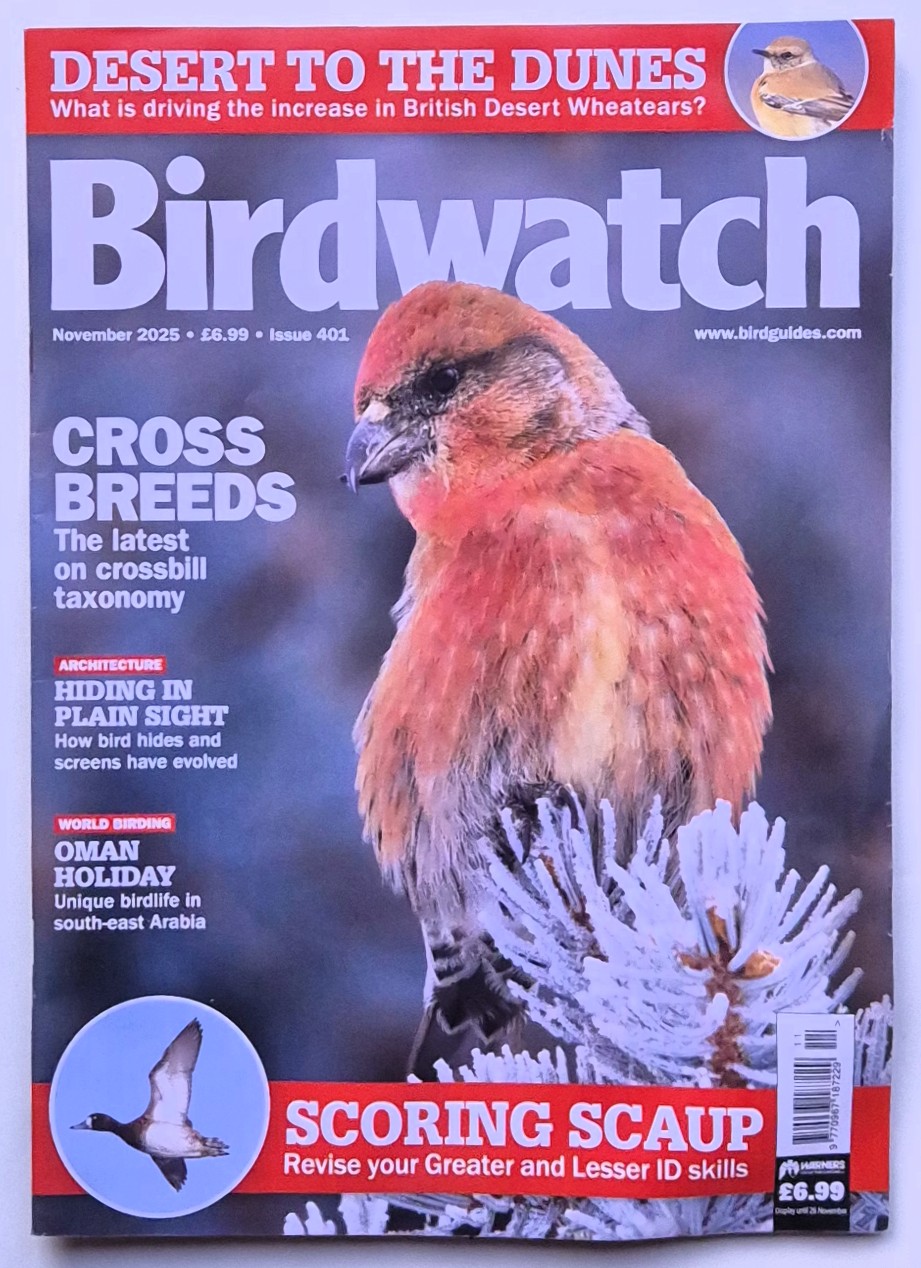
Birdwatch magazine November 2025
Issue 401
A Crossbill on the cover this month, a kind of finch with bills specially adapted to enable them to extract seeds from pine cones. Which does leave them with restricted potential habitats. The various species “with so many subtle clines in both features and calls, the genus Loxa poses a classification nightmare”. “Cline” is one of those words I always have to look up. Some words just don’t stick. “Abject” is another. It occurred in adverbial form as my one stage direction in a school play but it has two rather different primary meanings, so it wasn’t a very useful direction. It can mean extremely bad or servile (as in “abject apology”). Gemini AI offers “A cline in biology is a measurable gradient (gradual change) in a single characteristic or biological trait of a species across its geographical range.”
There’s a focus on Scaup, Greater and Lesser. When I saw the photograph on the contents page I immediately thought this was a Tufted Duck, but they are congeners so it wasn’t the worst mistake.
Twitches include the Madeiran Storm Petrel, Pechora Pipit, a Yellow-browed Bunting and more amongst the season’s arrivals.
A BirdGuides trip to the Fens looks wonderful, promising special encounters. I would really enjoy the large flocks of Lapwings and Plovers, Whooper Swans and other seasonal visitors like Wigeon, Teal, Pintail and Shoveler. This would be in January and I’m increasingly intolerant of the cold, but a good hotel might mitigate that. At very nearly £1,750 for just four nights, admittedly including evening meals, transport and guides, that is what I would expect but TripAdvisor is far from encouraging on that score. I do think the organisers of these things need to pay more attention to accommodation.
David Campbell writes about his learning more about weather in order to better anticipate migration events. Good for him, but this is a subject where I just feel my brain is already too full. For the same reason I have never learnt about incunable books, those published up to the end of 1500, a decision made early in my bookselling career – there was more than enough to learn about all that came later.
There’s been a boom in the number of Desert Wheatears recorded in Britain at this time of year, possibly another consequence of climate change. They are exceptionally, subtly, understatedly pretty little birds.
I hadn’t ever given much thought to bird hide design, but David Callan writes about some of the more unusual examples around the world.
Cleveland Lakes Nature Reserve
I first visited here in early spring. I thought to return, with the bike this time, in the hope of seeing more birds – some seasonal migrant ducks perhaps. It was disappointing in that respect but there were two things I had completely missed in the car park: not a gate, but I like it, and a stone bench, the shape of which I love.


I did see four Mute Swans, a Grey Heron and a Cormorant and an unidentified gull but that was about it for waterbirds. The Merlin app heard a Hawfinch but I didn’t see it – it would have been a first. Long-tailed Tits, however, seemed to be everywhere. They were typically secretive and fast-moving but I did manage thirty second or so with one of them sitting in a tree very close. Lovely.
TV and movies
I piled praise on Hamza’s Hidden Wild Isles on the BBC in my previous post and so was surprised to see a viewer’s unpleasant remarks. I tend to agree about the overuse of intrusive music in these documentaries, but someone said that this “should be about the beautiful footage captured … not about him, his friends or his family.” I don’t think Hamza seems egotistical in the slightest, his friends were also experts in their fields and I found his sharing his enthusiasm with two young nieces enchanting.
Nature and birdwatching are undeniably good for the soul and I usually relish the solitude. Just for a time, everything else goes away and I am only in the present and in harmony with the natural world around me. This was perfectly expressed by ‘amateur’ bird watchers in this charming, award-winning documentary, The Birdatchers: The Birdwatchers | award-winning nature documentary
You don’t need to be an expert but the learning is fun. But as per Hamza and his nieces, sharing the joy can be wonderful too. It did get me thinking again about ringing. We really should only be doing this as a last resort. Of course we need information to save them, but I cannot believe that it is not a traumatic process, nor that the birds are at least aware of the admittedly very light rings. They may be irritating. Again, I appreciate the need, but I hate seeing big cats with those heavy tracking collars. A friend who would know says that they often mean parasites and infections which the animal cannot deal with. And that there can be far too much competitiveness amongst those who fit the rings and collars. Certainly the justification for ringing at Walthamstow Wetlands rang rather hollow. We know the birds are there, we can see and hear them.
This seems like good news to me and a real benefit of AI: Why Hollywood’s Animal Actors Can’t Find Work. “People for the Ethical Treatment of Animals has long pushed to eliminate real animals from film and television sets, arguing that making them work for human entertainment is cruel and exploitative.” Quite. And there is plenty of history of animals being treated very badly indeed by the industry.
I much liked Chris Packham’s unashamed tree-hugging on his televised pub walk. It has become such a catch-all term. Someone recently said to me “I know you’re the tree-hugging type but …” before going to make racist remarks. I know he’s a homophobe too. How weird that he thinks tree-hugging means being against those things, which of course I am, but it’s not the same thing.
Red Admiral, Red Squirrels, Harvest Mice & Great Tits
A late appearance of a Red Admiral in the garden – and I am not alone. I have seen reports of other sightings which is most unusual this late in the year.
I have been convinced of the continuing presence of Wrens in the garden for some time, thinking that was one bird song I really knew. I am not ruling out the possibility but the Merlin app identified Great Tits not Wrens recently. It seems Great Tits do a great deal of confusing imitation. Although it may just be my lack of knowledge.
With a mast year and plentiful supplies of food, Red Squirrels have been doing well with populations climbing in various places around the country. Good for Grey Squirrels too but as I have long argued, describing them as “dreaded” is ridiculous. Yes, they do carry a virus which is lethal to the reds but at one site none have been spotted for four years. If it comes to it the introduction of Pine Martens which preys on the greys but cannot reach the higher dreys of the reds seems an ideal solution.
There is an excellent informative piece about Harvest Mice here: Mammal watch: Harvest Mouse – BirdGuides. I didn’t know that, uniquely amongst British mammals, they have prehensile tails, nor of the intricacy of their ball-shaped nests. One commenter suggests that they are not so much nocturnal as supposed but that is based on studies of captive mice which seems almost irrelevant.
Every Last Fish
As ever I have too many books waiting to be read, far too many, to order this one, but I was fascinated by a review of Rose George’s Every Last Fish: What Fish Do for Us and What We Do to Them, Granta, 2025. She exposes the horrors of salmon farms, illegal dredging of marine protected areas, the trafficking and abuse of workers in the industry, and the collapse of African fisheries where fish have been hoovered up to feed foreign fish farms (the irony). One in five of the fish we buy “will have been caught by a vessel operating outside the law.” As many as half “may be mislabelled as a different species.” Regulation and monitoring barely exist and are certainly not fit for purpose. Rose George uses the plural “fishes” to remind us of their individuality just as I aim to do with ‘game’ animals. We do terrible things to fishes and “pretend their mouths are numb.” She respects the fishermen she meets and goes out to sea with but when she asks a skipper whether the fish he is gutting are alive or dead he says he doesn’t know and hadn’t ever given it any thought.
Pure Capitalism
As everyone I have spoken on the subject to waits in fear for the upcoming budget, I have been thinking about the kind of capitalism, born of Thatcher, which now prevails and tried to find a term for it. Neo-capitalism is already taken and apparently refers to a relatively humane system, and also taken are hyper- turbo- and supercapitalism. So pure or extreme, unfettered capitalism is the best I can come with for now. The water industry in the UK is the perfect example. And we seem to live in a kleptocracy. Obligatory company annual returns, now known as confirmation statements cost £1 in 2023. In spite of increasing computerisation, this rose to £34 in 2024. Quite a hike. Now it is to go up even further to £50. It’s a classic stealth tax. It might not seem a huge sum but it is an increase in just two years of nearly 285%. I have to file for three companies and so £150 is not an insignificant annual cost. The government must be raking it in.
I haven’t posted for a while since I have been overwhelmed with work – the enjoyable but complex task of cataloguing a completist’s Mervyn Peake collection. Those were always my favourite collectors, the most fun, but they are few and far between now. Instead there are far too many, for my liking, people who see books as just another commodity to be traded without any real love for the objects.
The local paper reports the imprisonment for two months of a homeless man for stealing steaks from a supermarket worth less than £40. This seems out of all proportion. I expect he was hungry and penniless. It may be that he is very well known to the police indeed and this was the result of their wish to lock him up for just about anything, but it doesn’t seem right when, week in, week out, there are reports of paedophiles and other abusers serving no prison time at all.
“Steal a little and they throw you in jail, steal a lot and they make you king” – Bob Dylan.
Literature
W.S. Merwin
The Harry Ransom Humanities Research Centre at the University of Texas is one of our oldest and most important customers. I happened upon this on their website – the slickest I have ever seen and also rather beautiful: The Poet’s Voice in a Different Key. I know little about W.S. Merwin but am keen to find out more. I hope there will be a biography. “The garden makes for an astonishing expression of care for this world. In 1976, the poet W.S. Merwin arrived on Maui’s north shore to study with Zen teacher Robert Aitken. Soon after, Merwin found himself standing on the edge of a degraded landscape—its soil stripped by generations of extractive agriculture and its once-rich ecosystems long diminished. But what others might have seen as lifeless or lost, Merwin saw as possibility: “The condition of the soil did not, in itself, daunt me,” he wrote in The House and Garden: The Emergence of a Dream.“
““I had long dreamed of having a chance, one day, to try to restore a bit of the earth’s surface that had been abused by human ‘improvement.’ I loved the wind-swept ridge, empty of the sounds of machines, just as it was, with its tawny, dry grass waving in the wind of late summer.”
“Merwin’s garden itself is a testament to the idea that there is another way—another way of living, of interacting with the earth, of manifesting our concerns with communion and pleasure. In an essay titled Coming to Palms, he wrote: ‘A garden is made of hope, which contributes to its pleasure and its fragility. It cannot be proven, nor clutched, nor hurried. And the hope of a palm garden is to be a palm forest.’”
William Blake
A blogger whose posts I enjoy more than any other recently quoted these words from Blake: “The tree which moves some to tears of joy is in the eyes of others only a green thing that stands in the way. Some see nature all ridicule and deformity… and some scarce see nature at all. But to the eyes of the man of imagination, nature is imagination itself.” Starmer, Reeves et al., take note.
This is from her post Portrait of a tree: Cyrus | absolutelynotnormal
She is a teacher and sometimes writes of those trials and tribulations – and the rewards of that profession. I remember the teachers I respected, the ones who inspired me, and I am absolutely sure she is one of those, one of the really good ones.
J.R.R. Tolkien
It’s that time of year – I have been watching The Hobbit and Lord of the Rings yet another time. The extended versions. I love almost every moment although The Hobbit has flaws. The Lord of the Rings is perfect. I get more from it every time and understand Middle Earth that little better. New highlights emerge, perhaps not even noticed before: the concept of moon runes, for example, runes which can only be read by moonlight, sometimes only at the same time of year as when they were written. There’s always been for me Arwen Evenstar dealing with the Ringwraiths and Gandalf calling Shadowfax. And of course the Ents. Who are real. In the sense that we are learning more about how trees communicate with each other and make decisions. And there is the author’s mastery of the language. How beautiful is this in a heated exchange between treacherous Grima Wormtongue and Eowen, shieldmaiden of Rohan? Grima says to her: “Oh, but you are alone. Who knows what you’ve spoken to the darkness, in the bitter watches of the night… when all your life seems to shrink, the walls of your bower closing in about you… a hutch to trammel some wild thing in? So fair. So cold. Like a morning of pale spring still clinging to winter’s chill.”
Not to forget Gandalf’s famous words once returned as Gandalf the White: “Look to my coming on the first light of the fifth day, at dawn look to the east.
There is a great deal in the book about kings. Some are good, some malign, but they are idealised as strong figures of leadership and courage. How very, very different from the tawdry monarchy we endure now. Andrew Mountbatten Windsor with his absurd made up surnames is not the only one to have been caught being involved in dodgy dealing – so has the king. There cannot be much more for anyone to say about the Epstein connection (far from the only abuser to have been embedded in the royal family’s circle) but I became curious because it seemed to me possible that Andrew had not actually committed an illegal offence in that regard. In New York state the age of consent is 17. But in the U.S. Virgin Islands, one of which owned by Epstein, it’s 18 (with certain exceptions). So that seems cut and dried. No doubt there are more revelations to come.
Uncontacted tribes in danger
In other news: British influencers trying to reach uncontacted tribes ‘are a “growing danger”
“Influencers trying to reach uncontacted tribes are a growing threat to their survival, a charity has warned.
There are currently 196 remaining uncontacted Indigenous groups living in forests across the globe who have their own languages, cultures and territories.
But according to a new report by Survival International, a London-based Indigenous rights organisation, uncontacted groups are seeing ‘surging numbers’ of influencers who enter their territories and ‘deliberately seek interaction’ with tribes.
It explained how ‘adventure-seeking tourists’, influencers’ and ‘aggressive missionaries’ are becoming a growing threat to these groups as they introduce diseases to which isolated tribes have no immunity to.”
As a species we seem quite incapable of leaving things, animals and people alone.
Likewise: Mississippi highway crash releases ‘aggressive’ research monkeys into community | Fox News
What are we thinking?
Orca attacks
Another documentary: Scientists Explain the Mysterious Orca Boat Attacks
There are various suggestions but the answer is that we don’t really know why these are happening in the Gibraltar Strait. Possibilities include noise, bio-accumulation up the food chain of PCBs and heavy metals, the development of an ecotype like the populations who have learnt and pass on how to hunt seals on ice floes or beaches, or that it’s hunting practice, which seems unlikely to me. Most likely, I think, is that they are being playful although I rather like the idea that they are seeking revenge on our species. It certainly doesn’t surprise me that they like the feel of bubbles. We do, after all, we have our jacuzzis. And ducks do too. I really miss the ducks at HART Wildlife Rescue. When I refilled their small pools the braver ones would often come right up to the hose and absolutely revel in the bubbles I was creating.
WordPress Scams
Just a quick warning that I had a couple of phishing e-mails recently purportedly from WordPress, saying that I needed to update my payment details. They weren’t terrible in terms of authenticity and I did feel the need to check – such a waste of everyone’s time.
The Durrell Wildlife Conservation Trust
Good to see that following much pressure that the Trust has finally called an end to ‘pay-to-shoot- deer stalking on its Scottish estate. More good work from Protect the Wild and others. There will still be culling though. Contraception is a way forward supported by some. But re-introducing wolves and lynx is surely the solution. If only I had a pound for every time I’ve said that.
Trail hunting
More seriously good news. Labour has pledged, refreshingly, actually to honour one of its election manifesto promises. Trail hunting really will be banned. About time. And Protect the Wild has released a new video, narrated by Chris Packham as usual, this time about the mistreatment of the hounds. In just three years there were 2,444 welfare incidents involving foxhounds and they are simply shot if found unsuitable or no longer useful.
Trivia?
To end this rather long post, I recommend this for information and light relief: 20 Useless Bits Of Trivia You’ll Immediately Tell Everyone About
For example, there are more artficial flamingos in the world than real ones. A jiffy is an actual unit of time. The dot over a lower case “i” is called a tittle.
Leave a Reply