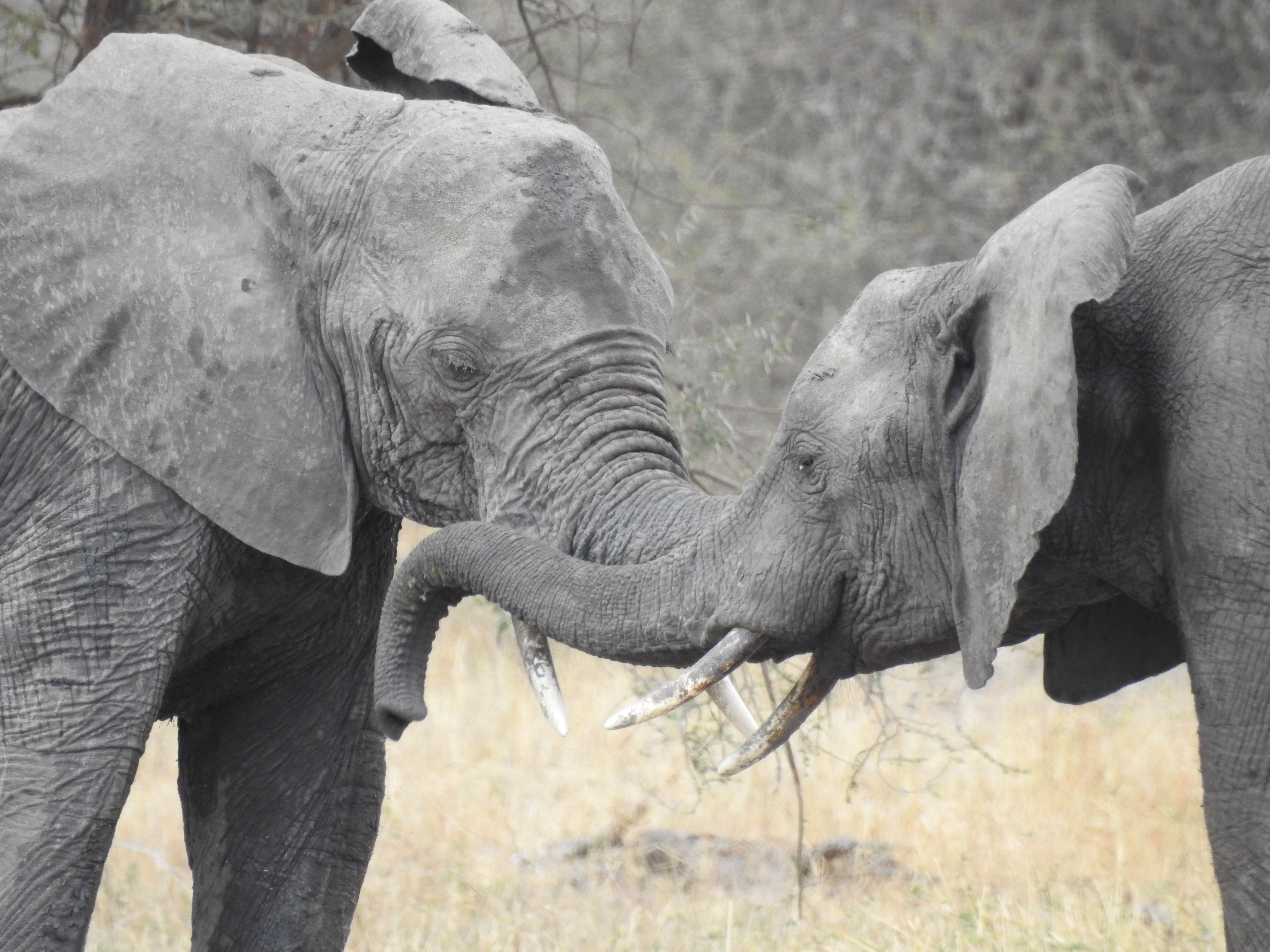
I took the picture above on my first safari in Tanzania and it was almost the first of the trip and I think one of my best, not because of any skill with the camera but because of the way it depicts the profound and emotional relationship between the two elephants greeting each other with love.
I watched two wild life documentaries on Youtube last night. The first was this:
When Giants Turn Nasty: Why Elephants Are Killing Their Keepers!
It’s a terrible title. Musth may be a contributing factor in many cases but mean and nasty are I think totally inappropriate descriptions for entirely understandable behaviour. Elephants in captivity turning on their mahouts or their keepers in zoos is hardly surprising. Any captive elephant will have been broken through torture as a calf, whether then used as a tourist attraction, as a temple elephant, or put to work logging or ploughing fields. Mahouts believe they develop a bond with ‘their’ elephants but punishment is always on the cards – the bullhook or ankus, a truly nasty weapon, is used to inflict pain and fear and is rarely out of a captive elephant’s line of sight and is applied to their most sensitive parts. They are chained, incarcerated, forced into unnatural behaviours and develop stereotypical behaviours as a result of their mental anguish. I am amazed that these last straw moments don’t happen more often. I have a very simple solution to this problem: do not keep elephants in captivity, at all, ever.
More problematic, less easily resolved are attacks on humans by wild elephants. I may celebrate the killing of a hunter, by elephant or Cape Buffalo (as happened recently) and the death of a matador in the bullring, but obviously not people killed in rural villages trying to protect their crops. It is suggested in the documentary that some elephants may be entering villages with no intention of eating but solely for the purpose of taking out a human or two. One can hardly blame them – their land has been encroached upon and arable crops provide easy pickings. They are hunted for their teeth. As Mark Shand says, they are angry. He does know what he is talking about and is the author of Travels on My Elephant, Penguin, 1992 and Queen of the Elephants, Jonathan Cape, 1995, but note the possessive pronoun in the first title. As he also says, if an elephant wants to kill you they will – as fast as a racehorse in short bursts, there is no escape. Sometimes they kill by crushing, sometimes they just rip people apart.
I do take issue with the statement in the documentary that elephants only “perhaps” grieve and mourn. Surely there is no longer any doubt about that.
From Animal Trust:
One of my very favourite wildlife observations is that African elephants’ ears are shaped like the continent of Africa, whilst Asian elephants’ ears echo the Asian continental outline. Instead of quietly marvelling at this, we enslave them, using the vicious ankus, a metal hook, to control them. Mark Shand, in his Travels On My Elephant, makes a halfway decent fist of justifying this, having been initially appalled by it, arguing that it is simply the only way to control them. But the possessive pronoun in his title gives the game away. How about not using and controlling them at all?
And of a holiday in India:
About fifteen years ago I also reported to PETA the desperate plight of a temple elephant in India, kept chained in the dark, unable to move and with open sores from the chafing of the restraints. Pain and sadness were in her eyes. At the time they were not in a position to act, but temple elephants have been released since and huge progress is being made in India through positive direct action, the establishment of sanctuaries and, crucially, education – a programme called Compassionate Citizen has reached nearly sixty million children.
In Jaipur, having befriended another family on holiday and sent the children off to get to know each other after supper, we talked animatedly about our day. The other couple said that the absolute highlight for them was seeing the elephants and riding on them up to Amber Fort. I was not in the mood for an argument, didn’t really want to spoil their moment and decided to let it pass. They wouldn’t leave it alone though and urged us to enjoy the experience ourselves. After a third or fourth repetition, I had to say something rather than muttering darkly to myself, and so I stated that there was no way I was going to do it. They were intelligent people and asked me why, so I told them. They were horrified at their thoughtlessness. “Of course, we should have thought about provenance, we should have thought about how they are treated.” I had done exactly the same thing many years before – I had ridden on an elephant in Thailand, blissfully ignorant of the reality.
In Jaipur, some one hundred elephants are ridden up and down the steep hill on cobbled streets in the blazing heat. To get them to that, broken point, they would have been viciously and violently beaten and punished. I have seen footage of the breaking of baby elephants in Thailand, in that case as often with their mothers chained nearby (if their mothers were not killed when they were first captured) so as to completely break their spirit. It will haunt me forever. It happens that since then the use of the Jaipur elephants has been widely protested and PETA are now on the case, to some but not yet enough effect. When they are not working, they are usually kept in cramped and filthy conditions, chained so tightly that they can scarcely move, and subject to all kinds of injuries and disease, especially of course to their feet. Gajender K Sharma, country director for the World Animal Protection organisation, also says: “You can see the suffering in their eyes. The eyes are saying ‘this is enough, this is enough.’ ”
The second documentary can be seen here:
Australia’s Most Destructive Creature
Cane Toads (Bufo toads, Bufo marinus) were brought to Australia in an attempt to control crop destruction by Cane Grubs. It’s a pretty well-known and typical story of what happens when people interfere with ecosystems in this way. The commentator points out early on: “After dutifully carrying out exactly zero studies on the potential impact on the Australian environment, they imported 100 toads from Hawaii and let ’em loose … 100 toads quickly became 1,000, and then 10,000 and then 10 million and then 100 million.” What I hadn’t realised is that although they are omnivores, they eat pretty much anything except Cane Beetles, which perch too high off the ground for them to reach whilst the larvae living underground are also unobtainable. The toads are huge, highly poisonous and spreading rapidly. The problem is unlikely ever to be resolved.
Native species have suffered of course, some at risk of extinction. They haven’t had time to evolve strategies and defences to deal with creatures with whom they have not co-evolved. Some though, such as Australian Water Rats, have developed ways to prey on the toads without being poisoned.
The eggs and tadpoles are poisonous too and Cane Toads lay a lot of eggs, up to 40,000 at a time. On top of that, range expansion has been accelerating. In one of those instances of fast-forward evolution, the toads have been developing longer legs – they can move faster and further. The only upside is that they are also evolving a taste for cannibalism (mostly the tadpoles).
___________________
This creature appeared on the window this morning.

It seems to be a Southern Oak Bush-cricket. They are apparently hard to distinguish from a ‘regular’ Oak Bush-cricket but I am convinced by the shape formed by the cerci, the appendages at the end of the abdomen, that this is a male Southern – the female has an ovipositor instead. The species is fairly new to the UK, first recorded in 2001 and they are wingless.
Leave a Reply