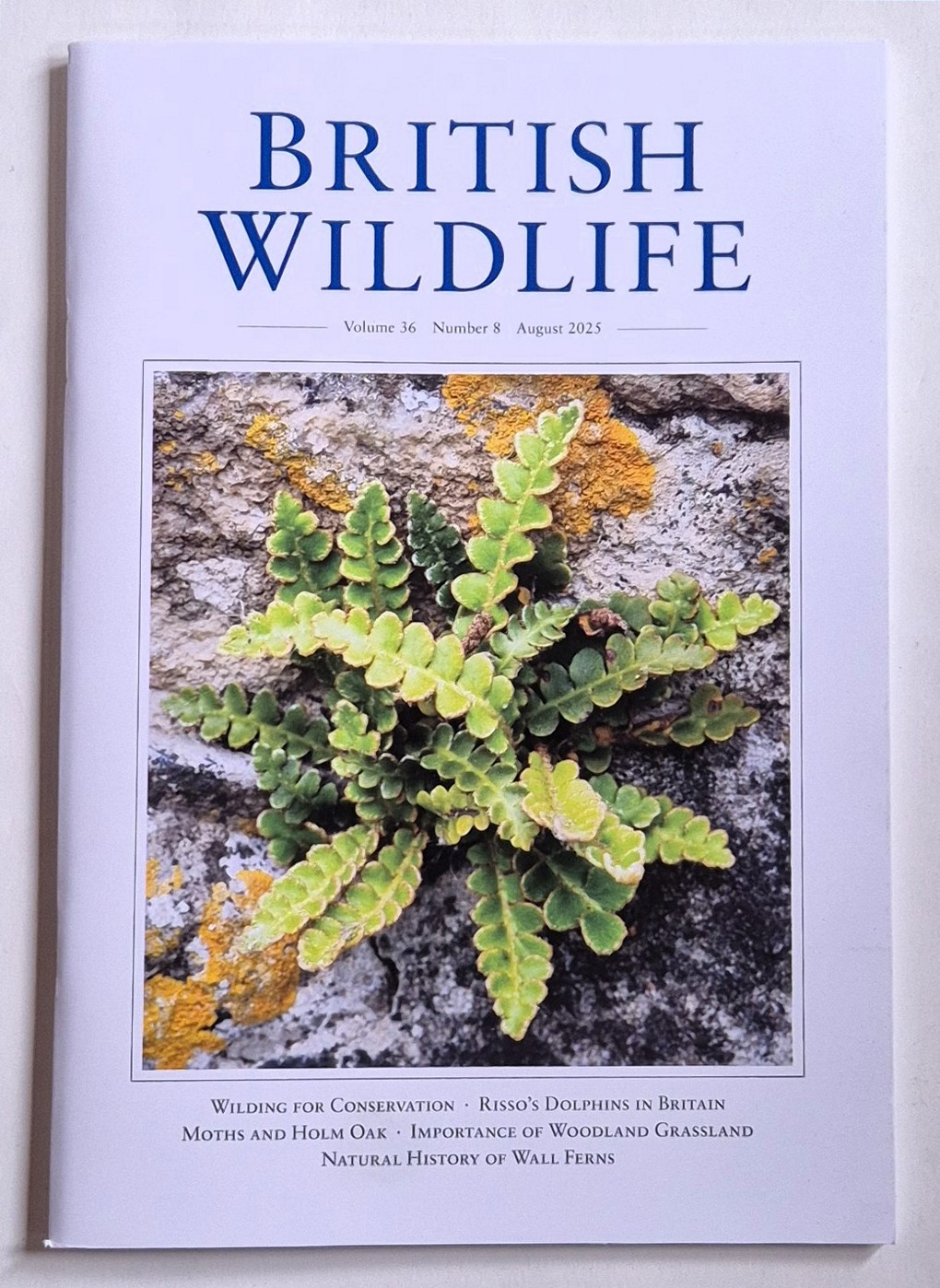
Volume 36 number 8
It seems quite brave to put a ‘humble’, unglamorous fern on the cover, but I love ferns so it works for me. Specifically it’s a Rustyback Fern, Asplenium ceterach.
This issue opens with the last of the Wilding for Conservation series, 26 articles, a reflective piece by Rob Fuller and Guy Freeman. It seems clear that for rewilding to be truly effective in terms of biodiversity, it needs to be done on a large scale, which is not to denigrate smaller projects. We still need to reintroduce the mammalian apex predators (wolves, lynx) and although much has been achieved in a remarkably short time, these are only modest steps so far.
‘Risso’s – Britain’s Forgotten Dolphin’ is one of seven species found in British waters. They have tall dorsal fins and blunt faces. Their relatively few teeth are not significant in feeding. They are suction feeders specialising in cephalopods. They are named for Antoine Risso (1777-1845) whose worked paved the way for Georges Cuvier’s formal description in 1812. They have not been easy to study, diving deep, living in remote places and tending to move away from boats. We still don’t really know why dolphins behave as they do at the surface (breaching, spy-hopping, flipper and tail slapping and so on) but it’s thought that it’s to do with communication. I maintain my belief that a lot of it is done for fun, for the joy of it. It is not certain but seems likely that Risso’s may interbreed with Common Bottlenose.
We have no estimates of global abundance or trends, but extensive research is ongoing. Although they are in theory protected by law, they are being affected by “bycatch, pollution, habitat loss, climate change and disturbance”. As with other cetaceans, they are probably affected by loud noise at depth, ascending too quickly which can cause a decompression sickness similar to that in humans. And they too are victims of Faroe islanders – three killed there in September 2009, 21 in April 2010 that we know of.
In habitat management news from the RPSB, inexpensive, quick to install, floating predator fences have been found to be effective in protecting wildfowl from foxes and badgers, nether of which will submerge their heads when swimming.
Amy-Jane Beer (passim) joined a trespass of the source of the River Bride on the Bridehead Estate in Dorset. A new owner, hiding behind an asset management company, immediately closed the grounds to public access which had hitherto been a cherished place for locals to picnic, gather, propose marriage and scatter ashes of loved ones. She’s justifiably angry about other exclusions too and the continuing water crisis, sceptical about essential action actually happening: “… the ideological experiment of a privatised water industry needs to end.” I could not agree more.
Another article emphasises the importance of creating or maintaining open grassland habitats in woodland, stressing that over management can be highly destructive.
Hugh Raven in his ‘Letter from Caledonia’ is angry too, having enjoyed a couple of days on board Greenpeace’s Sea Beaver to film the seabed. Illegal fishing remains a huge problem. The laws are in place “but when governments claim credit for the laws they enact, then wilfully refuse to apply them – that is when the hackles rise.”
Fred Rumsey’s piece about wall ferns celebrates those which “have succeeded in conquering the urban environment”. I am always amazed to see plants at all in what appear to be such entirely barren places.
Simon Barnes is in pensive mood, writing a poignant article ‘The Naturalist’s Fork’ – the joys and wonders of nature are always tinged with sadness, something “not always easy to live with.”
In ‘Conservation News’ compiled by Guy Freeman, there’s a story which epitomises everything that’s wrong with current and proposed planning laws, the absurd notion that damage to the environment can be ‘offset’ somewhere else. Planting saplings having ripped up ancient woodland is not a balanced equation. In this case around 860,000 trees were planted during creation of the A14 in Cambridgeshire. That sounds pretty good, but five years on almost all have died. And we read that Scottish government is outright “failing to support nature-friendly farming”.
______________________
From elsewhere the Wildlife Trusts have released a damning report on the environmental pollution caused by the intensive pig and poultry farming industries, particularly run-off into rivers. Whilst the report is to be welcomed and, one hopes, not ignored by government, this seems to me yet another case of “no shit Sherlock”. The Trusts shouldn’t have to be spending their time and energy on this. We know what the problem is, government knows. Crack on with the solutions.
When I visited Minsmere, the RSPB’s incomparable flagship reserve, there was much excitement about the appearance of a handful of prehistoric-looking Glossy Ibises. As I wrote in Animal Wild, “It was heart-warming that everyone seemed happy to share information, to let everyone else know where last they had been seen. The following year, 2023, a breeding pair was confirmed in Cambridgeshire, a first for the UK. ” Now we have a significant influx of flocks coming in around the country. 605 were recorded on September 8th across Britain and Ireland. They are prehistoric-looking creatures. My third edition of Collins Bird Guide, 2023, shows a range which does not include Britain and Ireland at all. The origins of the name “ibis” go back beyond Ancient Greece to Egypt where the ibis was a sacred bird – the word derives from the hieroglyphic. (Myers (Susan). The Bird Name Book, Princeton University Press, 2022.)

A paritcularly good issue of Wildlife Watch magazine, full of information and photographs for young enthusiasts and the more experienced alike which I will keep for reference. I knew those squiggly coils of sand one sees on beaches were produced by worms, but not that they were the result of Lug Worms digging a tunnel by eating and then excreting the mud and sand. I will be looking out for “fungi feasters” when I go looking for fungi this year and there’s a page on various types of plant galls: Alder Tongue, Oak Marble, Nail, Knopper and Ramshorn Galls and Robin’s Pin-cushion. I absolutely applaud the Wildlife Trusts for this.

And this annual report highlights the multitude of achievements by the NWT and there’s a booklet listing upcoming events and workshops, which if I lived in Norfolk I would be addicted to.
Also in the post is the latest from PETA. Thanks wholly or in part to PETA, Coca-Cola, Unilever, Ferrero International, Barilla, Eat Just and others have abandoned pointless animal experiments altogether. Not so Mondelēz who are holding out. Who knows why? I had not heard of them but they own Oreos, Cadbury, Sour Patch Kids and Ritz Crackers. Time for a total boycott of these products. If unconvinced, consider that amongst the ‘tests’ mice and rats are force fed human faeces and glass beads as well as chemicals. Who even thinks of such purposeless devilry?
Leave a Reply