Beginning with the good news, two Dorset hunts, following convictions for illegal activities, have been asked not to to attend an agricultural show. I have only ever been to one and absolutely hated it. This might seem a small victory but it seems significant to me. They parade their appallingly abused hounds at these events, but this suggests that the public have had enough. Gillingham and Shaftesbury Agricultural Society have stated: “We understand that trail hunting remains a divisive issue. This decision does not reflect a shift in the society’s values, nor is it a commentary on legal hunting activity. Rather, it is a response to recent legal convictions and our responsibility to maintain the reputation and charitable aims of the show.” It is quite something that the society, in spite of these weak protests, does not consider the presence of the hunts beneficial to its reputation nor charitable aims.

Berkshire, Buckinghamshire & Oxfordshire Wildlife Trust have issued a pleasingly punchy newsletter for Summer 2025. There’s a lovely celebration of beetles and of Greenham Common (passim) but also some very real anger about the government’s planning and infrastructure bill, no doubt underpinned by their many other betrayals of wildlife and the environment. It also seems significant that more traditionally conservative and relatively mild-mannered organisations like the wildlife trusts and the RSPB are increasingly saying: enough is enough.
Camp Beagle (again, passim), are also particularly outraged. The government has expressed support for MBR Acres (see Infiltrada. Undercover. Inside the bunker. – Animal Wild and elsewhere) saying that the beyond belief cruel experiments are essential for national security and pandemic preparedness. As so often, the government chooses to ignore the science. Animal testing, everyone now knows, simply doesn’t work and is only about money. “The U.S. Food and Drug Administration and National Institutes of Health—two of the world’s most influential scientific agencies—have acknowledged that 95% of drugs found safe and effective in animal tests go on to fail in human trials, due to toxicity or lack of efficacy … the USA government has already started to move away from animal testing and it will be a dereliction of duty by UK government if this opportunity is not taken..” We are urged to write to our MPs.
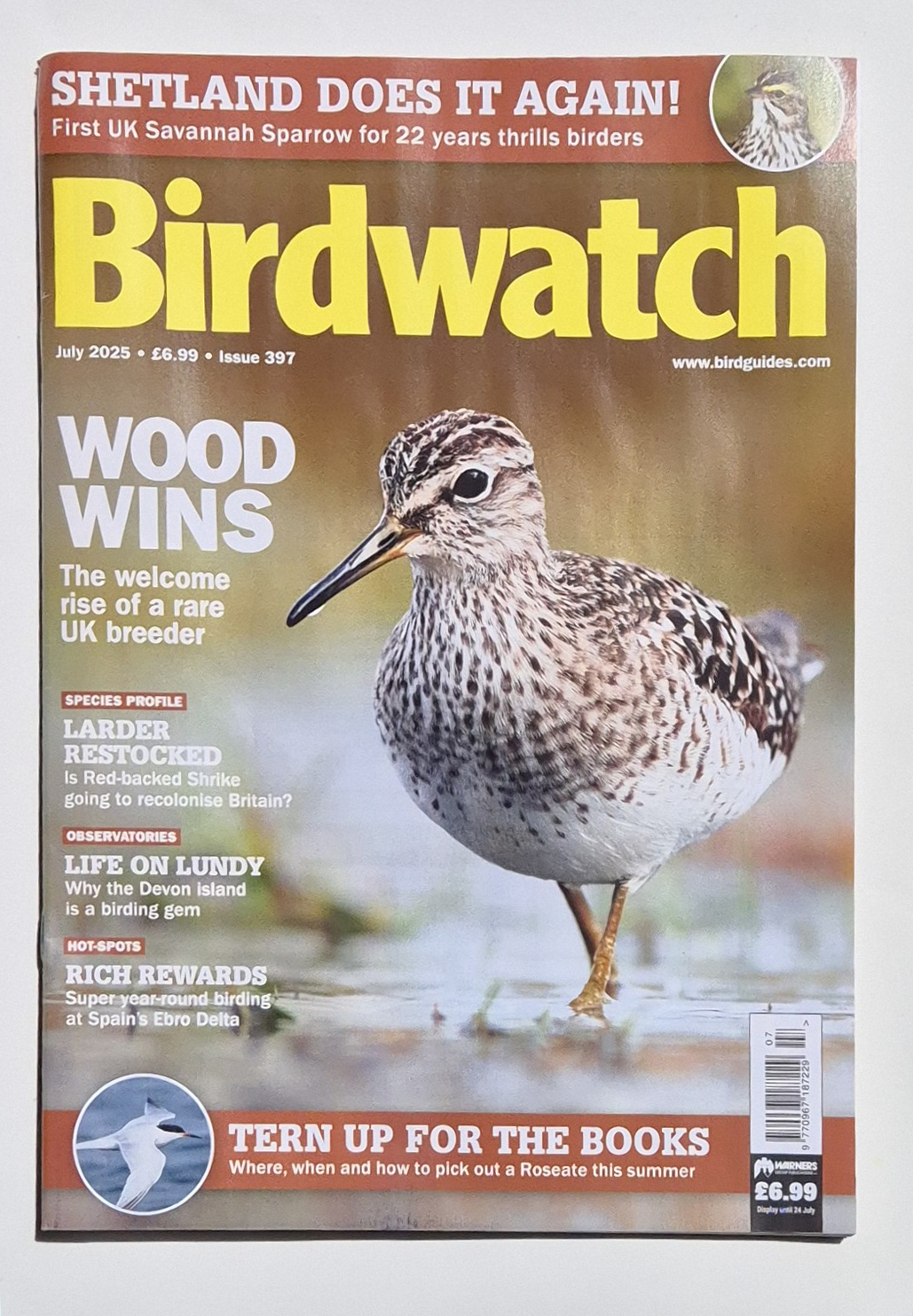
Birdwatch magazine, July 2025, issue 297. The cover features a Wood Sandpiper, which seems to be faring quite well in northern Scotland, and there are photographs of other species inside, Buff-breasted, Spotted and the forlorn sounding Solitary Sandpiper. Collins Birds of the World lists many others: Bairds, Broad-billed, Common, Curlew (confusing), Green, Least, Marsh, Pectoral, Purple, Rock, Semipalmated (?), Sharp-tailed, Spoon-billed, Spotted, Stilt, Terek, Tuamotu (from the Polynesian island), Upland, Western and White-rumped. Looking at the images, I take my hat off and then some to anyone who can distinguish them all. Of the Wood Sandpiper Bozena Kalejta-Summers writes: “Let’s hope that the beautiful flute-like song of this delightful shorebird may one day be heard across valleys and bogs throughout Scotland.”
Mark Avery writes judiciously about the Right to Roam, an always controversial topic. I am strongly in favour but agree that caution should be exercised when it comes to protecting wildlife. He concludes with my current bête noire, “I’ve got this far and I haven’t even mentioned dogs …” Lucy McRobert at the end of the magazine concurs: “I love dogs; however, I am increasingly irritated by the insistence of so many that nature reserves and wild areas are appropriate places to walk their pets.” I suppose there would be a backlash, but the RSPB and others could surely easily ban them from reserves altogether.
A report from BirdGuides in horribly timely fashion tells of damage to a Little Tern colony in Norfolk which has had a good breeding season – uncontrolled dogs disrupted the colony and killed at least four chicks. What will it take?
David Campbell ponders the future of the Red-backed Shrike, or butcher bird – they impale their prey on thorny bushes or barbed wire for later consumption. We only really see them here as rare passage migrants. They have ‘bandit’s masks’ and a little hook at the tip of their beaks. There is no longer a breeding population largely due to the use of pesticides and other agricultural intensification and also egg collectors. Campbell explains that a return would not be impossible with the right habitat restoration.
I am lucky enough to have seen rare Roseate Terns off Coquet Island in Northumberland. Mark Newsome tells us all about them – statistics, how to identify them and where and when to see them.
From the book reviews section, Peter Cavanagh’s How Birds Fly: the Science and Art of Avian Flight, Firefly Books, 2024, looks and sounds wonderful and not too bafflingly technological. Just now, at £40 it is resistible but probably not for long. Ah, I have found it at half that price, so that fragile resistance has gone in moments. I can’t wait to see it. And since I wrote this, it has arrived. It is utterly gorgeous, beautifully illustrated and the text seems fascinating. I’ll return to it but it randomly fell open at a chapter (“Losing Flight”) with a quote by the heading from Joni Mitchell’s ‘Big Yellow Taxi’. So it’s all good. I actually feel slightly guilty since £40 seems such a very reasonable price.
An interlude from the avian. This headline caught my eye:
Zoo urges people to donate their unwanted pets to feed their predators
A moral quandary? The zoo is in Denmark and asks for unwanted chickens, rabbits and guinea pigs. Personally I don’t think zoos should exist at all, but to the commenters who describe this as “deeply perverse and degrading” and a “sick invention” I would say that this is another example of the inconsistency with which we treat pets (a word I dislike anyway) and those we kill to eat ourselves or keep in zoos. The zoo assures potential donors that the animals will be gently euthanised. This is surely very much preferable to their being abandoned or disposed of in far crueller ways.

Moving on to the August issue 298 of Birdwatch, above, I am continuing largely to ignore the reports of twitches, megas and the like, but there is always enough else for me to continue happily with my subscription – and there are always the photographs and interesting bird names to enjoy. Ancient Murrelet for example, an alcid or member of the auk family.
Mark Avery wonders why governments ignore and are allowed to ignore the fine and extensive monitoring work which results in the hugely important Breeding Bird Survey (from the British Trust for Ornithology, the RSPB and Joint Nature Conservation Committee, the last of which is actually sponsored by DEFRA).
The Osprey on the cover was seen at Rutland Water, renowned as the location for Bird Fair.
I am a bit obsessed with bird names so was pleased to see Barbara Mearns’ article about renaming those named after people. But would that not erase the historical record? The American Ornithological Society is forging ahead nonetheless. Of course some of the exceptional naturalists in question may have had their flaws but it does seem a shame to get rid of this way of enticing people to research their lives and achievements. Examples include the yarrellii subspecies of White Wagtail after William Yarrell, Steller’s Eider after Georg Wilhelm Steller, and Wilson’s Storm Petrel after Alexander Wilson.

In the Summer/Autumn 2025 RSPB magazine, the ‘member takeover’ issue, I was surprised to learn from Dominic Couzens that raptors do not learn their hunting skills by observing their parents. Those skills are innate.
Conservationist Mary Colwell writes about the continuing decline of our Curlews. It is clear we need to undo the damage we have done and manage land for their survival. The way we farm is a major issue as usual.
Simon Barnes is always on good form and he celebrates the birds which visit these shores in winter. I would dearly love to see skeins of Pink-footed geese coming into Norfolk, sometimes as many as 2,000 in number at once. I am sure that the sight would make me drop to my knees as he suggests.
Much research is going on to find ways to mitigate the scourge of Trichonomas gallinae which affects many birds but especially finches. One solution, for now, is to avoid using flat surface feeders. The RSPB has suspended sales of bird tables, window feeders and seed catching trays.
A real treat in the garden yesterday evening – three Wrens perching in a fairly bare tree, making lots of noise. It was as close-up as I have ever seen them. I can hear them now this morning as I write.
One more piece of non-avian good news – a trophy hunter has been killed by a Cape Buffalo he was trying to shoot in South Africa. Bizarrely, CBS describes the attack as “unprovoked”. Hardly that.
Finally, issue 355 of BTO News.

As always, insights into the importance of data for long-term planning. This newsletter includes news of surveys of mosquitoes to help understand the worrying presence of the Usutu virus in, particularly, Blackbirds, a Winter Gull Survey, and a major survey of bats in the Channel Islands which revealed fourteen species, six never previously recorded there, and modelling to enhance our knowledge of the effects of wind farms on seabirds.
Leave a Reply