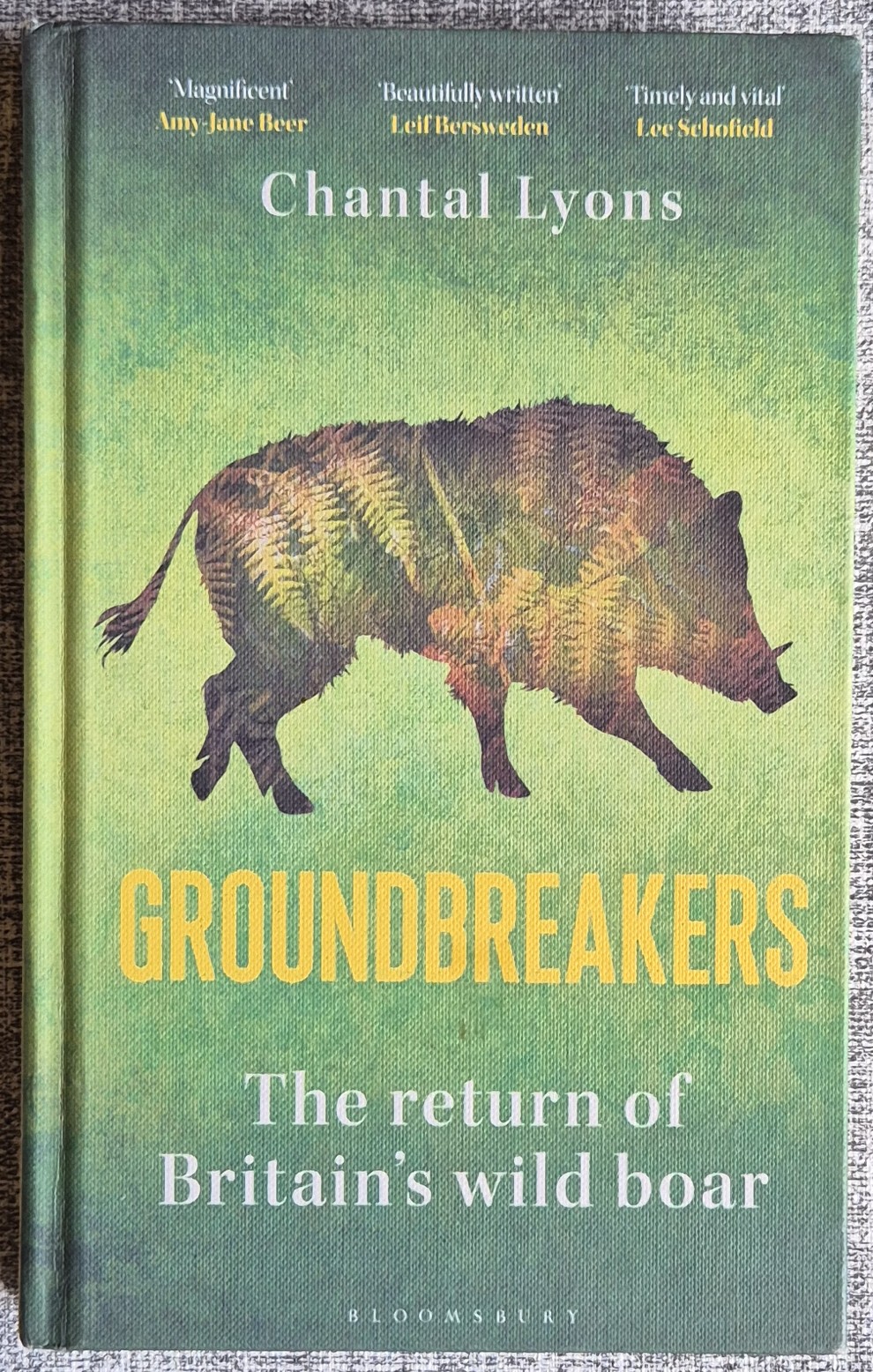
Lyons (Chantal). Groundbreakers, the Return of Britain’s Wild Boar. Bloomsbury Wildlife, 2024. Book review.
Truly wild boar were hunted to extinction in the UK in the thirteenth century, but now, through a long history of releases and escapes, they’re back. And Chantal Lyons really loves them.
A lot of delightful new words for me in this intelligent and compassionate book:
‘Sessile’ and ‘pedunculate’, to describes two types of oak tree. ‘Sessile’ normally means immobile but in the context describes oak trees with long leaf stalks and short acorn stalks. It’s vice versa for pedunculate oaks.
‘Holloway’, a sunken lane.
I did not even know ‘sounder’ to describe a gathering of boars, nor ‘brumation’, a state of dormancy for reptiles and amphibians which stops short of actual hibernation. ‘Phoresy’ (or phoresis) is when an organism attaches itself to a host for the sole purpose of travel. I have come across ‘solastalgia’ a few times before. It’s a relatively recent neologism akin to nostalgia but relating specifically to environmentally induced distress, that is the impact of environmental change. ‘Eldritch’ I feel I should have known – eerie or supernatural.
Then there are r-strategies and k-strategies. These are too complex to define here but to wildly oversimplify they are lots of offspring and fewer respectively.
Also the Bader-Meinhof phenomenon, that familiar feeling that you can’t stop seeing an unusual word once you have learned it. It reminds me a little of the Mandela Effect, which occurs when a large number of people believe that something has happened (the death of Nelson Mandela for example) when it hasn’t. There are plenty of good examples here:
What Is the Mandela Effect? 20 Examples & Explanations
The author concentrates largely on the boar population in the Forest of Dean where there is much very obvious evidence of their root(l)ing, sometimes like “miniature asteroid craters”. They are large animals and so scary to many: males can be almost three feet tall. Their principal enemies are farmers, other landowners and … Forestry England who carry out culls whilst admitting that they really have no idea what they’re doing or of numbers.
Boar societies are matriarchal in much the same way that elephants are and they have boarlets or stripy ‘humbugs’.
The author has some lovely and evocative turns of phrase: “Buzzards that I only notice when they peel themselves from their perches like bark sprung to life.” “And the trees … crackle. I’ve never heard them make this noise before. It’s like the sound of them thinking.” Which made me think of Tolkien’s Ents.
In spite of what some farmers say, whilst boar will eat a dead sheep opportunistically, they are extremely unlikely to kill and eat a healthy sheep, if at all. 90% of their diet is plant- or fungi-based and they are diversifiers not destroyers. They are not a problem for other wildlife. Domestic dogs fulfil that role most destructively. Other animals and plants take advantage of all the rooting and benefit from it. Again, like elephants, but not like humans it would seem, they do not operate in the short-term alone. At Knepp Tamworth pigs were introduced as boar substitutes and the results bear out this argument.
Chantal Lyons is sensibly understanding and sympathetic to those who resent the boars’ disturbances and fear their presence. But we risk making our own species an island, we become strangers on the planet as far as the rest of its inhabitants are concerned (not an island of strangers in the Keir Starmer racist sense).
Saboteurs and various other organisations do what they can to protect the boar with all of the predictable controversy. One of the Sabs, Chris Packham style, was victim of having a boar’s head nailed to a tree by his house. But there’s a sense that things have calmed down somewhat now. Of the cull, again as with elephants, the author writes: “We can’t know how it feels to be a boar who survives the death of their kin in the cull. And we should never lose sight of this. We may yet recognise in them hitherto unimagined or denied capacities for trauma, just as we learned too late that African elephant culls that targeted only adults left behind a generation of psychologically disturbed youths who weren’t ready to be out in the world alone. Their wounds never healed.”
Joining a hunter in Scotland, she sees the corpse of a boar he had killed: she was just a year old and pregnant with five fully formed offspring.
During lockdown in Tours, boar came into the city every night. Wonderfully the newspaper headline was “Pour les animaux, c’est la bamboche.” A party. The author makes the point I have made so often – if that happened here “it would have been something like “Boar rampage through city, leaving locals in fear for their lives.” I am sure “carnage” would be thrown into the mix too.
Contrary to some beliefs, wild boar are emphatically not feral pigs. Wild boar often have some pig genes in them, and vice versa, they are not the same thing and “feral pigs” is used to demonise them.
In a particularly astute assessment of the state of nature, especially in Britain, we are reminded that we live in a delusion whereby we can keep taking whatever we want whenever we want and that nature will somehow keep on giving. But energy cannot be destroyed, only transferred, and we are stealing from our descendants. “And now the debt is coming to collect itself.”
Boar have been back here for over 30 years. So, how many (apparently) intentional attacks on humans have there been in all that time? Two. One dog walker lost the pad of a fingertip, another suffered a bruised thigh. What a minusucle price to pay. Whilst global figures are higher (288 attacks between 2000 and 2012), in Europe there has been just one report (a child was injured). We don’t seek to extirpate domestic dogs for their sometimes murderous attacks.
As the author reminds us in summary towards the end: “Mess with nature, and nature will mess with you.”
Leave a Reply