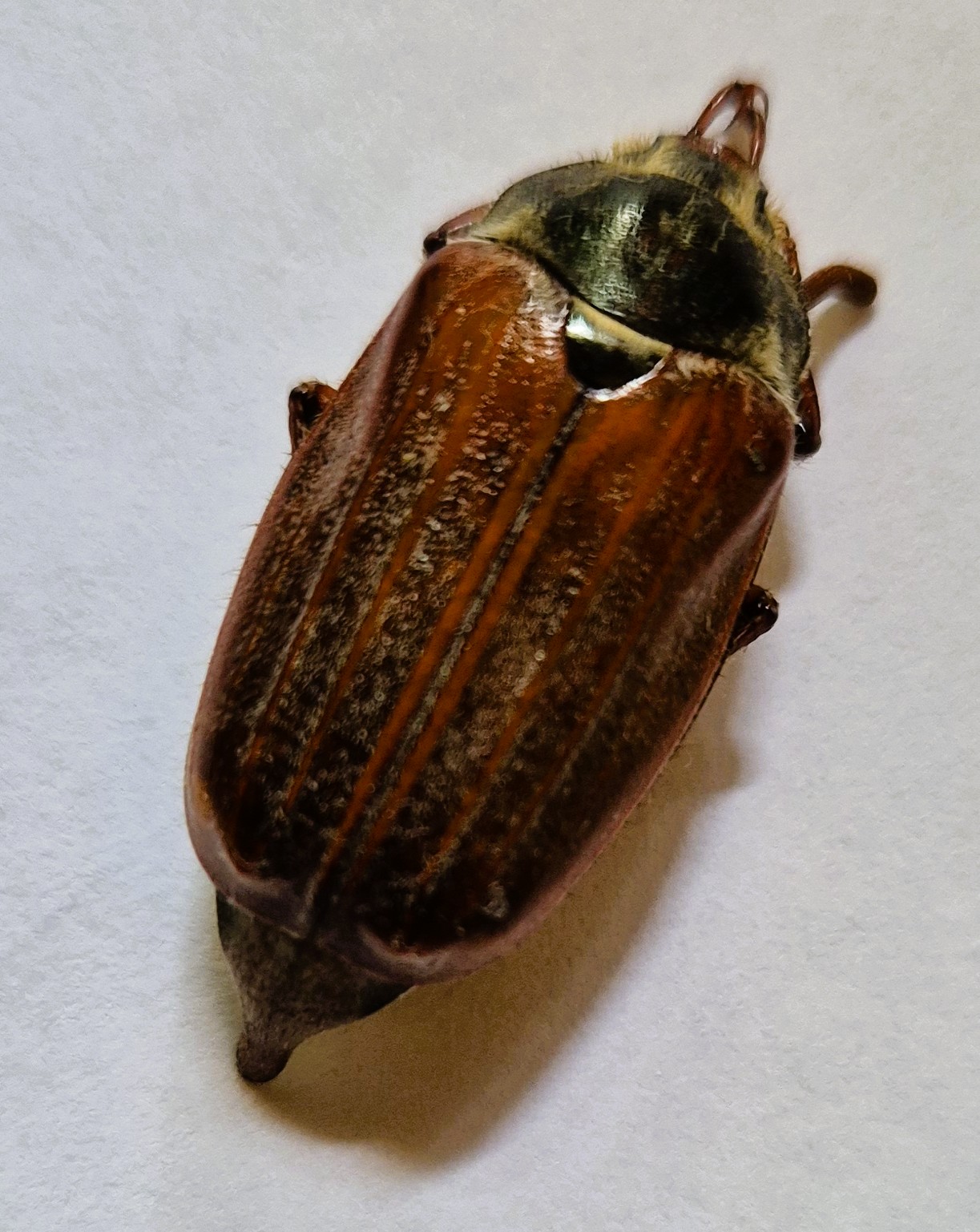
May bug
My son and his girlfriend thought that they had found, to their horror, a Cockroach in the bath and so did I at first, but it turns out to be a May bug or Cockchafer, the largest chafer beetle in the UK. I don’t recommend googling “cockchafer” without a filter. It seemed to be dead but disproved that when I placed it in the garden.

Unidentifiable from the photo was this visitor, below, but the translucence of the wings is nice.

PETA
I am ashamed to say that I have yet to renew my Vanguard membership of PETA this year. I will do it when I can but £250 just isn’t manageable right now. I don’t know anyone who doesn’t feel significantly worse off, at best, under Rachel Reeves. But they continue relentlessly, notching up remarkable victories. Not least:
Following a PETA petition (working with other concerned groups), “the Borough Council of King’s Lynn and West Norfolk has rejected plans for the development of two intensive mega-farms … The compassionate decision will spare around 48,000 pigs and 6.7 million birds a year from misery and terrifying death.
Cranswick plc is a UK food producer that owns the companies behind the monstrous plans – Crown Chicken Ltd and Wayland Farms Ltd. The food giant has previously sparked controversy in the media with cases of cruelty to animals, such as Feltwell Farm, which Wayland Farms owns, being suspended from the “RSPCA Assured” scheme in 2022 after drone footage captured the moment that 10 to 15 pigs were herded into makeshift pens and cruelly shot.
In addition to murdering millions of animals, Cranswick caused an environmental disaster and was fined £75,000 after it released polluted liquid into a Norfolk brook. Mega-farms – like those proposed – emit massive amounts of pollutants into waterways, soil, and the air every year.”
It’s worth remembering PETA’s incredible work in India, involving rescues, sanctuaries and, crucially, education. “Rahat” means relief.

Protect the Wild
Protect the Wild continues to grow apace and is ramping up on many levels. There’s ȧ new website, HuntHavoc.info, which will document out of control hounds, often illegally driven quad bikes tearing across private land, trespass and intimidation. Their End Bird Shooting campaign is also burgeoning and covers not just grouse and pheasants but also the shooting of ducks and geese for sport. It will pull no punches.
Wild Justice
Wild Justice are also very much on the case of course, in spite of Private Eye magazine’s cravenly and disappointingly running only one of their three advertisements. Their petition to ban, specifically, driven grouse shooting, has now acquired the critical 100,000 signatures which will lead to a parliamentary debate. They are also cleverly challenging the government’s evil Planning and Infrastructure Bill. Perhaps “evil” is too emotive, but personally I cannot see it otherwise. The government has said that it will not reduce the number of environmental protections in planning law, but two barristers were engaged and have shown that that simply isn’t the case.
BirdGuides: ornithologists attacked in Greece and hedgehogs relocated
A sobering report from BirdGuides:
“Masked hunters have ambushed and beaten up a team of international ornithologists from the Committee Against Bird Slaughter (CABS) on the Greek island of Zakynthos.
As a result of the attack three birders were injured and taken to hospital for treatment, CABS said. Local police have launched an investigation.
The incident, which happened on 16 April 2025 at 12.30 pm, occurred at the Keri peninsula, an area that is known for the illegal shooting of migratory birds. Despite a total ban on spring hunting on the island many hunters were reported to be present, with most of them were carrying shotguns.”
BirdGuides also details a hedgehog eradication programme in certain Outer Hebridean islands to protect ground-nesting birds, whose eggs the hedgehogs love to eat. We are assured that the hedgehogs will be relocated to the mainland rather than done away with.
British Wildlife: Black-headed Gulls
British Wildlife have sent a fascinating follow-up on the extinction of a Black-headed Gull colony (or gullery) at Ravenglass in Cumbria. An article published in 2021 noted that there were as many as 12,000 pairs in 1971, but fox predation in particular and human disturbance were though to be have been the primary factors in the decline. But the author, David Simpson, now shares new insights. The colony had benefited from strictly controlled human access, but during the Second World War egg-collecting took its toll until it ended in 1950. But also, there was myxomatosis. Fewer rabbits mean hungrier foxes. As usual, we interfere with nature at our peril. There’s a faint hope that maintaining a strong and healthy rabbit population alongside other controls might mean that the gullery could come back.
A new word
“Epigeal” was the answer to a recent crossword clue, new to me. It turns out to mean activity, such as seed germination, above ground. Below ground activity is hypogeal.
Icefish
Also snagging my attention was the discovery in 2021 of an extraordinary, previously unknown phenomenon: a unique ecosystem of tens of millions of Icefish nests on the Antarctic Weddell sea bed. Previously only a few dozen had been recorded. The number of 60 million over 92 or 93 square miles was extrapolated from a survey which recorded over 16,000 nests over roughly 500,000 square feet area. The nests comprise simply small circles of stones and may contain as many as 1,700 eggs. Happy days for the seals. Icefish are from the Channichthyidae family and these are Neopagetopsis ionah. They (the family as a whole) are the only known vertebrates to have no haemoglobin in their blood. From Wikipedia:
To compensate for the absence of haemoglobin, icefish have adapted:
- larger cardiac mitochondria and increased mitochondrial biogenesis to facilitate enhanced oxygen delivery by increasing mitochondrial surface area, and reducing distance between the extracellular area and the mitochondria in comparison to red-blooded notothenioids.
- larger blood vessels (including capillaries) and low-viscosity (RBC-free) blood to enable very high flow rates at low pressures.
- greater blood volumes (four times those of other fish).
- larger hearts with greater cardiac outputs (five times greater) compared to other fish.
- hearts lacking corronary arteries, and the ventricle muscles are very spongy, which enables them to absorb oxygen directly from the blood they pump.
Reasons for the original adaptation are still very much hypothetical. They are ambush predators of other fish and krill.
Night sky
I never seem to be in the right mood at the right time for astral photography, or I mess it up. But thanks to one of my daughters, I am reminded once again of the capabilities of cameras on mobile phones. This wouldn’t stand enlargement, but even so …

Leave a Reply