Even during such an emotional trip (see previous post) I did not of course forget about the wildlife. My first stop was the Alderney Wildlife Trust’s (AWT) centre and shop. I had hoped to meet the new warden at the observatory as well but timings unfortunately did not allow. The Trust is very active, organising bat, bird and hedgehog walks, boat trips, forest school events, moth trapping (hmm), rockpooling and so on, but we were not on the island for long enough. The fantastically helpful guy in the shop showed me live cam footage on a large screen so that I could see the Grey Seals and Gannets in action. I had wanted to spend time at Longis Nature Reserve which has a bird hide, but some of us were very intent on lunch at that point and so we cycled past it at some speed.
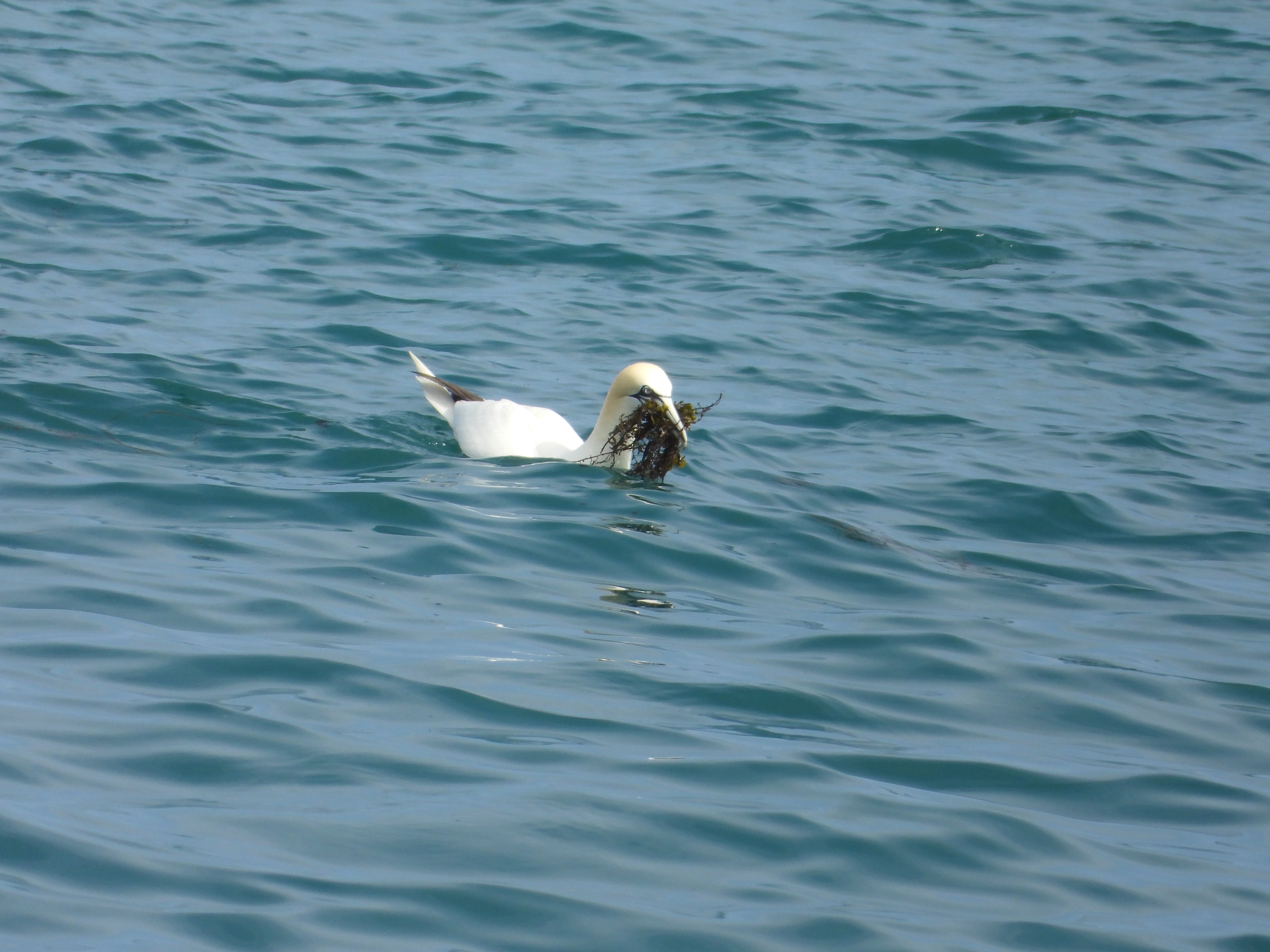
The big draw is in the form of Les Étacs (The Stacks), home to thousands of pairs of Gannets. They are only 100m offshore, but we couldn’t get as close as that and so good photos were difficult. But these may give an idea, taken from Fort Clonque.


The Gannets were busy collecting seaweed (from the seabed apparently) with which to build their nests.


There were a fair number of gulls too, Lesser and Great Black-backed and Herring Gulls, the first and last especially not easy to distinguish from one another (some of the websites designed to help actually contradict each other.) The key is in their legs – yellow for LBBs, pinkish for Herring Gulls. Herring Gulls are large but size does not much help with identification unless you have them side by side.


I saw several swallows and heard many Wrens (they seem to be having a good year, at home too) and Chiffchaffs, and of course saw Robins, Blackbirds and Chaffinches.
These Oystercatchers were enjoying a rest.

Shags and Cormorants are also easily confused (even for experienced birdwatchers according to Collins Bird Guide) but I am sure this is a Shag between the gulls:

Limpets at Corbelts Beach:


These are Common Limpets, which move around consuming algae when the tide comes in, scarping it from the rocks with their rough tongues which, according to AWT are “the world’s strongest known biological structure.” They return to their favourite spots when the tide goes out, marked by a ‘scar’ caused by their shells which helps them find their place.
This is Carpobrotus Edulis, with lovely flowers and interestingly fleshy, succulent and triangular leaves. It’s known as Sour Fig or Hottentot Fig, native to South Africa and considered invasive elsewhere. The plants have medicinal (anti-bacterial and anti-inflammatory) and culinary uses and benefits and are extremely robust, thriving on the poorest of soils in hot and arid conditions. It competes with native plants and can smother cliffs and dunes or even lead to coastal destabilisation and erosion. It was originally introduced to Alderney as an ornamental, first recorded in 1954. Detailed surveys have been carried out and Sour Fig is spreading. Volunteers have been enjoined to pull it up for bagging and burning, but it may be a losing battle.


Sea Thrift or Sea Pink, Armeria maritima, an image of which was once used to decorate the threepenny bit coin:

Three-cornered Garlic:

Not Wild Garlic, as I first thought, which has just appeared in the garden at home:


Three-cornered Garlic (or Leek), Allium triquetrum, is also considered invasive and on Alderney it’s everywhere. It too has medicinal and culinary uses but can be toxic it ingested in large quantities.
Ribwort Plantain, Plantago lanceolata:


Tent Caterpillars of some sort:


Bird’s-foot Trefoil:


The gorse was magnificent:


On our final morning in Alderney, my daughter, son and I went for a stunning walk, the “Zig-zag”, with the aim of seeing the renowned free-range Alderney pigs and getting a closer look at the Gannets. We achieved neither but it was glorious nonetheless and a number of the photos above were taken on it. We passed through Giffoine, a wildlife haven, and I am pretty sure I saw a (young?) Whitethroat for the first time, for which the area is well-known. He or she was in a tree in silhouette with the sun behind, but on flying off a pale underside was clearly visible.

From: Meyer (Henry Leonard). Illustrations of British Birds, c.1835-1844.
We would have come closer to Les Étacs but given our inadequate footwear decided the extremely narrow clifftop paths were too dangerous. I thought that my father would have approved our decision. As a boy, he and a cousin attempted to climb up a cliff face – the cousin fell to his death and my father’s tough old aunt Elsie, he said, never really forgave him for being the survivor.
What more can I say about Alderney except that I fell in love with it all over again?
Leave a Reply