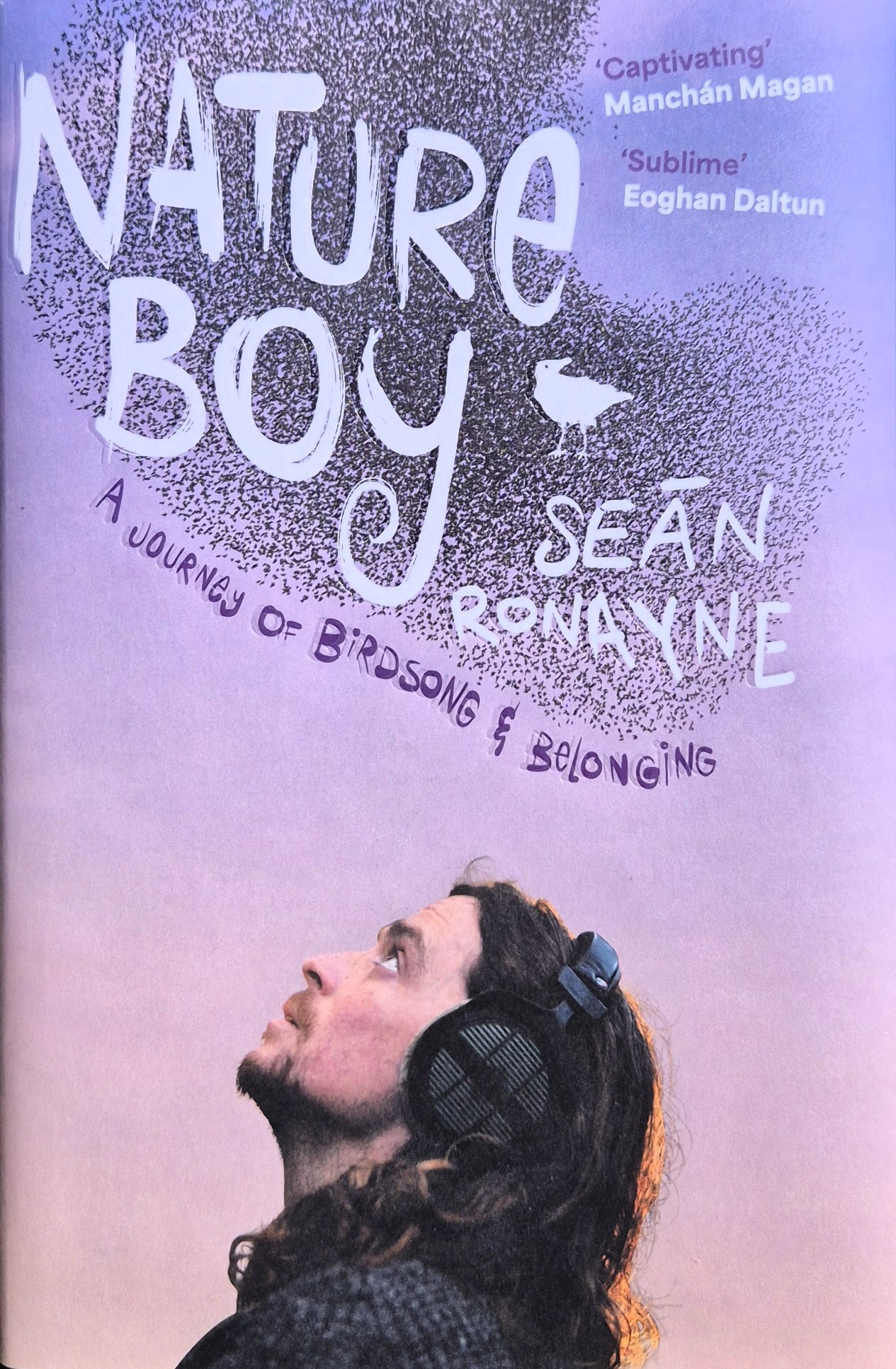
Seán Ronayne, Nature Boy; a journey of birdsong and belonging, Hachette Books, 2024. Book review.
I didn’t want to finish this book, in the sense that I didn’t want it to end. It had me in tears too many times to count and from the beginning I was sure that it was going to be one of my favourite books about wildlife of all time. False modesty aside, I have read a fair few. I don’t think anything will surpass Lawrence Anthony’s The Elephant Whisperer, Chris Packham’s Fingers in the Sparkle Jar is right up there and so is Amy-Jane Beer’s The Flow, but without wishing to turn this into a crude league table ot championship contest, I think Nature Boy takes the number two spot.
Starting from the outside, the dust-jacket design, by Steve O Connell (sic) is utterly gorgeous, with its delicate pinks and purples, showing Seán looking up at a Starling murmuration, as is the purple lettering on the white cloth spine. The black-and-white illustrations by Robert Vaughan which face the opening page of each chapter are truly beautiful too. And there are a generous number of colour photographs to boot.

I remember my then very young son seeing a murmuration for the first time, in Brighton I think. “Dad,” he said, “I could watch this forever.”
I have already mentioned Seán in this blog once before: “I watched Birdsong recently, a wonderful documentary about Seán Ronayne who has an extraordinary ability to recognise any number of bird sounds and even to visualise them as sonograms. And that includes birds imitating other birds. Much more of that gentlest of souls anon, when I have read his book, Nature Boy, which is arriving today. It made me resolve to work on my own abilities again and I have found something within which is helping me, that is to visualise a bird in my mind when I hear the sound – of course I have to have learnt it first, but it does help it stick.” I ordered the book very soon afterwards and have been devouring and savouring it ever since, either as I read the printed words or in my mind.
Seán is undoubtedly a gentle soul. I am reminded of Etta James’ famous words about Keith Richards: “He has a beautiful soul.” The book is unashamedly autobiographical, refreshingly and completely honest and often deeply moving. Seán found himself from his schooldays on to be an oddball, an unruly misfit, an obsessive introvert, nicknamed “nature boy” by his classmates not entirely kindly. It was not until he was in his early thirties that he was diagnosed with Autism Spectrum Disorder (ASD). It amazes me that someone so, by his own description, socially awkward, so terrified and paralysed by engagement, especially in small talk, for whom eye contact is out of the question, can be so very self-revealing in print. Nature Boy is also nothing less than an ode to nature.
The book’s dedication alone brought tears to my eyes, being to Laila, the author’s then unborn daughter. “I’ve loved you from the day you were little more than a seed … Know that you owe me nothing in life, but I do have just one wish. All I ask from you is that, one day, you fly the flag for nature and love it as it so deserves … This book is for you my little one. You bring us both untold hope and happiness and we are counting down the days to meet you. Ens veiem aviat petita meva.” Seán’s partner, Alba, is from Catalunya and those last words translate from Catalan as “See you soon my little one.”
An urban environment for Seán often results in a painful sonic overload, nature is where he finds peace and calm and sanctuary. He grew up on Great Island in Cork Harbour and was especially inspired by his nature-loving father and grandfather, the latter “a good man, who sought out the beauty of the world and saw the creatures we share this planet with for what they are – our brilliant, wondrous comrades in life. Not inconveniences or pests or things we should control or be wary of. Just brothers and sisters eking out a successful existence … with their own challenges and burdens to bear, and peaks to climb. Their own families to raise and their own happiness to seek.”
An encounter with a Magpie was particularly significant (I am punctuating this rather long review with a few photos of Magpies and Jackdaws in the garden). We learn that they are relatively recent colonists to Ireland (1676), which does not make them non-native, alien or invasive (to say so reveals a misunderstanding of the words). As I have said myself they are most unfairly vilified and it is simply untrue that they are attracted to and steal shiny things more than any other bird. “Why do we vilify nature? Why call wildflowers ‘weeds’ or refer to certain species as ‘pests’? This is all undeserved language, and a clear indication of our anthropocentrism – that humans alone possess intrinsic value in this world.” It is possible that Magpies mourn and even hold funerals, but they may be trying to learn what happened to their dead comrade to avoid similar dangers themselves.


[This Magpie looks positively benign, a word perhaps not many would associate with a corvid; sadly he or she seems to have broken a wing at some point, it sits at an awkward angle, but he or she is coping and surviving.]
The book is punctuated with inserts of data for a number of species: name, Latin name (genus, species), family, conservation status and of course vocalisations. An alarming number are amber or red-listed.
Of the Magpie encounter Seán writes: “This beauty is everywhere. We all too often forget the beauty in the every day. We only need to take the time look at and listen to what is right in front of us, and you never need to look too far. Stop searching for the big show – there’s no need. Open up your mind and let it come to you.” I feel I have come way towards this desirable state of mind in the last few years, and it’s life-changing.
I had not realised that the state of nature in Ireland is at least as bad as it is in the UK, possibly it is even worse. And it’s for the same reasons. We lack the direct connection, our children are taught next to nothing about it, and in Ireland it is is “on its knees like never before with 63% of our birds at risk of extinction … This is largely due to our capitalist, resource-draining society that has covered Ireland with industrialised farms, drained our bogs, overgrazed and burned virtually all of our uplands, and blanketed the rest in swathes of non-native conifer crops.” There’s a lack of respect too – we need to learn how to interact and how “not to interact” (my italics), from a place of respect.
Ireland may be the emerald isle, but it’s the wrong kind of green – cowfields mostly, which he seems to say as one word.
Now and then Seán comes out with something which really chimes with me and often makes me smile, whether it is his contempt for the shallow and meaningless corporate world, or his feelings about football: “… I didn’t like sports in general and I outright detested football.” He seems too to be similarly afflicted with Seasonally Affected Disorder (although sometimes I think everyone is , or perhaps that it would be strange not to be), writing of the departure of swallows and swifts as a sign “that the wet and gloomy winter is coming. I always despaired and prepared for the wall of grey when they left.” Those are my italics – I quite like wearing grey clothes, up to a point, but as a colour otherwise it depresses me, especially as a wall colour, indoors or out, it is the colour of boredom, dejection and death. He also speaks of a constantly racing mind, something else to which I can very much relate.
And then there the many, many nuggets of information new to me (I sometimes feel with these book reviews that all I am doing is being like that character in The Fast Show who just says “Isn’t it brilliant?” all the time), but how about the fact that birds, such as Blackbirds, with larger eyes are likely the ones who begin the dawn chorus – they can see better and are less concerned about giving away their presence to predators they cannot see.
[This Jackdaw, another regular visitor, strikes me as having an exceptionally pale head.]


A very serious case of meningitis very nearly killed Seán as a young man and that is another exceptionally moving part of the book. But it gave him determination to open his eyes and ears and pursue a career in ornithology, doing what he most loved and in doing so to repay the birds for all that they had given him.
One of my epiphanic ornithological moments was watching a multitude of terns in the Caribbean some years ago diving just offshore without realising that three hours had gone by – I was delightfully lost in it. Since then I’ve learnt a bit about both and terns and gulls are pretty easily distinguishable from each other, and I can even manage some of the more common and obvious species of each, but just to confuse me I am reminded here that the two are closely related, gulls and terns are both part of the Laridae family. Seán takes it many steps further by learning to identify the various juvenile gulls he sees, as though the adults weren’t difficult enough. He also mentions that “thorn in the side for birders”, the use of the word “seagull”.
According to this website, Is It Wrong To Call Gulls Seagulls? | Bird Spot, “We often get asked why ‘seagull’ is considered the incorrect terminology.
The word seagull is a colloquialism for describing a bird that belongs to the family Laridae, which also includes the terns and skimmers. There are over 50 species of gull worldwide with 11 found in the UK. These are the black-headed gull, common gull, glaucous gull, great black-backed gull, herring gull, Iceland gull, kittiwake, lesser black-backed gull, little gull, Mediterranean gull, and yellow-legged gull.” Or perhaps it’s that not all gulls are seagulls, but some are. Go figure. People get very heated about it. Seán includes Sabine’s Gull, taking the total to twelve. Different species have different numbers of age classes, giving 40 possible variations and even that number does not account for “aberrant plumages and hybrids, both of which occur with some frequency.” Good Lord.
He also tells us that the Eider Duck, surprisingly to me at least, has “the fastest level flight of any bird in the world”, up to 113 kph, around 70 mph, a.k.a. our motorway speed limit (which conjures up a picture – I could only just keep up with one at full pelt without breaking the law). I am disinclined to doubt him, but this seems arguable … more on this in a forthcoming post.
The book is also full of succinct but profound truths: “As is always the case, no matter what the species or habitat, the closer you look, the more you realise how much there is to learn.”
The author gets as excited as the next person on seeing rarities and unexpected vagrants (that word implies an element of choice to me but vagrant birds tend to be those blown off course, they are often not where they want to be), he gets the adrenalin rush, but exactly mirrors my feelings about the extremes of competitive twitching. “I did get involved in all this for a little while, but, to be honest, I found it all a bit weird. It’s highly competitive, political and, to me, nonsensical.” It can be highly intrusive too. And, frankly, laughable, as I found it at the Spurn migration festival where I saw a large, uniformly clothed group, an embattlement of long lenses, standing in a pub car park for hours looking at one tree. They were far too unfriendly for me to ask what they had seen, or were hoping to see.
I always like to make a mental note of words which are new to me. “Boreen” is an Irish word for a narrow country road. Another from this book is “mellisonant”, almost but not quite synonymous with “mellifluent”, sounding and flowing like honey respectively.
I hadn’t read or thought about the ‘butcher bird’ for a long time, the Woodchat Shrike. They tear apart small songbirds, reptiles, mammals and insects and then impale them on spikes (thorns, barbed wire), “They’re like small, feathered medieval executioners.” Their beaks look truly and suitably ferocious.
I have already mentioned the author’s fear of eye contact, his not understanding the simplest of social cues but he knows how to interact with nature. As I have inadvertently trained myself to do at HART Wildlife Rescue, with birds you have to pretend to look the other way. “You have to act as if you’re not interested in them.” It definitely works, even for the flightiest of pigeons or cleverest of corvids recuperating in the aviaries.
Seán becomes vegetarian during his journey, but there is his guilt about taking a camel ride which pretty much exactly describes my own. He feels bad about it even now but thinks that “the important thing is that we acknowledge and rectify these moments when we find clarity.” Or as Nick Acheson of the Norfolk Wildlife Trust said to me, we have to forgive our former selves and concentrate on what we can do now. Likewise I am in tune with him on Buddhism: “At first, I didn’t care for the temples … [but] it’s impossible not to fall for the tenets of this beautiful religion. Whether you believe in a god or not, anyone who practises a religion based on humanity, compassion, giving and, most importantly to me, a kindness to all animals, is very much a person to respect, love and value.”
And again likewise, he is tough on farmers, although careful (more than I sometimes am) not to tar them all with the same brush. He sees the disdain for ‘pesky’ nature which seems to be the “norm”.
At this point I returned to the Birdsong documentary and watched it again from start to finish. Is it patronising to describe an Irish accent as lilting? Seán’s voice is mellifluent indeed. And how very refreshing to see someone wanting to record the sound of the grouse, rather than a bunch of ecocidal raptor-killing maniacs only wanting to blast them out of the sky.
The Catalan relationship with nature is harmonious, people are attuned, to a far greater degree and are kinder and more compassionate we are told – bullfighting was banned in Catalunya in 2010. There he sees “one of the most majestic raptors of all”, the Lammergeier or Bearded Vulture. These strange birds have nine-foot wingspans and eat bones. It is they who perform the necessary for Tibetan sky burials.
We also hear of the author’s passion for ‘nocmig’, nocturnal sound recordings of migrating birds and a thrilling search for the Wallcreeper, which he puts himself through a lot to find. It makes for an exciting read. I love his careful use of pronouns, something I aspire to, when writing of birds and animals: “you never know who you’ll meet.”
Thinking about mimicry, we learn that Starlings are lifelong learners and Seán has recorded not only imitations of a vixen’s ‘scream’ but also and even his own voice calling in Toby the rescue dog. Also that woodpeckers’ drumming is territorial or deployed to attract a mate – they actually need dead wood in which to nest. Whitethroats are mimics too of an extraordinarily large number of species – some 72 recorded so far. What a mind-blowing thing that it is possible to know where they have been from the songs they reproduce, including those of Iberian birds and of a Blue-cheeked Bee-Eater which is only found in Africa. Those birds literally bring the sounds of Africa with them.
How very sad, Seán notes, that so much of the damage we do, such as hedge-cutting in the closed season, is avoidable and unnecessary. Finding Corncrakes is a real struggle, but they used to be so common that the author’s grandfather used to complain that they kept him awake at night – Crex crex is onomatopoeic. There is even an Irish curse along those lines. With rye grass everywhere and wetland loss, what chance do so many birds have? In 2022 there was just one pair of Ring Ouzel in Ireland – uplands have been grazed down to nothing and are burned each year at a terrible cost to wildlife.
Towards the end of the book, Seán emerges as an altogether more outgoing, forthcoming and confident person, doing radio and newspaper interviews and other media appearances as his fame grows. This is a wonderfully life- affirming book.
Seán concludes with a plea for what needs to be done, not that complicated and not that hard: to farm sympathetically with nature in mind, to restore our national parks, to tighten up the hedge-cutting laws and to ban weedkillers outright. And don’t spread slurry before heavy rainfall, if it must be done at all: agriculture is by far the biggest polluter of waterbodies. Meanwhile, we can all make our contributions, however small: respect the land, make space for nature, take responsibility if you have cats as companions, don’t use poisons. Of course that doesn’t cover everything, but these simple changes would make such vast differences.

Leave a Reply