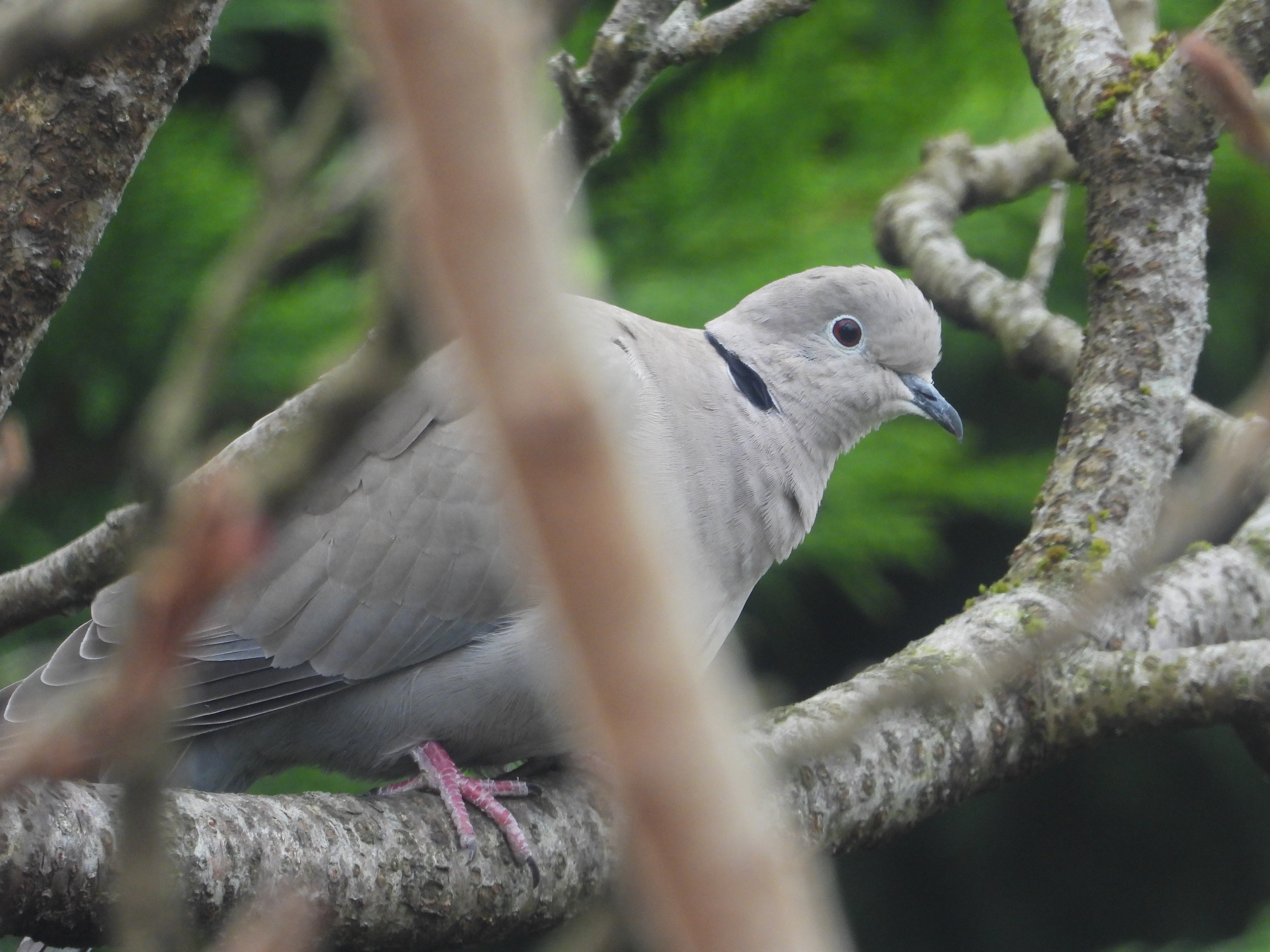
An adult pair were regular visitors earlier in the year as usual, but I haven’t seen them for weeks. Then two appeared this morning, but something was different and not just in their slightly fluffy appearance. They were shy and reticent, staying in the tree. I think they are juveniles and like to think the offspring of the earlier visitors. The parents would confidently land underneath the feeders and dominate every other bird, including the Jackdaws. These two seemed unsure of what to do. Foolishly I turned to what have become my go-to sources from which I have been pilfering images, but of course they do not appear in those nineteenth-century tomes (Gould, Morris, Meyer). The first Collared Dove to be recorded in the UK was as recently as 1955. I was very pleased to see them today. They are a special bird for me, amongst my favourites, although I do seem to say that about rather a lot of species – egrets remain my absolute number one though. When Nick Acheson of the Norfolk Wildlife Trust asked me which one, I said I didn’t mind – Great, Little or Cattle Egret. There is just something about them, their innate stylishness. Below is an extract from Animal Wild which explains some of my particular affection for doves.
Meanwhile, the results of the Big Garden Birdwatch are in with no great surprises, mostly largely the same as last year, but there has been yet another alarming fall in Starling numbers (also a bit of a favourite and so used for the Animal Wild dust-jacket, partly to make a point (they are much hated and persecuted and red-listed) and partly just because they are such beauties). Not so many years ago some twenty would raucously flock to the garden within moments of my putting out a feeder full of mealworms. But for the last few years there have been none at all.

Marsh marigold – another welcome re-appearance and part of the buttercup family.

And this is Christmas rose, appearing for the first time, seemingly from nowhere, Helleborus niger, also part of the buttercup family. Why it is called “black hellebore” is quite beyond me, although there does seem to be a dark version.
Here’s the excerpt from Animal Wild. It was only my third week at HART Wildlife Rescue and I still had (and still do have) a very great deal to learn. Paul was the centre manager at the time. I had been sent to the small, cramped, hot isolation room.
I was warned in particular about a flighty Collared Dove. Near on suicidal would have been a fairer description. She was actually one I had collected myself from a kind couples’ house. They were absolutely convinced they were looking after a Jay for some reason, saying that the vet they had taken her to had confirmed this. “Oh yes, we get a lot of Jays round here.” I was sure it wasn’t a Jay but began to doubt myself a little given the vet’s comment and thought it best not to correct them. Paul had told us that in all their years of training, the time vets spend learning about wildlife is not a matter of weeks or even days, but just a few hours.
I had worked things out so that as much as possible everything, fresh food and water, newspaper, was ready and a bird would spend the bare minimum of time on the scales.
About halfway through the morning, it was the turn of the Collared Dove. It all went really well, she sat calmly enough on the scales, and I was feeling rather pleased with myself, wondering what all the fuss was about until … until, I went to pick her up and put her back in her nice, clean pod. Then it all went horribly wrong. Somehow I misjudged it and she was off and away. I tried in vain and very clumsily to catch her. Around and around she flew, evading my every attempt, invariably finding the only two places in the room which were slightly out of my reach. After some minutes I was in a state of total panic. My heart was pounding, sweat was pouring off me, and as a result, to make things worse, my glasses kept falling off. It was pandemonium.
Finally I managed to catch her and put her back. I looked around the room. There were feathers and faeces everywhere. The poor dove looked bedraggled, her feathers all out of alignment and at peculiar angles. I began to pick up the feathers from the floor and everywhere else, then sprayed and cleaned the entire room. I looked into the pod and seeing that she had rearranged her feathers beautifully in no time at all, breathed a huge sigh of relief. But then I looked up. There was blood on the ceiling. I looked into the pod again – there was also blood trickling down the bird’s face. I sprayed and wiped the ceiling but knew I needed help. Looking absolutely aghast I went to find staff member Tia. “The dove got away. And there’s blood.” “Oh no, I had better come and have a look.” “Thank you, I am just going to step outside for a minute to get some air.” Tia quickly realised that the wound on the dove’s head was an old one, she had had a tick in that spot when she came in, which she had re-opened by bashing herself against the ceiling.
Tia can be a little bit scary if she thinks you’re careless or not paying attention (woe betide you), but that’s because she really, really cares. By this time we had got to know and respect each other (well, I respected her anyway).
“Are you ok?” she asked. “Oh, no, you’re not, I can see it in your eyes.” “I am so, so sorry,” I said. With a solicitous kindness I will never forget, she said, “Don’t be. They are wild animals after all, there is only so much we can do. You should see how I beat myself up when I make a mistake with one of them.”
That made me feel better, but I arrived back home still in something of a state of shock and was reliving the incident for days, seriously wondering if I was cut out for wildlife care at all. But what Tia had done was put it into context.
With the final pigeon in isolation, I weighed him and then put him straight away into an empty pod, even though I was making more work for myself since that would now have to be thoroughly disinfected too. But that wasn’t happening again, not that morning.
I found out that I was far from the only person to have had trouble with this dove although I was teased that I was the only person she hated quite so much. Even outside in the aviary, she was seen throwing herself at the roof. There was a happy ending though. Two weeks later the dove was ready to be released. She was flying well even though she was missing a tail feather. The spot where she had been found (releases are always sited in this way whenever possible, for the sake of familiar surroundings and perhaps even friends and family) was not exactly on my way home, but I knew it from before and it wasn’t too much of a diversion. I offered to undertake it, feeling I owed it to the bird. It was to be my first release too, something I had hoped for for a while. Robyn asked if I was sure it wasn’t too much trouble, but this I really wanted to do.

The dove in question in the boot of my car awaiting release
I drove around for a while looking for a suitable place and found a bit of open parkland with a copse of tall trees in the near distance. As I carried the cat box across the grass, I constantly checked for danger. An unleashed dog over there, too many people on that side. Phone camera at the ready, expecting everything to go into slow motion, with some accompanying epic music perhaps, I knelt down behind the box and opened the door. She was gone in an instant, heading up and straight for the trees where I was at least able to take a picture of her in her newfound freedom. I sent it to HART via WhatsApp, letting them know the release had gone well. It was a wonderful feeling, especially to have played a part in the full cycle – collection, care (of a sort) and release.
Something else was in the air. I hesitate to include this, if I read it elsewhere I would almost certainly dismiss it as wishful, deluded thinking. But when each of my parents died, I received some very clear, unequivocal messages from them in the form of the appearance of doves. I know that I am not alone in experiencing something of this kind. I won’t go into the detail, suffice to say these messages were extremely convincing and on one occasion came when I had specifically requested a sign, on others they were unasked for, to the extent that, non-religious though I am, I now believe, know, actually, that there is some part of us which lingers for a while, looks down on the living, before we go we know not where. To let us know they are ok. A friend of ours whose wife died suddenly at a very young age told us that the next day he said out loud, “Lucy, if you’re there and you’re ok, let me know by making that clock on the wall work.” It hadn’t worked for years in spite of every effort. Tick-tock. Immediately. In this case, I was grieving the sudden and wholly unexpected death of my first love, Jaqi, and I had attended her funeral in Norwich. Was it really a coincidence that this release took place on the very following weekday? Was that our final farewell?
Every year, we are visited by two Collared Doves in our garden. Just two days later they reappeared for the first time that spring. Had word got around? I told Tia when I was in next. “I am so pleased,” she said. Karma, in the columbine world at least, was restored.
Leave a Reply