Magpies
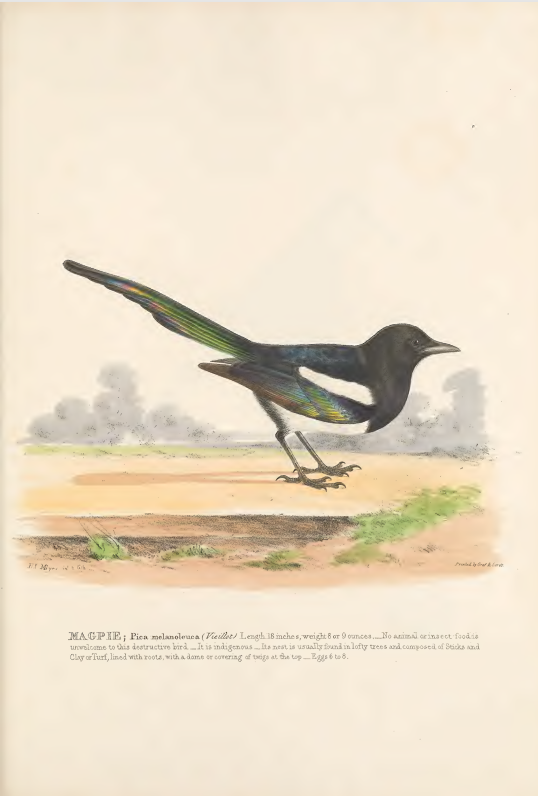
I cannot quite believe I had never noticed before that Magpies are far from being black and white. It was only yesterday with the sunlight at just the right angle that I saw the marvellous iridescent blue on the wings and green and blue on the tail.

The photo at the head of this post is from Meyer*, this below from Gould*. The online versions of these monuments of nineteenth-century British ornithology are proving an inavaluable resource.

Meyer’s illustration emphasises the green, Gould has more of both colours, but as with Gould’s Peregrine Falcon, the head shape doesn’t look quite right to me. Meyer has the species as Pica melanleuca, Gould Pica caudata. Clearly I have a very great deal to learn about the evolution of and changes to these scientific names. Collins Bird Guide gives today’s Pica pica. Linnaeus gave us Corvus pica but the bird was moved to a separate genus, Pica, in 1760 by French zoologist Maturin Jacques Brisson. Neither Gould nor Meyer seem to have been aware of this which just adds to my confusion over this subject. Pica pica is the Common or Eurasian Magpie. The North American Black-billed Magpie was thought to be conspecific but this was changed in 2000 by the American Ornithologists’ Union, who accorded it separate species status. There is no one firm consensus about the many subspecies. The Yellow-billed Magpie is treated as a separate species however.
As corvids they are of course amongst the most intelligent animals on earth and Wikipedia says that they “have been observed engaging in elaborate social rituals, possibly including the expression of grief” and that they are one of only a few species able to recognise themselves in a mirror. They can count, use tools and strategise collaboratively to hunt and defend themselves.
The pied part of their name, from Myers*, has come to mean black and white in the context but is thought rather to derive from the Proto-Indo-European root pi- meaning pointed. The first part is from a shortening of Margaret and was once used to describe a “gossipy woman”. Magpies are nothing if not noisy and curious (but they don’t really steal very much jewellery and there is no empirical evidence to suggest that they are attracted to shiny things more than other birds). They have had a very rough ride though. Meyer describes them as “destructive” and their appearance is seen as an ill omen in many cultures (I was taught that seeing just one rather than a least a pair was very unlucky). They have long been associated with the devil, and sorcerers and witches were believed to ride them or even turn into them in Germany and some parts of Scandinavia. They have been hated and feared in France too. The Magpie was the bird who refused to enter Noah’s ark, who did not go into full mourning like other birds after the crucifixion … it was common for people to cross themselves on seeing one or at least to doff their hats. This information comes from Swainson* who quotes Bishop Mant, who wrote a history of the church of Ireland and enjoyed parodying the romantic poets:
For skill
To build his dwelling few can vie
In talent with the artful pie :
On turf -reared platform intermixt.
With clay and cross-laid sticks betwixt,
‘Mid hawthorn, fir, or elm tree slimg.
Is piled for the expected young
A soft and neatly woven home :
Above of tangled thorns a dome
Forms a sharp fence the nest about,
To keep all rash intruders out.
This Jackdaw was looking rather regal I thought.

And these two, Robin and Chaffinch, just ridiculously pretty.


And here are the Wood Pigeons, doing their thing, making baby pigeons again. It’s a wonder they have time for anything else.


*Gould (John). The Birds of Great Britain, 1862-1873.
*Meyer (Henry Leonard). Illustrations of British Birds, c.1835-1844.
*Swainson (Charles). The Folk Lore and Provincial Names of British Birds, 1866,
*Myers (Susan). The Bird Name Book, Princeton University Press, 2022.
Komodo Dragons
I came across a video on Youtube, part of series called Real Science, which I recommend. The writer and narrator is Stephanie Sammann. I like her accessible style. This one is called The Insane Biology of the Komodo Dragon. I almost got to see them in Indonesia many years ago but the sea was too rough for the boats to get to the island (I cannot now remember which one, they inhabit several). They are apex predators and for many years it was thought (and I was taught) that their prey was poisoned by bacteria in their prodigious saliva. But the hypothesis (from the 1970s and 1980s) was not based on data – in fact they are venomous like snakes, they have venom glands in their jaws. Water Buffalo are often prey but their demise is now thought to result from their retreating to water having been bitten where bacteria from their own faeces infect the wounds. The Water Buffalo were introduced, there was no co-evolution. The teeth of a Komodo Dragon point forwards and backwards, are serrated front and back, regenerate and have phenomenally sharp tips strengthened by metal. They have attacked humans but it’s rare – they will defend themselves but would rather avoid us. Oddly, some academics are still stubbornly clinging to the saliva theory, perhaps because, like politicians, they are unwilling to admit that they might have been wrong.
Polar Bears
Continuing the black and white theme, it is fairly well-known that the bears’ skin is black, but the fur is not actually white, it is transparent and hollow, the colour, white or otherwise, is the result of the scattering of light.
Both Chris Packham and Protect the Wild have vigorously called out the World Wildlife Fund on the subject following a two-year investigation. I think I was some sort of a child member many moons ago but I began to have my doubts at a very young age, no doubt prompted by their having prince Philip as a patron. Their logo was and is a panda. Lately though they have been using Polar Bears in their promotion and marketing. The organisation was founded by trophy hunters, not conservationists (the two are mutually exclusive in my book), in particular prince Bernard of the Netherlands. It’s always the royals. Whilst hunting Polar Bears is illegal elsewhere, up to 400 per year are allowed to be shot in Canada – for commercial gain. The pelts are worth a lot of money. In both 2010 and 2013 Russia and the US pushed for a total ban under CITES, but WWF lobbied against it both times, instead supporting the Canadian government and the fur industry. According to them, the bears do “not yet” require full protection. As Rob Pownall of PtW asks, what are they waiting for? They talk about sustainable harvesting and the rights of indigenous people but refuse to come right out and say they oppose commercial hunting. They have in the past also lobbied against full protection for elephants, giraffes, rhinos and hippos – the last as recently as 2022. I hope they will lose many of their supporters and donors – they are a nothing but a false front.
Spring
It does seem to be showing the first signs of arrival. The bleak weather and environment (right up against the M4) on our badger sett survey at the weekend matched my mood and I only lasted a couple of hours. Since then, my water bill for 2025-2026 has arrived showing a staggering 38% increase on last year’s (Thames Water has just had the go-ahead to take a loan of £3bn but is £16bn in debt, see previous posts, for all the wrong reasons) and a claim against Hampshire County Council following serious damage to my car after hitting a series of potholes, which were under water at the time, has been dismissed. I know that councils are desperately short of staff and funds and so I was not too surprised to read when I filed the claim in early October that it would not even be looked at for three months or probably longer. Any requests for information before then would slow things down even more. I submitted photographs, invoices and the what3words location. I did not hear from them at all apart from the immediate automatic response but waited patiently. Their website now tells me that the claim has been dropped because they could not find the pothole. Perhaps because it has been fixed in the intervening period? I will check. So I have had to hand it over to my insurance company, which will of course cost me more in premiums. I hope they get the full amount because otherwise I will lose the excess as well. I did sell a few books recently for some hundreds of pounds, at heavy discount, but my customer then asked to pay in four, then three instalments, to help her cash flow. All very well, but clients do have a strange attitude to booksellers, forgetting that we have to make a living. What, I felt like asking, about my cash flow? I cannot bear to look, listen or read about what’s going on in America at present, but I have decided that electric cars are the total con I always suspected – they just push the pollution back up the manufacturing process and the batteries have to be disposed of somewhere. I have come to the conslusion that is a capitalist trick – and who is the main beneficiary? Elon Musk, described as the second most powerful man in the world, perhaps the most powerful depending on the extent of the influence he has over you know who. So, with various other factors, not the best of times. But, that Magpie. And these hazel catkins – sometimes one just needs a little brightness on an otherwise very grey day.

Leave a Reply