I have often sung the praises of Stephen Moss’ Mrs Moreau’s Warbler; how birds got their names, Guardian Faber, 2018 especially in Animal Wild. In an update to this post
Birdwatch, HART Wildlife Rescue and other wildlife notes and news – Animal Wild
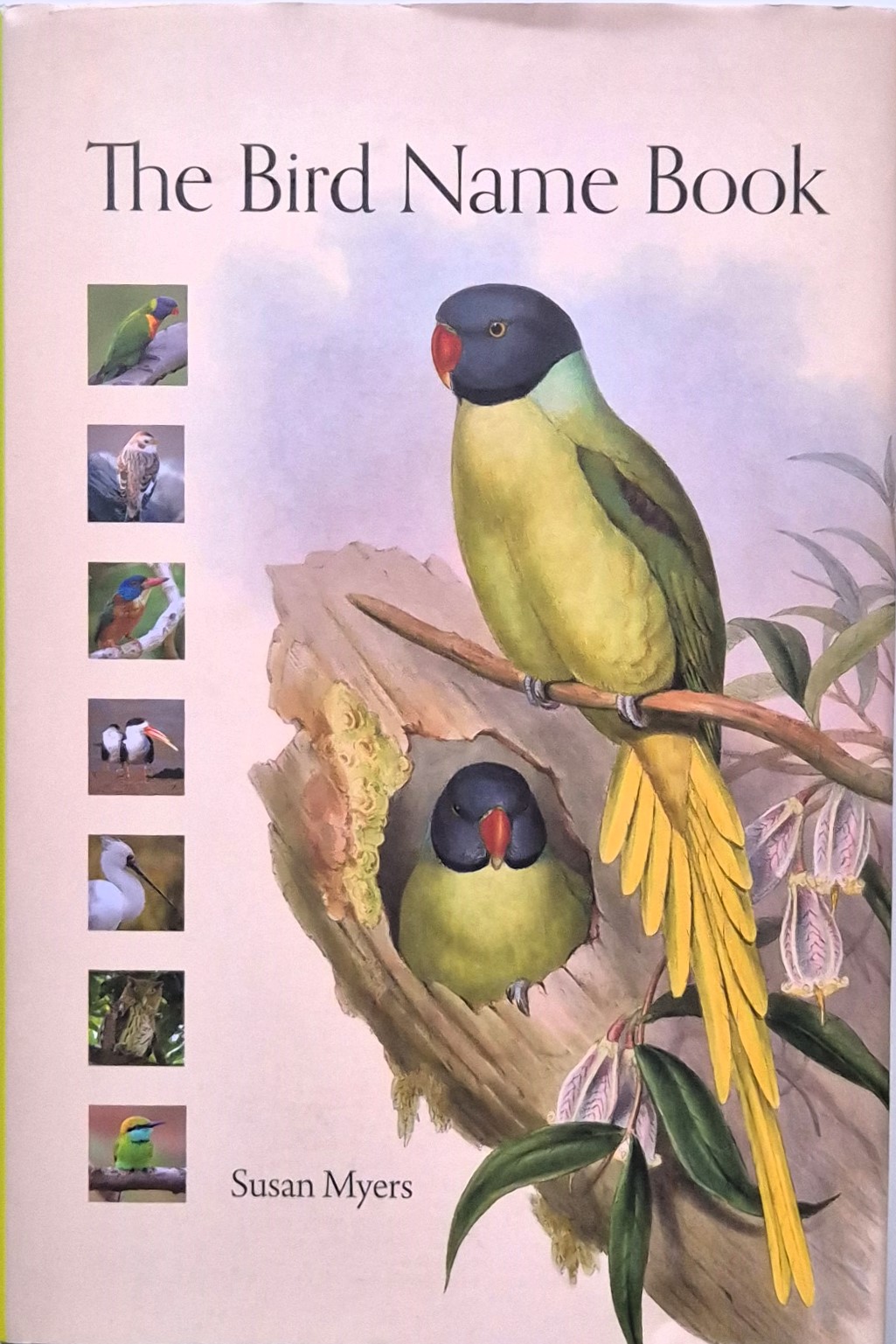
I reviewed The Vanishing Mew Gull; a guide to the bird names of the Western Palaearctic, by Ray Reedman, Pelagic, 2024, which I found very disappointing, chiefly on the grounds of production quality and value for money (poor paper leading to text showthrough, only relatively few less than brilliant black-and-white illustrations and very short entries for each bird, some of which seemed only to state the obvious). I fear Mr Reedman must be rather unhappy with his publishers after what was obviously an enormous amount of work. I am returning the book but having got the taste for the subject again, I then ordered the book above, The Bird Name Book, Princeton University Press, 2022, by wildlife guide Susan Myers, author of other books such as Birds of Borneo. It is a world apart and everything that I had hoped for from my earlier purchase.
This book has heft, it does not feel cheap in the slightest (it is Princeton University Press so this is not surprising), it has a dustjacket, is bursting with colour photographs and illustrations from mostly nineteeth-century works, and the entries are in-depth and authoritative. The etymological histories are interwoven with facts and anecdotes and quotations, it is a treasure chest. This is priced at under £30 which makes the £65 for The Vanishing Mew Gull seem almost an insult to author and reader. I am sure I will come back to the present volume over and over again. The alphabetical listings are preceded by an introduction about why and how we name birds and brief histories of some of the major ornithological players in the field. There is discussion of the history of standardisation (as I have said, about to undergo a major upheaval in the not too distant future) to get rid of the confusion arising from such factors as British colonialism and regionalism. Some etymologies are reasonably clear-cut, others more nebulous – it is a complex and often delightfully quirky subject.
The word “bird” itself comes from Old English bridd or brid (as opposed to fugol or fugel from the Proto-Germanic, which evolved to “fowl” or vogel in Dutch and German, probably words used to indicate “flier”). Brid, which became “bird” by the late 1500s, once referred to chicks, nestlings and fledglings, but by the late 1700s any type of bird. We read that James A. Jobling in his The Helm Dictionary of Scientific Bird Names published in 2009 divided the naming of birds into nine major categories.
These are eponym, morphonym, toponym, autochthonym, taxonym, bionym, ergonym, phagonym and phononym, applicable to both scientific and common generic names. In essence, with the first category perhaps including a subset of nicknames, these define in this context birds named after a person, the bird’s morphology (such as plumage), a place, names from other languages, birds named in relation to other taxa, habitat or environment, behaviour, diet or prey type and vocalisations.
By way of example, I will see what the book has for the birds I have photographed this morning, beginning with this Jackdaw, in the second picture in classic angry-looking pose.


The two-part name is essentially onomatopaeic from the birds calls, but “Jack” is also a sort of nickname, whilst “daw” is from Old English dāwe, Originally simply the “Daw”, Alfred Newton, author of the four-volume Dictionary of Birds published in the 1890s seems to have considered the compounding of the two words superfluous, describing “Jackdaw” as “the vulgar and redundant name”. In the first scene of Othello, 1603, Shakespeare has Iago revealing his selfish and manipulative nature, saying that his inner and outward selves will always differ. Until such time, “I will wear my heart upon my sleeve, For daws to peck at.” I wonder if this is also the first use of the phrase wearing your heart on your sleeve.
Next up this lovely little female House Sparrow:

We learn that there are thirty-three species of Old World sparrows, sixty-five New World and two others, Timor and Java Sparrows which are in fact finches. Susan Myers suggests that it is is probably one of the oldest English bird names, deriving from Old English spearwa from Proto-Germanic sparwan. As spearwan it appears in the fifth-century The Apocryphal Gospels of Mary. Laurence Andrew in The noble lyfe, 1527, describes the “sparow” as “lytle … wylye”. Newton went further back still, to Proto-Indo-European, suspecting that spér or spor-ow would have applied to many small birds but became increasingly specific over the centuries.
This, I am fairly sure, is a young Reed Bunting:

“Reed” as in “House” above needs no explanation. The origin of “bunting” is “unclear” but the name has been in use since the 1300s, also spelt bountyng and buntynge. It may come, says Myers, from “Scottish buntin or English bunty, meaning ‘short and stout or thick.’ ” Which seems less than wholly appropriate. Another possibility is derivation, for the Corn Bunting at least, from Middle English bunt, “meaning ‘spotted, speckled, pied.’ combined with the dimunitve suffix -ing, but Newton thought this was unlikely.” There are five species of Titmouse now – the name has become much more specific. These birds were only feeding from the ground here at first but as of today at least two of them have worked out how to use the feeders. For some of them, their yellow markings are very bold, almost garish.
Finally for now, this rather doleful looking Great Tit:

Known as titmice or actually titmouses in earlier times, the word “tit” “came into English in the 1500s from the Icelandic tittr, the Norwegian tita ot the Swedish tätt“, all of which simply indicated something small. There is no connection with the word for a woman’s breast which has an entirely different etymology. It is “titmouses” not “titmice” because the “mouse” part is from the Anglo-Saxon mase from an Ancient Greek word for “small”.
I feel I have learnt a very great deal from these five entries alone which completely satisfy my curiosity and delight in the origins of words generally and the names of birds in particular. I really cannot imagine how this book could be bettered.
Leave a Reply