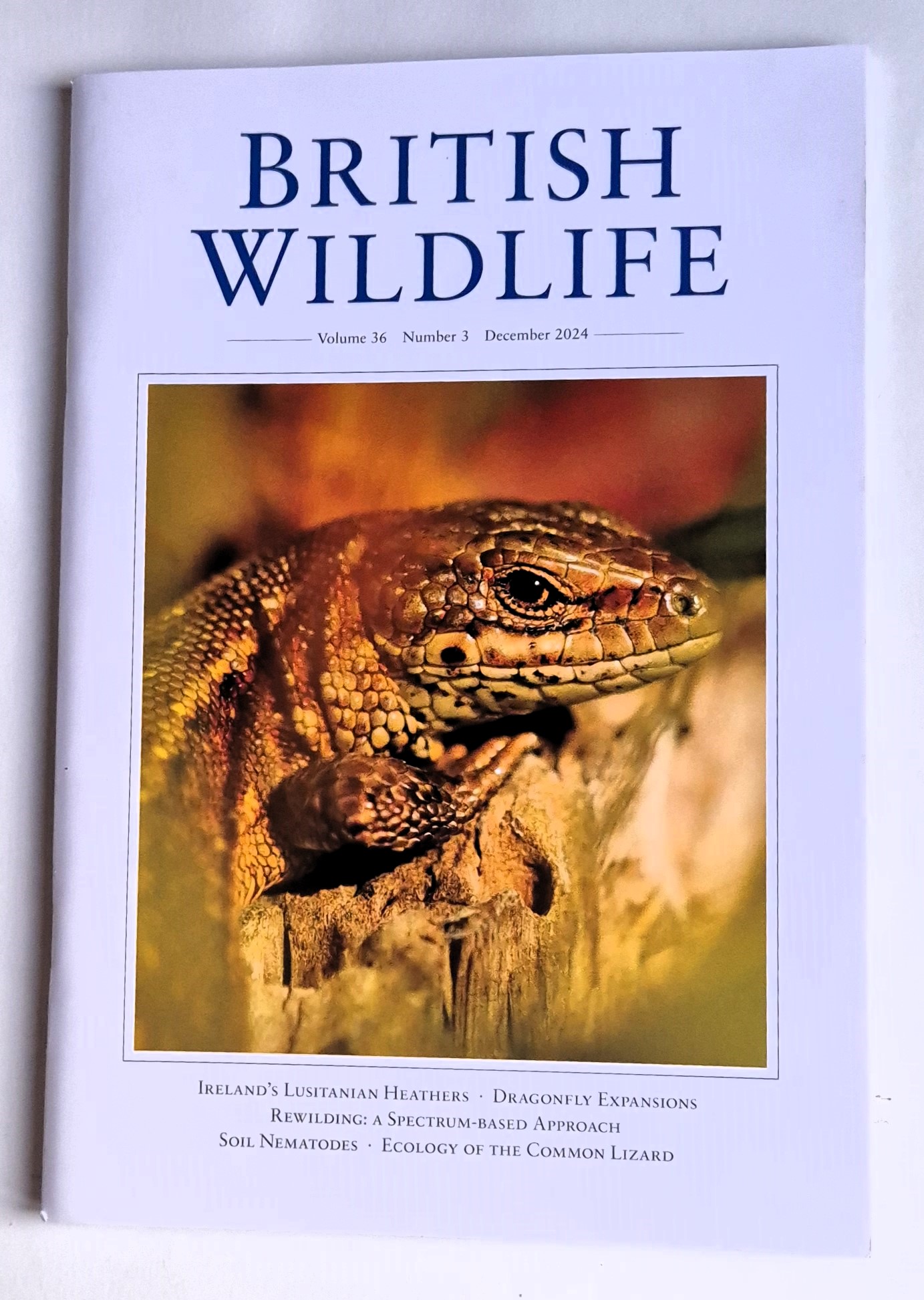
British Wildlife, Volume 36, Number 3
The Common Lizard on the cover somehow looks relaxed and malevolent at the same time. The issue opens with a piece questioning whether Ireland’s Lusitanian heathers are in fact Spanish. I am sure it’s fascinating but to be honest I struggle to care terribly much.
Brett Westwood in his “Natural reflections” notes a pleasing rise in the number of Hobbies in his part of the world, the West Midlands, but confirms that butterfly populations have “bombed”. This may be in part due to the arrival here of a parasitic tachinid fly, Sturmia bella, but also to climate change. Certainly I saw a mere handful for the entirety of 2024. He struggles to cope with the onslaught of bad news for wildlife stories like so many of us – absences pain him. Black or white media reportage risks making us feel there is nothing to be done.
Steve Cham writes of the continuing expansion of dragonfly and damselfly ranges. Common names such as Scarce Hawker may have become inappropriate or tempt fate. They are a subject I know almost nothing about but I have been very pleased with these photographs.

Migrant Hawker

Beautiful Demoiselle
Science and careful habitat management are responsible for the slow recovery of our Bittern population: 80 pairs in the 1950s, only eleven males by 1997, some 233 in 2023.
Benedict Dempsey discusses the conflict between rewilding and farming. In my view there simply shouldn’t be one. Some tact may be necessary to avoid more conflict, but farmers have done enough damage and perhaps should do what they’re told now. There’s a photograph of Belted Galloway Cattle – I happened to see a small herd just the other day. Since I cannot remember where that was, I am beginning to wonder if I dreamt them. Not impossible – I was surprised by their unusual appearance when I definitely actually saw them in Northumberland.
Amy-Jane Beer (I have just published the first two parts of my review of her book, The Flow) writes of a visit to an animal rescue in Spain. Birds of prey suffer the same persecutions there as they do here.
There is a long piece on nematodes, specifically free-living soil nematodes. Again, my brain is too full I think even to begin to learn about these creatures. Hugh Raven addresses the difficult issue of mink control. The devastation he records, such as the total destruction of an entire tern breeding colony, confirm that unpalatable measures have to be taken.
Like the “Scarce” name mentioned above, “Common” Lizard or “Common” Crane may lead us into a false sense of security, suggest Nick Michael in his comprehensive piece about the former. It is not all bad news, but habitat loss is not helping of course and they have many and various predators. Translocation projects seem not to be terribly successful. Astonishingly, different populations of the one species can be either viviparous or oviparous. DEFRA has made moves to begin to deal with the country’s water crisis, but there is very, very much more to be done. Denmark is taking the UK to task about our protection of sandeel stocks, essential food for seabirds, using EU law, pressuring the EU to take the case to arbitration. This, farcically, would see EU law being tested against itself. The wildlife crime section is as depressing as ever, but I have already covered most of it elsewhere in the blog. The grouse shooting industry is with grim inevitability, fighting back.
Stephen Moss writes about Starlings, which provoke reactions of hostility from many. Sure, they are loud and quarrelsome, yobbish even, but they are also very beautiful which is why there is one on the cover of my book Animal Wild in an attempt to persuade people to celebrate them. We love the murmurations, are not so keen in other contexts or closer quarters, but as Moss points out, they merit “the title of Britains’s most underrated bird.”

Issue 392.
For this issue I am for once going to skip past the pages of rarities, ‘megas’ and twitchings, except to mention the appearance of a White-crowned Sparrow in Cley in North Norfolk in 2008 – I love that the bird was immortalised in a stained glass window in the village church.
The magazine’s annual awards include the Guano Award for Environmental Harm. Once again our own government is the recipient. Discovery of the Year is awarded to learning that a rise in Goshawk populations could do much to address the Grey Squirrel ‘problem’. Yet again our interference, introductions and removal of natural predators has caused the problem in the first place. The Pale-legged Leaf Warbler has been anointed Rarity of the Year.
Gull identification is rarely straightforward, although I can manage a fair few species now. The rare vagrant American Herring Gull seems to throw up more confusion than most as we read in a piece which features no less than twelve variations of juvenile plumage – and that’s just photographs of standing birds. As Josh Jones says, “It can take a while to get one’s head around the basics … but the reality is that we are always learning new things.”
There is more on the upcoming united global bird taxonomy and the sometimes controversial splittings and ‘losses’ of species. Some twitchers do not care for shorter lists to tick off. Carrion and Hooded Crows for example will now be treated as a single species but I am unconvinced that this should be described as a “lumping together” nor that it is bad news for corvid lovers. Some species have over time been lumped together only to be split again as fresh evidence has emerged. Three species have been split away from the European Herring Gull (American Herring, Mongolian and Vega) but three species of Redpoll are now one. Swings and roundabouts.
Much has been written lately about planned changes at the RSPB and Lucy McRobert asks “what’s going on?” “Ouch,” she writes of Mark Avery’s recent rather angry piece (perhaps rightly so). I have asked one friend who works for the organisation and one who volunteers for comment but have had no response. Rising costs are the main problem and some reserves and in particular their shops and cafés are not paying their way or worse. One volunteer at Rainham Marshes fairly and squarely blames previous mismanagement and neglect and a reader’s letter confirms. Most distressing, she says, are the scrappings of educational programmes, surely second only to conservation in what should be the charity’s priorities. Many charities also struggle to compete in the world of social media platforms – they simply do not have the resources. Even the magazine may become digital only. Let’s not kick them when they’re down says Lucy McRobert, the RSPB remains a superlative force for good, but ruthless bsiness approach notwithstanding, they should keep returning to the core work: “Be authentic, be human. Nature must come first …”
I have been frustrated in the past by the difficulty of getting decent pictures of birds in flight and have had very few successes and so I found the advice here useful – tracking is key, and shutter speeds should be set at 1/2500 or even 1/3200 if you want an image of the wings without movement, with the ISO increased accordingly. I will be practising.
UPDATE. I have looked into it before but delving deeper this time, the consensus seems to be that capturing other than large birds in flight is simply beyond the capabilities of my Nikon P1000. The best camera for capturing those split second moments seems to be the Sony A9, but the latest version III of this costs some £5,000 for the body alone, miles beyond my budget.

I have just noticed that the primroses in the garden are flowering, this one somewhat shyly. Primula vulgaris. Primula means “the first” but January is pretty early even for them.
Finally a letter in the local paper asks if otters are heroes or villains. Who but an angler would even ask?
Leave a Reply