When I said to one of the tour leaders on my trip to Norfolk that the egret was my favourite bird, he asked which one. I said I really didn’t mind – Great, Little or Cattle. They share an extraordinary elegance. I should have known it wouldn’t be as simple as that. There are both Western and Eastern Cattle Egrets for a start, also Snowy, Intermediate (neither one thing nor the other?), Reddish (which shows two morphs, light and dark, both with black and red bills, the dark morph with a red neck and head), the Chinese and the Slaty (the only black egret). Two others have two morphs, the Dimorphic (so no surprises there) and the Pacific Reef Egret.
On the same pages of Collins Birds of the World, along with a panoply of closely related Herons is the Hamerkop. I love that the text describes this bird simply as “unmistakeable” – it certainly has a very distinct and unusual shape – and enthusiastically notes that they build “massive domed nests on trees or on cliffs.” The Shoebill is also described as unmistakeable. Both species are to be found on their own lonely branch of the taxonomic tree, sharing the preceding parent branch with Pelicans.
“Egrets, we have a few” is the headline which gets no marks for originality. I have seen and I think quoted something like it before, but it’s a great pun worth repeating. Delightfully, there has been a population explosion: the BTO records 12,000 wintering individuals in the UK. They were unsustainably killed for their plumes in the nineteenth century for use in millinery. The effect of the notion that they looked better on women’s heads than on the birds played a significant role in the formation of the RSPB.
As ever with Birdwatch magazine, there is slew of reports of rare sightings and twitchings. The appearance of a Pale-legged Leaf Warbler brought 1,000 people to East Yorkshire on one day alone. Others pictured (and I list them just for the wondrous names if nothing else) include the Tennessee Warbler, Northern Harriers, Pechora Pipits, Steppe Grey Shrike, Eastern Olivaceous Warbler, Pallid Harrier, British Lanceolated Warbler, Wilson’s Phalaropes and, abroad, Crested Honey Buzzard, Northern Mockingbird, Cape Verde Shearwater, and “well-twitched” Sora.
There is a whole article about competitive British and Irish listing which reminds me why twitching holds so little interest for me, which is not to say that I wouldn’t be excited seeing a species for the first time. The importance of vetting (by the British Birds Rarities Committee et al.) is underlined in the next piece about a case of ornithological fraud, the Hastings Rarities scandal. Hundreds of records ha₫ to be expunged. The central character was George Bristow, a taxidermist operating between 1892 and 1930, who sold birds which he claimed had been shot as rare vagrants in Sussex and Kent but in fact would have been killed abroad and imported. It is possible that he was himself a victim of a certain amount of deceit by his suppliers, but it seems clear that he made a great deal of money from it all. As in the world of rare books, obsessive collectors can all too easily be … gulled.
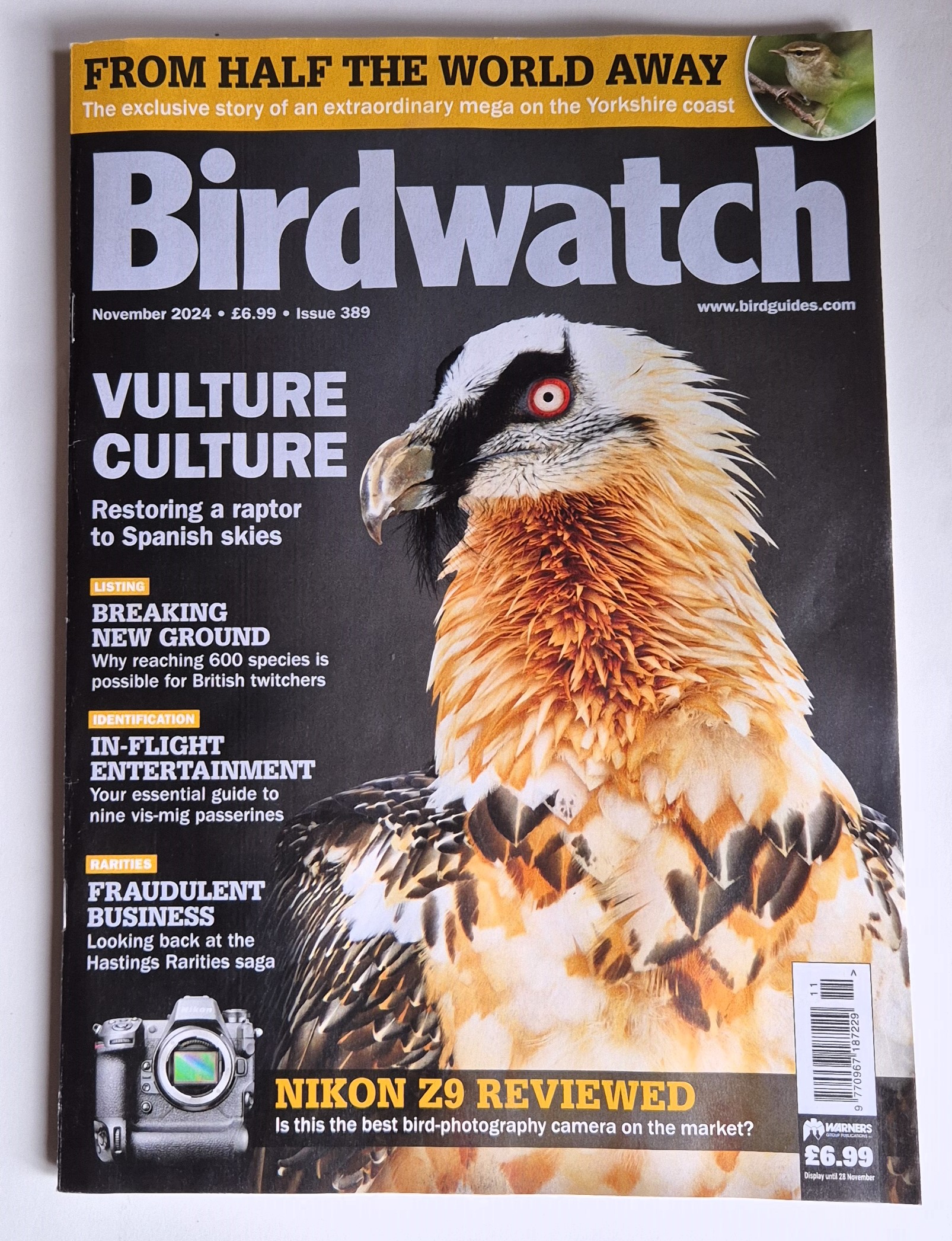
A project to reintroduce the Bearded Vulture (featured on the cover of the magazine) in Spain makes me wonder why namers of birds seem to have difficulties when it comes to facial hair analogies. Like the Bearded Tit (not bearded, not a tit), what this Vulture has is very much more like an extended moustache.
A guide to field ID of “Vis-mig” passerines confirms to me that I will never achieve the necessary levels of competence to distinguis֫h similar species in flight, whether it be the three species of Lark (Shore Lark, Skylark and Woodlark) seen in Britain, or the Song Thrush, Redwing and Fieldfare. Ì am full of admiration for those who can do it. I have improved, I think, when it comes to waders, to some extent at least and, largely, as long as they are on the ground. An “accidental paradise” brought about by flooding in the Lincolnshire fens saw the influx of extraordinary numbers of ducks, herons, egrets and other waders, including Avocets, Common Redshanks, Sanderlings, Purple Sandpipers, Little Stints and absurdly confusingly named Curlew Sandpipers.
As I turn the page to read about the westward spread of the Great Spotted Woodpecker, “a welcome addition to Ireland’s avifauna”, a daily garden visitor appears at one of my feeders in timely fashion – the markings never cease to bewitch me, the stark blacks and whites and the bold flashes of red.
In the previous issue of the magazine Mark Avery was highly critical of Birdfair and the direction in which it seemed to be heading, very much echoing what I had heard from friends who had attended. Stephen Moss, author of many books including Mrs Moreau’s Warbler, which I absolutely loved, and Ten Birds That Changed the World, which didn’t quite work for me, now defends it. He argues that it is hugely important for wildlife tourism and raises large sums for conservation. He is furious that the BTO, Wildlife Trusts and WWT “didn’t bother to attend”. But delighted that Birdfair has become far more diverse and inclusive, no longer the preserve of the “pale, stale and male”. It also offers an opportunity to “meet, make friends and network” although not if it’s anything like the Spurn Migration Festival, where I found people cliquey and unfriendly to the point of profoundly rude – but perhaps that was just me. Lucy McRobert though in her closing comment piece recalls being “patronised in bird hides by strangers” and even “scoffed at for not knowing something.” All too common in the world of bookselling too, amongst collectors and even more so amongst the dealers. In both cases, what a shame that there seem to be so many unwilling to share their knowledge generously or even at all when we have a shared and harmless passion in common.
There’s a review of the Nikon Z9, a mirrorless interchangeable lens camera, which I have looked into recently myself. It is apparently very heavy and “built like a tank”. The specs are incredible – a 45.7 MP sensor and for JPG as opposed to RAW images, thirty frames per second. It may well be the best camera for bird photography ever. My Nikon P1000 has a 16 MP sensor and manages seven frames per second, which is not really fast enough for birds in flight much of the time. But it has a 125x optical zoom, which Nikon has not even tried to improve upon. It costs a little under £1,000 and I love it. The Z9 is £5,299 for the body alone and I can see no lens that comes close to the range of the P1000’s “superzoom”. And they run well into four-figures too. The P1000 came out some years ago and it does now lag behind in terms of subject detection and tracking, but ultimately there is only so much I can or am willing to spend on a camera. I also slightly reluctantly admit that the cameras on my Samsung S24 phone are pretty amazing, especially I find for macro shots.
In the book review section, Jeff Ollerton’s Birds & Flowers, an intimate 50 million year relationship sounds very interesting. For the second time in less than a week I learn that insect-pollinated flowers tend to be purple, blue or yellow, whilst those pollinated by birds are often red, orange or magenta. The devastation of wild bee populations brought about by the use of neonicitinoid pesticides and the effect on the pollination of wild flowers is well-known, although certain farmers and successive governments remain in deep denial, but it’s a sobering thought that where we lose a bird species there may well be endemic plants left without pollinators, leading to a decline in plant diversity too.
Nesting season is well and truly over now and I have taken the opportunity to do a little hedge-cutting, pruning and tidying, but we are rightly asked not to do too much of this. Piles of leaves and dead stems can provide sanctuary for wildlife over the winter. Prettiness isn’t everything and neat and tidy lines and empty spaces certainly aren’t.
I had not thought about mixed woodland flocks before – it seems they are often led by Great or Blue Tits, for example, and that ‘followers’ can benefit from the calls of other species which may indicate the presence or absence of food or predators.
Little did I think not so many years ago before my love of birds was rekindled that this magazine’s arrival in the post would prove so exciting nor that I would happily spend an entire morning with it.
Leave a Reply