I was keen to explore this topic as reported in BirdGuides online. There are three global avian lists most widely used but inevitably there are differences between them. The plan is to unify them in one final list, AviList, which it has been agreed will be the official taxonomic reference. As ever with such matters, there has been plenty of controversy.
“Les Christidis, Chair of the WGAC [Working Group on Avian Checklists] Executive Committee, commented to Living Bird magazine that the integrative species concept used by the working group ‘looks at all areas of evidence to make an assessment, including morphology, behaviour, ecology, genetics, phylogenetic relations, time since divergence based on genetics, biogeographical distributions, and of course any evidence of reproductive isolation.’” Nevertheless there has been much fevered speculation and some emotional and rather far from scientific responses including claims that some species are being “lumped together”. It does seem surprising, if true, that the Hooded and Carrion Crow, Corvus cornix and Corvus corone, may in future be treated as a single species, but this would not in fact be a new development. The former was given single species status only as recently as 2002. There are four subspecies of Hooded Crow or, arguably, five, just to complicate things. Hooded and Carrion Crows do hybridise and they are certainly very closely linked genetically. A standard (partial) definition of a species after all is of a reproductively isolated group – one species cannot interbreed with another. BirdGuides reports, again rather emotively, that Cabot’s Tern may be “on the taxonomic chopping block” and may be “lumped with” the Sandwich Tern. There is a short list of “contentious splits believed to have survived the merge” and mention of the Scottish Crossbill which is “safe for now.” No doubt there is a tongue in cheek element to this but there seems to be genuine anger in some of the comments. One commentator says that the WGAC is ironically named and that he is “personally sick of the US common name tinkering”. He is far from alone, particularly when it comes to species named after, for example, slave owners, but science and language are not and should surely never be static.
I am reminded of the statues controversy and also a somewhat heated recent conversation with a volunteer at a National Trust property who complained that a “blackamoor” (a word she defined incorrectly) work of art depicting a Black man bearing a sundial had had to be put in the basement following a complaint. Quite right too (the complaint and the decision, to be clear). I must be being naïve I suppose, but isn’t there a simple solution to the statue problem? Put them all in a museum where people can go to look at and learn about them if they so wish. Certainly, in my view, slave owning individuals and others should not continue to look down at us in the streets from on high in a lionisation of what they perpetrated. Princess Michael of Kent got into some deserved trouble for wearing a blackamoor brooch in an astonishing display of insensitivity. She is well-known for a slew of racist remarks over the years. A big museum would be needed for the Prince Albert memorial however which includes derogatory stereotypes depicting the Victorian belief that white European men liberated indigenous people from barbarism. Not impossibly big though.
The comments continue in similar vein. “If Scottish Crossbill is safe then the whole thing is a joke.” Weirdly someone suggests that this will all lead back to a Victorian view of the world and that “The big danger of official name lists is they help extinguish what may remain of many cultural and linguistic traditions purely for the benefit of a minority bird professionals/enthusiasts need for uniformity.” No one is saying that it will become illegal to use the old names. We could say that this is such and such a bird, formerly known as … It worked for Prince for a while. An inconvenience perhaps, but a very minor one. For a long time I have tried very hard to use “he” or “she”, “who” and “whose” and so on when referring to animals – as Ingrid Newkirk said in her HARDtalk interview (see earlier post), animals are not like us, they are us. It makes for the occasional clumsy sentence and requires just a bit of effort, but it really isn’t that hard. For me this new list will be a celebration of advances in our scientific understanding and controversial renamings a celebration of enlightenment. As with the statues, fox hunting, shooting and the use of horses in sport, most of us have moved on.
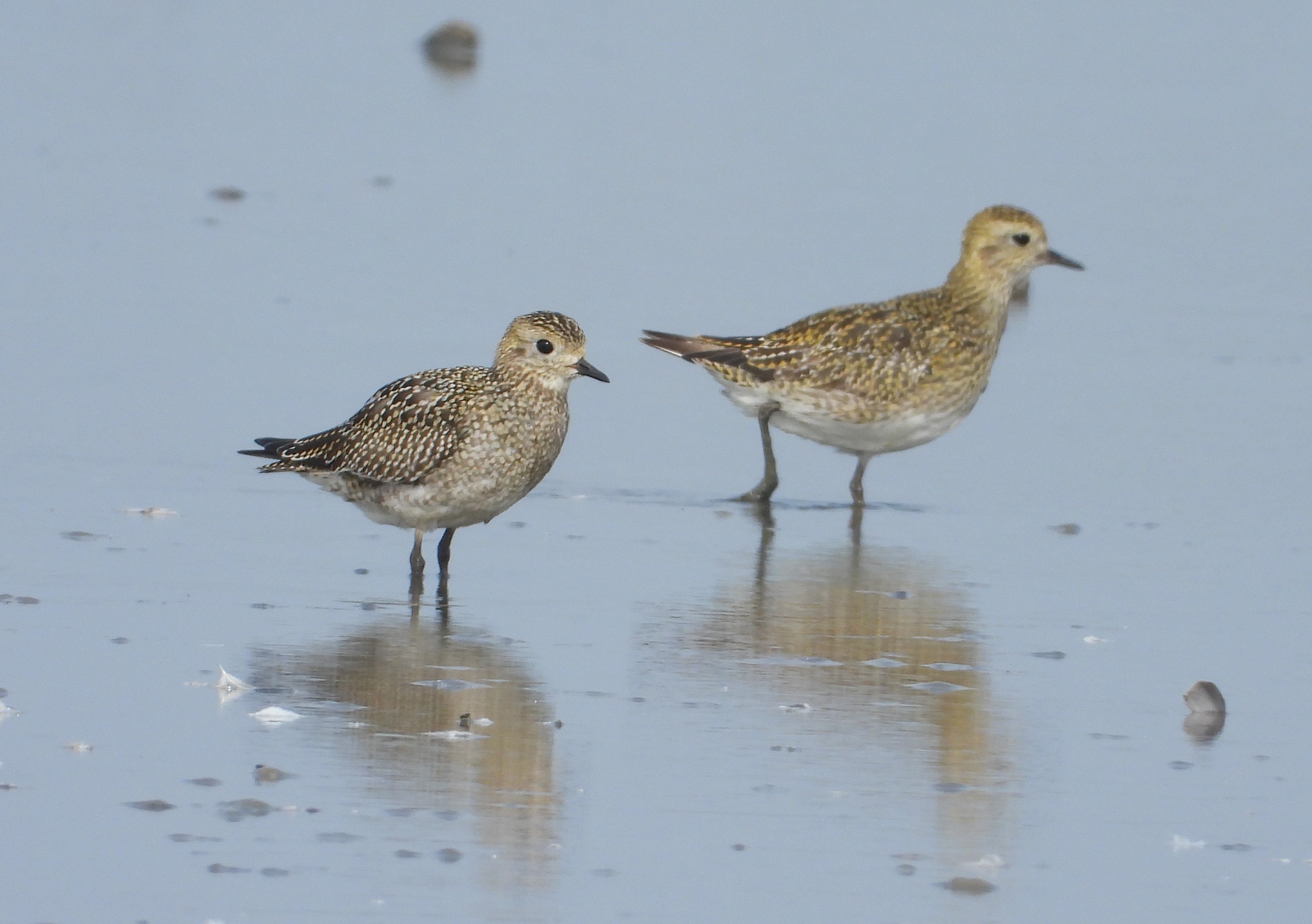
The European Golden Plovers at the head of this post, Pluvialis apricaria, are one of 69 species recognised by the International Ornithological Congress in the Charadriidae family, which includes dotterel and lapwings. In Iceland the first appearance of Golden Plover heralds the arrival of spring. Wikipedia describes the taxonomy of the family as “unsettled”. I find that rather wonderful.
Leave a Reply