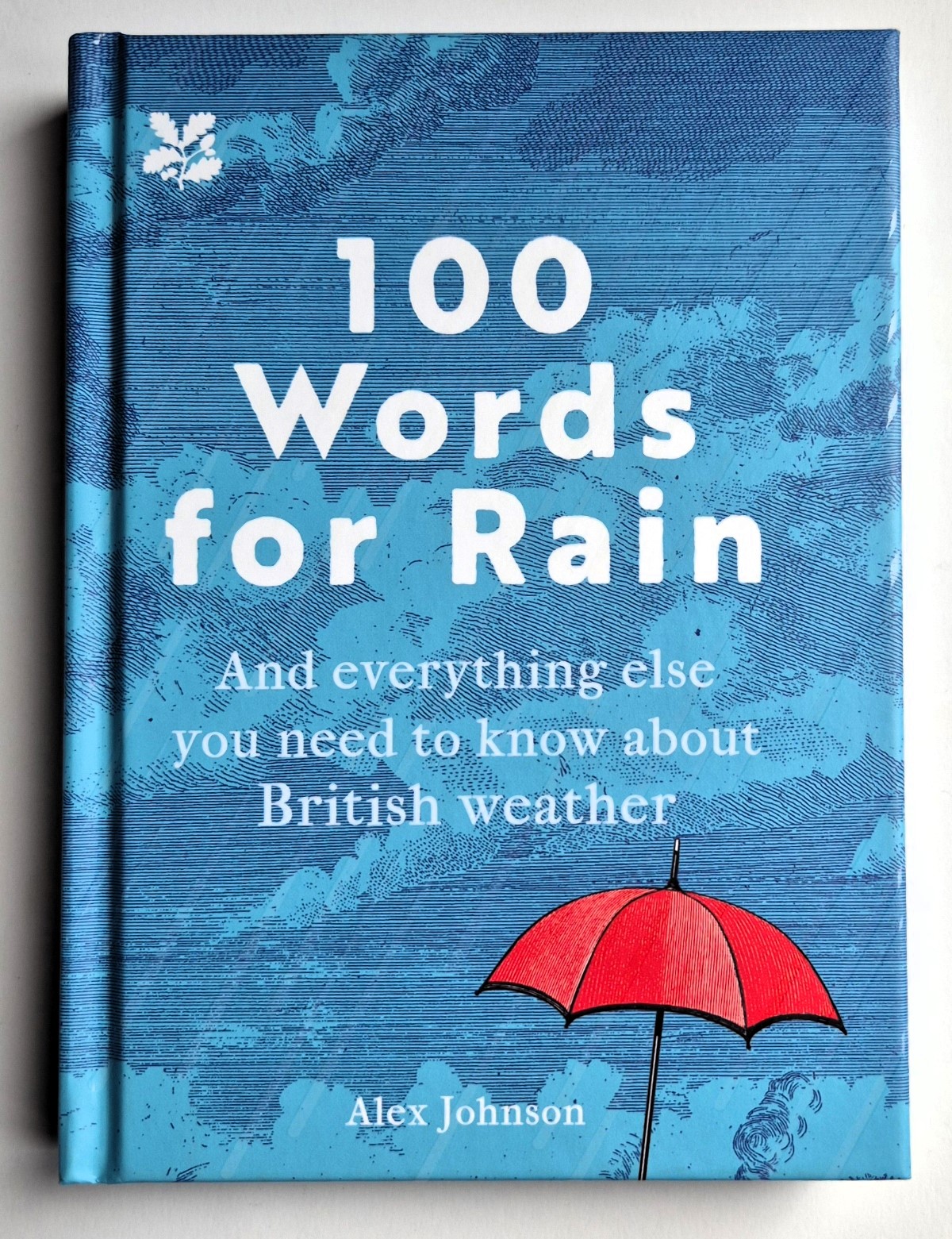
100 Words for Rain and everything else you needed to know about British weather by Alex Johnson, National Trust Books, 2024.
This a charming, light-hearted, interesting and informative book but it is not without flaws. There is no information about the author but he comes across as thoroughly likeable and someone who does not take himself too seriously, and his trawling of literature for weather-related quotations (especially for the pathetic fallacy so favoured by writers of the Victorian era – think Wuthering Heights – and indeed the literary giant Thomas Hardy) is hugely impressive.
There are a couple of quotes from Byron which reminded me that I have never rated him much, which is probably a kind of literary blasphemy. This, for example, from Don Juan, just isn’t very good, is it?
But Glory’s glory; and if you would find
What that is – ask the pig who sees the wind!
At least he feels it, and some say he sees,
Because he runs before it like a pig…
Give me Gerard Manly Hopkins, also quoted, any day of the week.
Early on in the book, I enjoyed learning the obsolete words “foxy” and “apricity” which describe deceptively bright but chilly weather and warm sun in winter respectively.
But – observations made in 1269 sound “remarkably modern” in translation we are told, but surely that has everything to do with the translator not the original text. The great naturalist Gilbert White, see Animal Wild, is described as “not technically a meterologist” before a few quotations by him about weather, but those do not make him a meteorologist in any sense. World Meteorological Day is celebrated annually, we are told, but although there is no such national day in Britain, the American version has “a strong London connection” in that a balloonist took weather readings at an unprecedented height during the first balloon flight over London in 1784. That seems to me a tenuous connection to say the least. Discussing television weather symbols, the “hieroglyphs”, triangles for showers, dots for rain, asterisks for snow and three horizontal bars for fog were “hardly intuitive” we are told. Perhaps not, but hardly rocket science.
I like the lists of dialect and other words for various kinds of weather but think the author has Jane Austen wrong when he suggests that she used the word “pelter” as a synonym for heavy rain. She was, I think, simply using the word in the sense of something being thrown down, or pelted, not employing what he thinks is a curious local variant.
Fascinating is the explanation of that wonderful smell produced in the aftermath of rain which is the result of the water coming into contact with a yellow oil stored by plants and bacteria in the soil, combining to create “geosmin”.
I was also delighted to learn of various rare kinds of rainbow (and that there is such a thing as phobia of rainbows, or at least there is a name for it, iridophobia), including moonbows, monochrome rainbows, double and triple rainbows, fire rainbows or circumhorizontal or upside-down rainbows, and my favourite coinage, fogbows. The last though is repeated, albeit described in a different way, later in the book, which seems careless – I am surprised the indexer didn’t point it out.
Weather myths are dealt with in short order – the one about cows lying down before rain is “hogwash” (I had always wondered what that logic was with that) but the old adage “Red sky at night …” is often correct. Johnson also cites rain on a wedding day being lucky, a good omen, although I was always told the opposite.
One of my favourite words, “serein”, does not pass muster for inclusion unfortunately. It means rain falling from a cloudless sky after sunset.
I do not mean to decry this book – it has a pleasingly broad sweep (including, to give just a few examples, the weather of Tolkien’s Middle Earth, a tornado intensity scale which runs from T0 to T10, admiration for J.M.W. Turner’s depictions of skies and weather, the reassuring tones of the shipping forecast) and there are many other nuggets and gems which amuse and inform.
A school production of King Lear, in which I played the tiny part of the King of France, was brought to mind on re-reading from this book the magnificent speech hilariously described by Charles Lamb as the result of Lear’s having been “turned out of doors by his daughters on a rainy night”:
Blow, winds, and crack your cheeks! Rage, blow!
You cataracts and hurricanoes, spout
Till you have drenched our steeples, drowned the cocks!
You sulfurous and thought-executing fires,
Vaunt-couriers of oak-cleaving thunderbolts,
Singe my white head! And thou, all-shaking thunder,
Smite flat the thick rotundity o’ th’ world,
Crack nature’s molds, all germens spill at once
That make ingrateful man!
A few personal weather-related comments.
I do not like umbrellas, I always lose them, the height at which most people carry them is at my eye level, and like hoods, I find they make me uncomfortable and slightly claustrophobic (in short, I would rather get wet).
A recollection of my first flight to Los Angeles where I was shocked to see from the aeroplane a thick layer of poisonous-looking yellow smog hanging exactly over the city.
The intensely annoying tabloid hysteria about the weather, whether announcing “heat waves” (a few days of sunshine), or the catastrophic explosion of the equivalent of thousands of bombs with the power of that dropped on Hiroshima (a thunderstorm) and dire warnings of paralysing, terrifying “Arctic” conditions (a winter’s day, perhaps with a little snow).
Driving along a narrow, single file country lane, with another car coming towards me – a sudden intense but brief hailstorm came down, the stones the size of small marbles, meaning that neither driver had any control whatsoever.
Scrambling down a mountainside with friends because we could literally see a storm approaching us down the valley.
Arriving at a village high in Bali on the Pacific Rim and realising that that, sitting at the end of the street, was a cloud.
I am pretty sure I suffer from SAD, seasonal affective disorder but on the other hand isn’t it pretty normal to feel happier on a bright, sunny warm day than when the weather, is grey, wet and cold?
The exquisite song Summer Morning Rain by The Duke and the King, a wonderful band who I used to follow almost obsessively (I would see them as many as three or four times on one tour of the UK). The acoustic guitar evokes the song title perfectly. They produced two stellar albums, Nothing Gold Can Stay and Long Live the Duke and the King. The singer, poet and novelist Simone Felice, of the Felice Brothers, has a beautiful, ethereal voice and I would suggest a serious talent for songwriting, approaching that even of Bob Dylan, went on to a solo career with mixed results, but I also highly recommend his albums Simone Felice and Strangers. He does not shy away from protest and anti-military lyrics, nor profound words about love, disappointment, lies and the human condition. I saw the band at the Glee Club in Birmingham once. Just before they came on, a bizarrely stern announcement came over the tannoy from the theatre management – no one was to talk, move, use the facilities however desperate, stand up, dance, make appreciative noises before the end of a song … on and on it went. To my relief, Simone came on stage, walked up to the microphone and said, “There are no rules in here tonight.”
Leave a Reply