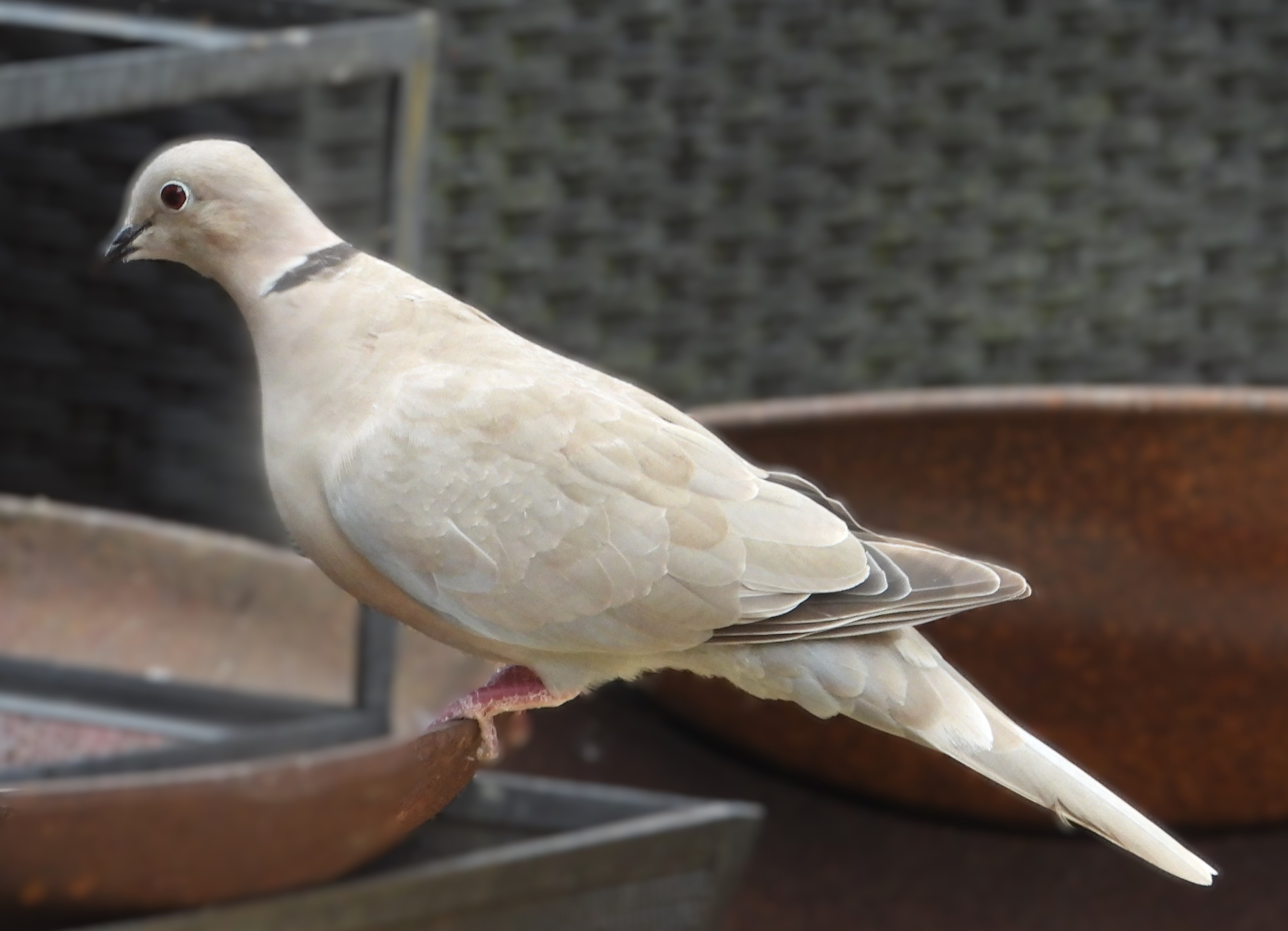
This beautiful Collared Dove enjoyed a drink with perfect timing, just as I finished writing this post and was wondering what to use as the headline image.
I recently wrote that I tend to avoid blogging about birds in other parts of the world because it stretched the limits of what my brain could absorb. Nevertheless … This month’s magazine cover shows an endangered Spoon-billed Sandpiper which breeds on tundra and winters mostly in Myanmar. It is a very odd-looking bird. The shape of its beak looks out of place with the rest of its form.
I love a bad pun but the headline to a short piece about the bounceback of the Cirl Bunting is a bit much even for me: “Coming full Cirl-cle”. It is a very striking little bird. Rare sightings are reported in the usual style. A Zitting Cisticola causes an adrenaline rush and wobbliness and we also read of a Brünnich’s Guillemot, a Bridled Tern at Coquet Island and many others including a Red-footed Booby, Red-breasted Flycatchers and Caspian, Black and Least Terns.
I am aware of and have seen a fair few species of tern and wondered how many I hadn’t heard of there could possibly be. How many species of tern actually are there? It took me a long time to find a definitive answer. The general internet consensus seemed to be around 40. The website theworldsrarestbirds.com has an article entitled “50 Terns Species” but this is followed, strangely, by a list of 50 terns and gulls (the photographs are terrific though). ChatGPT says there are about 45 but lists only 30. This was beginning to irritate. It was time to go to a proper reference work – a book, and where else other than Collins Birds of the World? The answer is straight from Douglas Adams, my mother’s favourite number, 42, with a wonderful variety of names. Those in italics are the ones missed by ChatGPT, which had only Crested Tern listed as a single species. Strictly speaking I think all of the scientific names should be italicised.
Aleutian Tern (Onychoprion aleuticus)
Antarctic Tern (Sterna vittata)
Arctic Tern (Sterna paradisaea)
Australian Tern (Sterna nereis)
Black Tern (Chlidonias niger)
Black-bellied Tern (Sterna acuticauda)
Black-fronted Tern (Chlidonias albostriatus)
Black-naped Tern (Sterna sumatrana)
Bridled Tern (Onychoprion anaethetus)
Cabot’s Tern (Thalasseus acuflavidus)
Caspian Tern (Hydroprogne caspia)
Common Tern (Sterna hirundo)
Crested Tern:
Greater Crested Tern (Thalasseus bergii)
Lesser Crested Tern (Thalasseus bengalensis)
Chinese Crested Tern (Thalasseus bernsteini)
Damara Tern (Sternula balaenarum)
Elegant Tern (Thalasseus elegans)
Fairy Tern (Sternula nereis)
Forster’s Tern (Sterna forsteri)
Gull-billed Tern (Gelochelidon nilotica)
Inca Tern (Larosterna inca)
Kerguelean Tern (Sterna virgata)
Large-billed Tern (Phaetusa simplex)
Least Tern (Sternula antillarum)
Little Tern (Sternula albifrons)
Peruvian Tern (Sternula lorata)
River Tern (Sterna aurantia)
Roseate Tern (Sterna dougallii)
Royal Tern (Thalasseus maximus)
Sandwich Tern (Thalasseus sandvicensis)
Saunders’s Tern (Sternula saundersi)
Snowy-crowned Tern (Sterna trudeaui)
Sooty Tern (Onychoprion fuscatus)
South American Tern (Sterna hirundinacea)
Spectacled Tern (Onychoprion lunatus)
Swift Tern (Thalasseus bergii)
Whiskered Tern (Chlidonias hybrida)
White Tern (Gygis alba)
White-cheeked Tern (Sterna represa)
White-fronted Tern (Sterna striata)
White-winged Tern (Chlidonias leucopterus)
Yellow-billed Tern (Sternula superciliaris)
They mostly look pretty similar to one another, at least to me. I love everything to do with the naming of birds. “Least Tern” seems a bit harsh – it doesn’t even seem to be the smallest – and I am not sure the “Elegant Tern” is particularly more so than any of the others. I was not entirely clear about how the scientific names worked (genus, species) but this excellent website by Mya Bambrick set me straight, which is not to say that it is straightforward.
200+ Scientific Bird Names Decoded & Explained – All Bird Species
The Royal Tern, for example, used to be classified as belonging to the Sterna genus until a study undertaken in 2005. For a moment I thought that the Collins guide has somehow omitted the White Tern but then I found it hiding amongst the gulls for taxonomic reasons. One good tern deserves another. There’s a bad pun and it’s not even original.
I hugely enjoyed and have written about Stephen Moss’s excellent Mrs Moreau’s Warbler* which is all about bird names and am currently reading his Ten Birds That Changed the World. I will go back to it but am not sure about it just yet in that I am not convinced that the level of detail when it comes to literature and history is perfectly judged.
*From Animal Wild:
The Dunnock, for example, is also known incorrectly as the Hedge Sparrow, but they’re not sparrows. The Black-Headed Gull does not have a black head, rather it is mostly brown. Gulls with completely black heads extending to the neck would be Little Gulls perhaps. The author raises questions about whether naming in itself helps us to appreciate nature or if it is an attempt to give us a kind of sovereignty. There are those who think all animal names which include references to human individuals should be done away with – certainly many of them stem from the colonial era. There is also the ‘problem’ of ‘rude’ names. Some are inadvertent (tit – watch your word order if you are talking about a pair of Great Tits – booby, Shag – the BTO even had a post temporarily blocked somewhere online because it included the word ‘woodcock’), others less so: the Wheatear’s name is derived from its ‘white arse’ for example. Absolutely not inadvertent is the stellar alternative name for the Kestrel: the windfucker. This was used by the pamphleteer and playwright Thomas Nashe in 1599, other dialects coming up with ‘wind bibber’, ‘wind cuffer’ and simply ‘fuckwind’. In ornithological circles the word for the overall impression of a bird is … jizz. There are various theories for the etymology of that one. Name changes have been going on for a long time. What’s constant is that they tend to be extremely controversial in the ornithological world.
At HART Wildlife Rescue this week staff member Lydia kindly took time out to allow us to see a Buzzard close-up. It seemed to have a deformed beak which is probably why it had died of starvation. It was otherwise of course absolutely stunning. We were shown the glottis, the hole in the bird’s tongue which is the opening to its larynx and trachea through which birds breathe. I had no idea. One of many reasons it is best not to try to give water to a bird via syringe or pipette unless you really know what you are doing. One might naturally aim for the centre of the mouth but this will could easily kill the animal. This took me here:
Do Birds Have Tongues? Anatomy, Functions, Adaptations, And Evolution | Feathered Realm
Some birds apparently don’t have tongues, the Swift for example, and Woodpeckers which have a tongue-like “hyoid apparatus”.
I have written about the controversy over renaming birds and was interested to learn, incidentally, that the same thing is happening in the botanical world. The Hibbertia for example is named after George Hibbert, a member of Britain’s Regency pro-slavery lobby. Over 200 plants, fungi and algae will be renamed.
I do love this magazine and marvel that so much is packed in each month. Clearly the publishers derive a good deal of revenue from the advertisements and fair play to them. There are a lot, almost all for an utterly bewildering variety of binoculars and scopes.
Mark Avery wonders whether we can hope for new legislation to protect birds of prey and our countryside from the driven grouse shooting industry and whether the Scottish legal changes go far enough. In England we haven’t even made a start as with so many other urgently needed actions to protect wildlife from criminals. He is cautiously optimistic but given the disgraceful betrayal over the badger cull I am less so.
There’s an article about Lindisfarne, Holy Island, which I am lucky enough to have visited relatively recently, and another on the difficulties of identifying the various species of Petrel from land. Also pieces on the usefulness of sonograms and the impact made by the pioneer naturalist and author W.H. Hudson (1841-1922), who passionately campaigned for and end to the destruction of the world’s natural resources and beauty, in particular the slaughter of wild birds, just as so many of us do today. Amy Robjohn’s piece, “Autumn has arrived” is for me a bit depressing after the summer we have failed to have or been able to enjoy. Lucy McRobert writes about collecting which is something, as a bookseller, I feel I know a bit about and her love of wildlife art. I have a passion for it too, but am nervous about how much I could very easily spend. The golden rule which makes any form of collecting worthwhile, as opposed to investing for profit, is to buy what you like, not what the market dictates.
Leave a Reply