This was an online course run by the British Trust for Ornithology (BTO). I have hugely enjoyed all of their bird ID courses and this one had the advantage of being entirely free.
It was a serious and sobering couple of hours.
Firstly though, in the garden two days ago I saw, for the first time in my life (other than from a moving car in which case it was usually a best guess), a Wren. I was only aware there was one about from an unusual call which the wonderful Merlin app identified for me. I had heard it a few times lately, but this time saw the bird from just a couple of feet away for a few brief seconds. Our eyes met. I am not alone – in spite of its being Britain’s most common bird (8.5 million pairs), many people have never seen one, at least not close-up – they are small (9-10 cm) although their song is astonishingly loud for their size. Then, yesterday, I saw another one, on the ground. Perhaps it was the same one – he or she also paused momentarily before quickly moving on. Like Dunnocks they are alleged to look rather dull but I beg to differ.
Today I picked up a baby House Martin near Kingsclere for delivery to HART Wildlife Rescue. We are so very busy at the moment – five foxes I think, ten Tawny Owls, rabbits, hares, and an endless stream of songbird nestlings and fledglings, ducklings and goslings and, as always, hedgehogs.

The journey included two more firsts. I noticed as I drove into the small, lovely village of Ecchinswell I a little illustrated sign ahead: “Moorhens on road”. Then as I approached the house where the House Martin had been found, a Green Woodpecker took off from the lawn in front of me. Again, I had never seen one before. What an utterly spectacular bird.
Incidentally, the rescued Kestrel I mentioned here:
A Blackbird in the house, more lilies and some very pretty notebooks – Animal Wild
has now fledged and been released.
Back to seabirds.
Red List species must satisfy one of the following criteria:
Globally threatened.
Historical population decline in the UK between 1800 and 1995.
At least a 50% decline in the UK breeding population over the last 25 years.
At least 50% contraction of UK breeding range over the last 25 years.
This, above, is from The Red List | Bird Spot
The other two categories are Amber and Green, the last being of least concern.
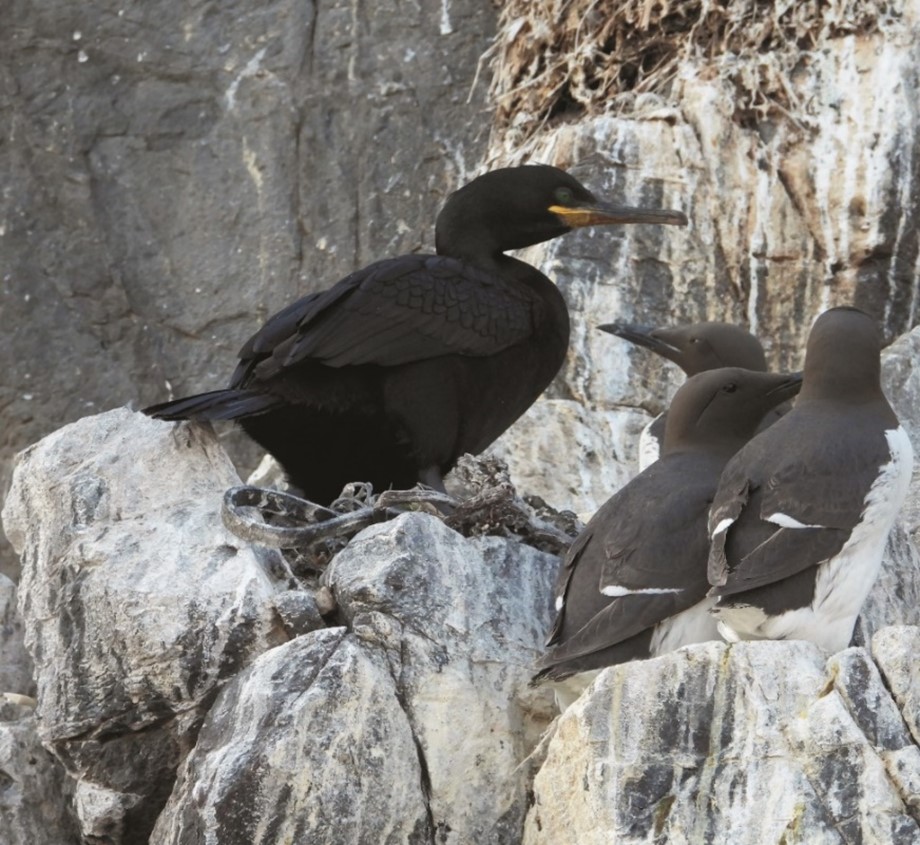
In the UK we see 24 species of seabird. Of those seven are red listed (Leach’s Petrel, Shag, Arctic Skua, Kittiwake, Herring Gull, Roseate Tern and Puffin), 17 are amber, including five species of gull and five of tern and only the Cormorant (shown at the top of the post, with Guillemots) is green listed.
Avian influenza (AI for the purposes of this post) has of course had a huge effect, especially on seabirds. Because of their dense colonies and frequent, aggressive interactions, spread of disease is rapid.
Bass Rock, home to a colony of 75,000 pairs of Gannets before AI, birds whose populations were previously showing an upward trend, was devastated, whilst from inland colonies alone in 2023 an estimated 10,000 Black-headed Gulls died.
We were advised to report dead birds to DEFRA (not sure how much good that would do) or to use the Birdtrack app.
The session began with the Auks: Guillemot, Black Guillemot, Razorbill and Puffin, all of conservation concern.

Puffin
Puffins dig their burrows in thin soil on rock and they are quite fragile and vulnerable to damage by, for example, humans and sheep and sometimes if the colonies are too densely packed they can be undermined by the Puffins themselves.
The availability of sand eels is critical for Auks and Kittiwakes too. They forage relatively close to their colonies (within ten miles or so) and if they have to go further as the sand eels respond to warming seas, they cannot raise their young. There has been terrible overfishing although it is now banned within twelve miles of our coastline. There is pressure from other countries however to overrule this. Puffins raise one chick per year and are long-lived, one recorded as being 47 years old.
There are 1.3 million Guillemots in the UK (they are counted individually, all the other numbers refer to pairs) since it is impossible to pick out pairs from their extremely dense colonies. They are also long-lived and all these colonies are susceptible to winter and summer storms.

Razorbills
There 225,000 pairs of Razorbills, 20% of the global population (GP), showing an 18% decrease of late. They also feed on sand eels and so are susceptible to the same pressures. An individual was recorded as being 42 years old.

Guillemots (including uncommon polymorphic Bridle Guillemot)
Black Guillemots number 75,000 pairs, 6% of the GP, the oldest individual recorded being 24.5 years of age. They are counted on the water because their nests are deep and well-hidden in the rock.

Gannet
The Gannet, the largest breeding seabird in the Northwest Atlantic, numbers 340,000 pairs, over half the GP. They have shown a 2% population increase but they are site faithful and there are a relatively small number of colonies. They too raise single chicks. Oldest recorded: 37 years. AI changes the colour of the iris from pale to black – if they survive. Discarded fishing gear, especially nets, is a huge problem for them. They forage quite widely and are more adaptable and so not as reliant on sand eels.

Kittiwake colony
The Kittiwake is our most numerous breeding gull at 250,000 pairs, 10% GP. There has been a 45% decline, probably primarily to do with sand eels, and they are generally highly concentrated in a small number of colonies. They do often raise two chicks and so populations can recover more quickly. They can also take advantage of human structures.
The Cormorant is green listed as stated above, but the closely related Shag is red listed so the question is why? Shags (33% GP) don’t breed inland at all, unlike Cormorants and so are more susceptible to bad weather. Neither bird is waterproof (an adaptation which allows them to dive deeper and for longer) and Shags can get waterlogged and unable to regulate their temperature leading to death, but Cormorants can at least go inland.
After a brief aside on numbered plastic Darvic rings, of which I had never heard, we moved on to the Arctic Skua which are kleptoparasitic and known as the pirates of the sea. They have seen a 70% decline between 2000 and 2019, even before AI. They spend about two thirds of their time at sea, away from the colonies. Tracking by GPS or cheaper, longer-lasting geolocator tags (the data is coarser but the batteries last longer) has provided much valuable information, from colonies at Rousay and Fair Isle for instance. We have been able to see spatial resource partitioning between members of the same species, that Marine Protected Areas do contribute to breeding success, and a huge spread of wintering locations, for example in South America and south and west Africa from just one UK location.
Next, the large gulls. There are 61,000 pairs of Herring Gulls, 12% GP, showing a 44% decline. They sometimes exhibit the same black eye syndrome as Gannets which is possibly also a result of AI. They are generalist feeders, their diet including smaller seabirds, fish, and invertebrates, and they scavenge on food left out, deliberately or otherwise by humans. They are happy to live in cities and towns. Rooves provide safety from ground predators and they may be helped by the warmer urban temperatures. Both Herring and Lesser Black-backed Gulls are doing well in places. Failures elsewhere could be down to local events, such as the closure of a landfill site.
The Lesser Black-backed Gull was persecuted as a pest in the nineteenth century, then recovered to some 55,000 pairs but more recently there has been a 49% population crash. There are 20,000 pairs inland but using more natural rather than urban nesting sites. GP 38.4%. Sometimes colonies collapse due to predation.
The Greater Black-backed Gull is the biggest in the world. They are much more exclusively coastal in the breeding season and highly predatory on other seabirds as well as fish, marine invertebrates and small mammals (even rabbits). They are site faithful so it is crucial to protect those sites. There are 17,000 pairs, 10% GP. They do not take well to tags.
Another area where data is so useful is in helping us to place wind farms in the right places. In the case of Lesser Black-backed Gulls, the birds are generally very good at navigating through the turbine blades – the collision risk is low, but they may avoid the area altogether and so have to travel further for food. Some migrate to the Iberian coastline and North Africa for winter. They come back via a different, inland route which again is useful to know for the placement of (inland) wind farms. Some winter in the UK.

Black-headed Gull
Of the smaller gulls, the Black-headed have had a particularly terrible time, down 29% with the loss of at least 10,000 from AI. The Common Gull is not really common at all, in fact they are named after common as in open land, numbering 23,500 pairs, 9% GP, down 50%. The Mediterranean Gull, a relatively recent breeding colonist first appearing here in 1968, is present in much smaller numbers – just 2,300 pairs. They are mostly to be found in the southern half of the UK and are amber listed.

Common Gull
Terns are ground nesters and therefore vulnerable to predation and climate change causing rising tides and current changes affecting food availability. Humans, dogs and drones all cause damage and they are in any case very sensitive to proximity to any of these. AI had a fierce impact, especially on Sandwich, Roseare and Common Terns last year.
The Sandwich Tern, named after Sandwich Bay where they were first identified, suffered a major decline in the nineteenth century due to egg collecting and the millinery trade. A ban enabled them to make a comeback, but AI wiped out 35% of them. There are around 15,000 pairs living in very dense, exclusively coastal colonies such as Blakeney Point in Norfolk which hosts 3,500 pairs. Good conservation work and protection of sites and habitat maintenance is helping them.
The Roseate Tern is red listed. Again the nineteenth-century millinery trade nearly drove it to extinction for their tail feathers, but conservation efforts brought it back from the brink. There are just 120 pairs however. Their habitat is highly specialised – they like a bit of cover and vegetation. They will also use nest boxes. AI brought what was a promising increase to a standstill with the colony on Coquet Island in Northumbria, which I wrote about in Animal Wild, suffering a 30% reduction.
We only have 1,400 breeding pairs of Little Terns (unsurprisingly the smallest of the terns) in the UK. They nest on bare shingle beaches and so are especially prone to human disturbance. They are well-camouflaged and easily trampled by accident, so colonies have been fenced off and there are wardens to check that dogs are on leads. Increasingly I am coming to believe that there are very, very few public places where dogs should be off lead at all. Little Terns are down in numbers by 25% since the 1980s. On the upside, they have responded well to decoys put out where they are less likely to be disturbed by humans and this has been a record-breaking year for fledglings.
Common Terns are mainly coastal but can also be seen on inland reservoirs and lakes, They are 40% down in one location. Tern rafts have been constructed to encourage them, successfully, to breed away from other species to help them avoid AI.

Arctic Tern
Arctic Terns (30,500 pairs) nest in large colonies. Only 31% have been surveyed so the full impact of AI has not yet been assessed. Their migration is extraordinary. Other terns mostly go to Africa but these make a 96,000 km round-trip to the Antarctic (sic) from, for example, the Farne Islands. They weigh just 100g (about the same as a Blackbird), live in an endless summer and the UK is the most southerly part of their range.
Tubenoses. These belong to the same family as the Albatross and have a strong sense of smell helping them to find prey, partners and breeding tunnels. The chicks are slow growing but they are long-lived.
The cliff nesting Fulmar, the size of a medium gull, is present in 350,000 pairs, 8% GP. They first arrived here relatively recently in the 1700s. All of the tubenoses stay with the same partners and have just one chick each year but do not start breeding until they are around six years old or more. One in the UK was aged 41 years, eleven months and seven days. Their breeding success rate is down from 0.8% to 0.3% and they too were hit by AI.
The Leach’s (Storm) Petrel is red listed. They are nocturnal in the sense that they only return to nest, in rock crevices, at night to avoid predators. We see 10,000 pairs, 94% them on St Kilda, 0.5% GP. They are very slow and awkward on land and prey to introduced rats, mice, pigs, cats, goats and dogs – also by Great Skuas who are unable to find enough food elsewhere. Numbers are down by 78%. A decline in Great Skua numbers may help them.
The Storm Petrel, at 25g, is smaller than a House Sparrow. They live mostly at sea and they too come back only at night, even avoiding moonlit nights. Their migration is long-distance, to southern Africa, chiefly from the Scottish and Welsh islands and the Irish coast. Population 38,000, 5% GP. This has grown by 41% largely due to mammal eradication programmes. They live in rocky crevices, man-made boxes and artificial walls. Delightfully these are known as Petrel stations. They are still of concern because of climate change, extreme weather and the risk of reintroduction of predators. Petrels generally have a strong, musky smell like almond oil and make strange, fascinating sounds.
There are 30 species of Shearwaters globally (they shear over the water, their wing tips just above it), in the UK we see the Manx Shearwater. They too spend their days at sea, coming back to their burrows at night – rafts of them can be seen at dusk waiting to come in. The UK is a stronghold for them – some 790,000 pairs breed here, which is most of the global population. The number is up 163% thanks to the eradication of rats and mice. Like all tubenoses they are monogamous and lay a single egg. Their burrows are fragile. The oldest known is around 56 or 57 years old. They winter on the South American coast, travelling five million miles in a lifetime. They alternate between short and long trips (up to eleven days) to forage, the former for their young.
Finally there was some information about the Seabird Monitoring Programme, a fine example of collaboration with 21 organisations involved. Surveys are of breeding success (how many successfully fledge) and breeding abundance with an annual census and triennial survey using sample sites. The data is key, allowing evaluation of the effectiveness of conservation programmes such as rat eradication and we need to monitor continually otherwise we just won’t know if we are getting it right.
Another of the course’s attendees mentioned her terrible experience at the Farne Islands, identical to my own, which I wrote about in Animal Wild:
In the evening it was time for another boat trip, this time a ‘sunset cruise’ around the Farne Islands, teeming with seabirds – Shags, Common Guillemots, Razorbills, Atlantic Puffins – and seals (Grey Seals, although we had been lucky to see a rare Common Seal on our way back from Lindisfarne). The colonies were a sight to see but at least four of us had serious issues with this part of the trip. The boat, with 74 people on board and a capacity for 90, was a surprise, we had rather been expecting something much smaller and more private. The highly skilled skipper took it to within, literally, inches of the birds, one could very nearly reach out and touch them. But it was horribly intrusive. We felt extremely uncomfortable with it. The Common Guillemots in particular were obviously frightened and disturbed by our presence. When fledgling guillemots, known as ‘jumplings’, emerge from the nest, their parents jump from high off the cliff into the sea and encourage their young to follow suit. As though that must not be terrifying enough, this jumpling had dozens of people raucously cheering him on. The commentary, dull anyway and inaccurate in places, was delivered in a bored monotone. The so-called wildlife expert on board was a young boy occasionally shouting “shag” or “seal”, who then went round the boat with a live lobster and a crab, shoving them in people’s faces and almost forcing them to touch them, before carelessly chucking them into the sea. I am surprised the National Trust, which owns the islands, allows this to go on – but it’s a money-spinner.

Jumpling
We had both been told there was no point complaining to the National Trust. If there is a code of conduct relating to proximity it is not enforced. A BTO trainer explained that only if a bird was Schedule I, like the Roseate Tern, would disturbing or even approaching be illegal. Otherwise, there is little to be done about such reckless and destructive behaviour.
Here is a link to answers to questions raised during these sessions this year and last:
Leave a Reply