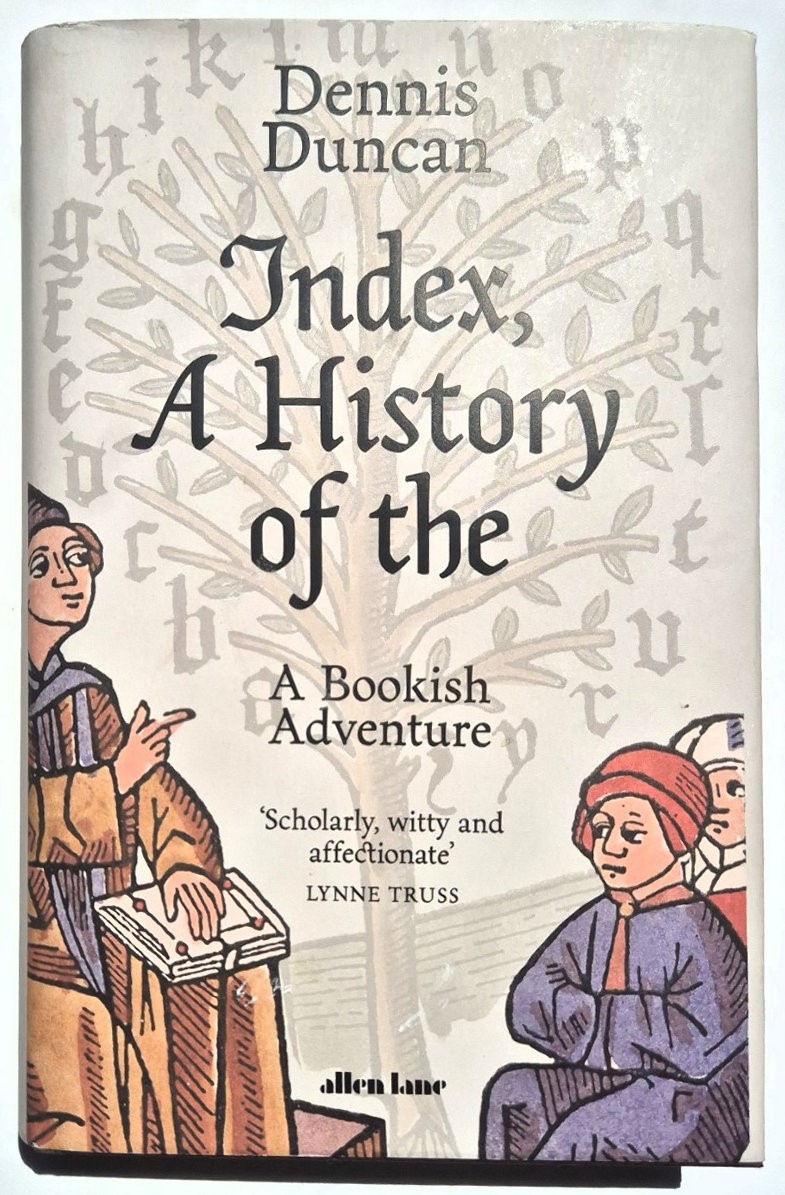
A review of Index, A History of the; a bookish adventure by Dennis Duncan, Allen Lane, 2021.
The photograph of the author, a translator and lecturer in Eglish at University College London, which adorns the dust-jacket of this brilliantly titled book shows a man (I hope he wouldn’t mind) with a cheeky and hugely likeable face. The book is just as Lynne Truss says on the upper panel of the jacket “Scholarly, witty and affectionate”.
One of the very few books I own which I have found infuriatingly conceivably in breach of the Trades Descriptions Act is The Curious History of Alphabetical Order; a place for everything by Judith Flanders, Picador, 2020. I have always wondered why the alphabet we use today is in its particular order and thought that this book might provide an answer. As early as page xvi we read: “The alphabet, as far as we can tell, was written from its very earliest days in a set order. Why, we don’t know, although ease of memorization seems possible, even likely.” I gave up on the book at the end of the first chapter, although perhaps I am being unfair and should go back to it. The ease of memorisation (as we spell it in the UK) theory surely deserves some sort of justification and I did not find the alphabetical titling of chapters (“A is for Antiquity…” etc.) pleasing. It almost never is, rather a forced structural conceit. In this case the chapters run just from A to I, then jump to “Y is for Y2K”. It just doesn’t really work.
Clearly the answer to my question is that nobody knows, but Dennis Duncan, one of whose lectures I would love to attend, takes us back to the middle of the second millennium BCE. Clay tablets found in northern Syria, one of which is illustrated in the book, show abcedaria in Ugaritic, a cuneiform script. The ordering of the letters is mirrored in the Phoenician alphabet and carries through to the later Hebrew, Greek and Latin alphabets. Certainly the illustration below shows strong similarities to the alphabets with which we are familiar now.

An eye-opener for me, no doubt a blindingly obvious given to those who know the first thing about search engine optimisation, is the revelation that when googling, one is not really searching the internet at all. One is searching Google’s index of the internet. SEO suddenly makes much more sense.
One of two early creators of the subject at hand was Hugh of St Cher whose portrait, part of a fresco of the Black Friars of the Dominican Order, is reproduced, showing him at work at his writing desk. He is wearing spectacles. The portrait was painted in 1532 which seemed too early a date for such a thing. It is in fact the earliest known image of a man wearing spectacles but it is indeed anachronistic, since the invention was not to appear in Hugh’s lifetime but a couple of decades later.
There is much in the early part of the book about the crucial difference between an index and a concordance, both useful but the former an interpretive rather than relatively mechanical exercise.
I was delighted to be reminded of the name of the paragraph mark, the pilcrow. An article in the Smithsonian Magazine by Jimmy Stamp describes it as relegated to the background in modern word-processing software, but personally I always press the button in Microsoft Word which makes it and spaces between words visible. My daughter, on the other hand, finds it no more than intrusive, irritating clutter. This in turn has led me to order a copy of Shady Characters: The Secret Life of Punctuation, Symbols and Other Typographical Marks, which Stamp describes wonderfully succinctly as being about “well, the secret life of punctuation, symbols and other typographical marks”. The pilcrow has a long and complex evolutionary history and it is shown in various fonts below, including my favourite, Garamond, used throughout this blog. I was equally delighted to learn that the little hand with a pointing finger sometimes seen in book margins rejoices in the name “manicule”.


I don’t know why I am so fascinated to the point of obsession with this sort of thing but clearly I am not alone.
As an aside, I certainly don’t have an eidetic memory, although I have known people who do and do remember one history O-level exam when I could almost literally see my written essay, which I had revised, in front of me and I was able to simply copy it down. What I can do, and I have no idea if this is common, ubiquitous or rare, is, when looking through a read book to find a quotation I am after, remember, visually and pretty much unerringly, whether the words are on a left-hand or right-hand page and roughly where on that page they appear, although they could be pretty much anywhere at all in the book as a whole.
Leave a Reply